
Outdated Drivers Are Slowing You Down
One free scan finds every outdated or missing driver and matches the right update for your exact hardware.Free scan · exact hardware matchWindows Errors? Fix Them Before They Spread
Repair common Windows errors and clear accumulated junk for a smoother, more stable PC - no reinstall needed.Free scan · no reinstalliTechGuides is reader-supported. When you buy through links on our site, we may earn an affiliate commission. As an Amazon Associate I earn from qualifying purchases. Learn more
SIMP 0136 is an isolated, planetary-mass object about 20 light-years away in Pisces. Its infrared brightness changes as it rotates, and NASA’s analysis of James Webb Space Telescope data attributes that change to several atmospheric processes working at once: patchy clouds at different depths, temperature shifts or hot spots higher up, and changing carbon chemistry. Clouds alone cannot account for the variability. The findings are interpretations drawn from spectra and models, not a photograph of weather.
What SIMP 0136 is, and why the label matters
SIMP 0136 is a useful stand-in for studying exoplanet atmospheres, but it is not a confirmed exoplanet. It does not orbit a host star, and NASA notes that it may be a brown dwarf. Astronomers therefore call it a planetary-mass object or an exoplanet analog. The title’s “exoplanet” is a reasonable shorthand for the atmosphere-science question, but the classification should be stated when the object is described.
NASA’s March 3, 2025 account, published under the headline “NASA’s Webb Exposes Complex Atmosphere of Starless Super-Jupiter,” gives these estimates:
What’s actually slowing this PC down?
Pick the symptom - the matching free tool is one click away.
- Mass: about 13 Jupiter masses.
- Age: about 200 million years.
- Distance: about 20 light-years from Earth.
- Rotation period: about 2.4 hours.
These are NASA’s published estimates. The mass and age depend on models of how such objects cool, so they should be quoted with that attribution rather than as direct measurements.
#1 Best Overall

- 【Excellent Optics】Astronomical telescope features 80mm aperture 600mm(f/6.7) focal length-The big aperture can capture more light; high transmission multi-fully coated optical lens can improve light transmittance, reduce the reflection of light. It will bring you more bright and clear images.
- 【Portable & Stable】Our refractor telescope has a backbag, an adjustable aluminum tripod and an upgraded phone adapter. All accessories can be packed into the bag, which is convenient for you to carry and storage for traveling. The tripod is stable and the height can adjust from 17.7" to 52", which is suitable for adults and kids. With the phone adapter, you can take amazing photos through your phone.
- 【Easy to Operate】 This telescope is easy to assemble even for astronomy beginners and kids. You can set up easily with the detail installation manual and video. No tools are required. It’s a great astronomy gift telescope for adults, astronomy enthusiasts, beginners and kids 8-12.
- 【Optimum Magnification】Our telescope for kids and adults is equipped with two replaceable excellent-quality eyepiecesa (20mm and 9mm) for 30X and 66X magnification. A moon filter transmits only 13 percent of the incoming light and improving contrast. Also with 5x24 finderscope, you can locate objects easily. A great option for astronomy lovers to explore the moon, Saturn and Jupiter.
- 【Satisfaction Service】We provide 3 years satisfaction service. If you have any questions about the product and service, please feel free to contact us to get 24-hour technical support from our expert team. Whether observing moon or viewing planets, our telescope can meet your all needs. It’s a great telescope for adults & 8-12 kids & astronomy beginners.
How Webb watched the atmosphere change
Webb observed SIMP 0136 in July 2023 with its NIRSpec and MIRI instruments, following the object’s infrared light across two complete rotations. Because the rotation takes only about 2.4 hours, the observing campaign captured how brightness shifted at different wavelengths within a short window.
The inference works in four stages:
- Record light curves. Brightness is measured repeatedly over time at many infrared wavelengths, producing a separate light curve for each wavelength.
- Compare curve shapes. Wavelengths whose brightness rises and falls in similar ways are grouped together.
- Estimate depth with models. Atmospheric models estimate the layer from which each wavelength mostly originates. Infrared light at different wavelengths escapes from different depths.
- Test explanations. Researchers ask which combination of clouds, temperature structure and chemistry reproduces the observed pattern.
The result is a model-based map of vertical and rotational variation. It is not a resolved image of clouds. NASA’s artist’s concept of SIMP 0136 is also an illustration; Webb has not captured a direct image of the object, and the artwork should be labelled as an “artist’s concept” wherever it appears.
The three signal groups and what they point to
NASA’s light-curve explainer groups the signals into three broad families. Its vertical cross-section is a possible atmospheric structure rather than a measured profile, and its pressure labels are approximate. The table below summarizes how each group is interpreted and where the interpretation runs out.
Recommended Free Tools
| Candidate contributor | Where it sits (model interpretation) | What it can explain | Limit |
|---|---|---|---|
| Patchy iron-particle and silicate clouds | Deeper iron-particle clouds and higher silicate-grain clouds, each probed by different wavelength groups | Cloud-related light-curve changes at more than one depth | Cloud-only models do not explain all the variability; cloud composition and height are inferred |
| Temperature variation and hot spots | Light from above the clouds, tracked by the highest-altitude wavelength group | Brightness variation above the cloud layer | The cause is unresolved; NASA lists aurora and upwelling hot gas as possibilities |
| Carbon chemistry | Wavelength curves that resist explanation by clouds or temperature alone | Changes in carbon-bearing molecules across the object | Abundances and mechanism remain unsettled; not stated quantitatively |
Patchy clouds at more than one depth
The clearest part of the picture is that clouds are involved and are not uniform. Wavelength groups that probe deeper levels track one set of changes, while groups that probe higher levels track another. NASA’s explainer attributes the deeper emission to iron-particle clouds and the higher cloud emission to small silicate grains. Those compositions are model-based interpretations, and the clouds are described as patchy, meaning their coverage varies across the object as it turns.
Rank #2

- Superior Optics: 400mm(f/5.7) focal length and 70mm aperture, fully coated optics glass lens with high transmission coatings creates stunning images and protect your eyes. Perfect full positive telescope for astronomers to explore stars and moon.
- Magnification: Come with two replaceable eyepieces and one 3x Barlow lens.3x Barlow lens trebles the magnifying power of each eyepiece. 5x24 finder scope with mounting bracket and cross-hair lines inside make locating objects easily.
- Wireless Remote: This refractor telescope includes one smart phone adapter and one Wireless camera remote to explore the nature of the world easily through the screen and take amazing celestial images.
- Adjustable Tripod: This telescope allows for many different viewing positions with a adjustable aluminum alloy tripod and a carry bag, the telescope and tripod can fit inside the bag for easy traveling and storage.
- Satisfaction: Buy with confidence from a leading manufacturer.
Temperature changes and hot spots above the clouds
Light from above the clouds carries a separate signal, which NASA attributes to temperature variation. The source of the heating is open. NASA’s two named possibilities are aurora, which has been detected at radio wavelengths on similar objects, and hot gas rising from deeper layers. Neither is confirmed as the cause for SIMP 0136.
Carbon chemistry that does not fit the simpler models
Some wavelength curves cannot be reproduced by clouds or temperature changes alone. NASA attributes them to changing carbon chemistry. Johanna Vos, a co-author, put the state of knowledge plainly in NASA’s account: “We haven’t really figured out the chemistry part of the puzzle yet.” The chemistry is therefore best described as a demonstrated need for another contributor, not a solved composition map.
Why a single spectrum can mislead
Lead author Allison McCarthy, then a Boston University doctoral student, summarized the core method in NASA’s account: “Different wavelengths provide information about different depths in the atmosphere.” Co-author Philip Muirhead offered an Earth analogy: “Imagine watching Earth from far away. If you were to look at each color separately, you would see different patterns that tell you something about its surface and atmosphere, even if you couldn’t make out the individual features.”
The practical lesson for anyone reading such results is that a single spectrum or a single time point can present a variable atmosphere as static. Interpreting it requires three things: the wavelength being discussed, the atmospheric depth that wavelength probes, and the rotational phase at which the measurement was taken.
Rank #3
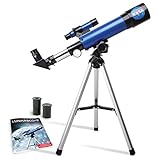
- INSPIRE CURIOSITY – The NASA Lunar Telescope allows your child to see the moon in incredible detail; the perfect gift for girls and boys interested in space, the moon, and astronomy!
- HIGH-QUALITY OPTICAL GLASS AND FINDER SCOPE – This easy-to-use telescope comes with a finder scope, low power, and high-power eyepieces; when used correctly, this combination will allow your child to easily locate the moon then zoom in for a close-up view.
- TABLETOP TRIPOD & SMOOTH MOUNT SYSTEM – Use the included tripod to steady your Lunar Telescope for optimal viewing, with a smooth mounting system that allows easy scanning of the entire lunar surface.
- PERFECT FOR BEGINNERS – This telescope is easy to assemble and use, making it ideal for young scientists and parents to enjoy together.
- AMAZON EXCLUSIVE - Blue Marble has developed this product exclusively for Amazon.
Earlier and independent evidence
The variability was reported well before Webb. Each of the following studies adds a different piece of the picture, and their numbers come from different instruments and conditions.
2009: the first variability evidence
Artigau and colleagues published “Photometric Variability of the T2.5 Brown Dwarf SIMP J013656.5+093347; Evidence for Evolving Weather Patterns” in 2009. The study reported about 50 millimagnitudes peak-to-peak variability in the J band during its observations. That value applies to that observing campaign and should not be treated as a permanent amplitude. The paper established rotational modulation, which later work has investigated in more detail.
2024: a time-resolved JWST spectral survey
McCarthy and colleagues’ arXiv preprint on the JWST “weather report” for SIMP 0136 describes time-resolved, low-resolution spectroscopy covering 0.8 to 11 microns. Its authors state that longer spectroscopic coverage is needed to probe long-term atmospheric evolution, which is beyond the two rotations observed in July 2023.
2025: NIRISS mapping of spectral variation
Akhmetshyn and colleagues’ 2025 arXiv preprint analyzes JWST NIRISS time-series spectroscopy from 0.85 to 2.83 microns, covering slightly more than one rotation. Their results are specific to that analysis:
Rank #4

- High-Quality Optics: The astronomical telescope features 500mm(f/7.1) focal length and 70mm aperture, provides stunning views and protects your eyes.
- High Magnification: Our durable telescope for kids and adults is quipped with two excellent-quality eyepieces (25mm and 10mm) and a 3x Barlow lens.it trebles the magnifying power of each eyepiece. Also telescope with 5x24 finderscope makes locating objects easily x
- Portable and Convenient: Telescope comes with a phone adapter and an adjustable aluminum tripod. Wireless remote control and carrying case for traveling or outdoor
- Great Gift Ideas: The telescope is a perfect gift or birthday gift for kids or beginner astronomers. It helps them build interest in astronomy ,exploring the world , enjoy life and away from the screen! The kids' astronomical journey starts from here
- Satisfaction Quality: Lifetime maintenance. If you have any questions about the product and service, please feel free to contact us, we will do our best to help you in 24 hours
- Two principal components account for 81% of the spectral variation. That is a statistical result, not a claim that two components fully describe the physical atmosphere.
- Comparisons with Sonora Diamondback models require at least three atmospheric regions to reproduce the time-averaged spectrum.
- The authors associate the variability with temperature and cloud coverage, and possibly with effective metallicity.
The NIRISS work adds mapping detail to the NASA interpretation, but it does not produce a unique physical map of the atmosphere.
What remains unknown
Three questions are still open. The first is the carbon chemistry: its abundances and mechanism are not resolved. The second is the hot-spot cause, where aurora and upwelling gas are candidates rather than established explanations. The third is long-term change. Two rotations are enough to characterize how the atmosphere varies over a few hours, but they do not show how the weather evolves over months or years. Each of these questions requires either further Webb observations or models that can reproduce several wavelength groups at once.
When you read a headline about weather on SIMP 0136, check which of these three open questions the claim addresses before accepting it as settled.
Free tools Windows power users keep installed
One-click scans. No signup required.
Quick Recap
Product prices and availability are accurate as of the date/time indicated and are subject to change. Any price and availability information displayed on Amazon at the time of purchase will apply.

