
iTechGuides is reader-supported. When you buy through links on our site, we may earn an affiliate commission. As an Amazon Associate I earn from qualifying purchases. Learn more
A uranium(II) center has been reported to reduce azobenzene by four electrons, producing a bis(imido) uranium(VI) complex. The result is a clear-cut example of a single metal carrying out a four-electron transfer in f-element chemistry; the proposed route reaches that outcome through two successive two-electron steps.
What the uranium reaction does
Azobenzene is the molecule reduced in the reported reaction. The product is a uranium(VI) complex containing two imido groups. In redox terms, the conversion is a four-electron reduction: four electrons are transferred to the substrate as it is transformed into the imido-containing product.


The paper reports this reactivity using an oxo-bridged diuranium(III) compound that reacts through a masked uranium(II) intermediate. The authors also report the same reactivity for a previously described molecular uranium(II) complex. The key claim is about the reaction center: the four-electron transformation is attributed to one uranium center, rather than to electrons being divided between two metals.
What’s actually slowing this PC down?
Pick the symptom - the matching free tool is one click away.
Why a four-electron transfer is notable
Uranium redox chemistry is often dominated by single-electron transfer. The authors framed their result against that background: clear-cut single-metal four-electron transfers had not been established in f-element chemistry. This reaction provides a specific molecular example of a single f-element metal handling a transformation that requires four electrons.
#1 Best Overall
That distinction matters. A multi-electron net reaction does not necessarily mean a metal transfers all the electrons in one event. Here, calculations support a pathway made of two consecutive two-electron transfers at the same uranium(II) center. The novelty is the reported single-metal four-electron outcome, not a claim that uranium generally performs four-electron chemistry or that every f-element reaction follows this pattern.
How the proposed pathway proceeds
First two-electron step
According to the computational studies, the uranium(II) center first transfers two electrons to azobenzene, forming a uranium(IV) hydrazide intermediate. This intermediate represents the first stage of the overall four-electron reduction.
Rank #2

- 30 different models of pure element samples, get more for your collections at one time.
- Stock in ampule bottles, with clear visions. Great for educations, sample displays, etc. Bottle size: Dia23mm*Height48mm, 10mL.
- Magerial Science choosen, up to 99.9999% high purity. Good for collecitons and lab use.
- A WOOW gift for special days!
Second two-electron step
A further two-electron transfer at the uranium center leads toward the uranium(VI) bis(imido) product. The calculations therefore support a sequence of two two-electron events rather than one concerted four-electron jump.
Do these 3 things before closing this tab:
1Clear out junk files and repair common Windows errors2Fix the driver behind crashes, sound loss and screen glitches3Repair Windows errors before they cause bigger problemsWhat the isolated intermediate adds
The authors isolated a cis-hydrazide complex and presented it as corroboration for the proposed route to the bis(imido) product. Its isolation supports the mechanistic interpretation, while the detailed sequence is also informed by calculations; it does not establish a universal mechanism for uranium or other f-element chemistry.
Rank #3
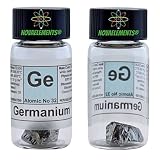
- Germanium sample - for collection
What the result does—and does not—establish
The work is a fundamental molecular actinide-chemistry result: it demonstrates a reported four-electron redox capability at one f-element metal center under the studied molecular conditions. The same paper also reports a two-electron reduction of diphenylacetylene, but the four-electron azobenzene conversion is the result behind the “first” claim.
The report does not establish an industrial process, scale-up, or a practical product based on this reaction. Its significance is the chemistry itself: a bounded demonstration that a uranium center can support a four-electron transformation through a proposed two-step pathway.
Rank #4

- High purity Strontium metal sample - for collection
Paper details
The study, “Single metal four-electron reduction by U(II) and masked ‘U(II)’ compounds,” by D. K. Modder, C. T. Palumbo, I. Douair, R. Scopelliti, L. Maron and coauthors, appeared in Chemical Science in 2021, volume 12, pages 6153–6158. Its DOI is 10.1039/d1sc00668a. The result is also summarized in Chemistry World’s 12 April 2021 report.
Quick wins for a faster PC:
Scan for outdated or missing drivers - takes under a minuteDriver Scan →Repair Windows errors before they cause bigger problemsFix Now →Quick Recap
Best Value
Product prices and availability are accurate as of the date/time indicated and are subject to change. Any price and availability information displayed on Amazon at the time of purchase will apply.

