
iTechGuides is reader-supported. When you buy through links on our site, we may earn an affiliate commission. As an Amazon Associate I earn from qualifying purchases. Learn more
Yes—the UniFi U7 Pro supports wireless backhaul as part of a UniFi-managed mesh network. It can provide Wi-Fi coverage where Ethernet is impractical, but it is not a substitute for a wired uplink when maximum performance and stability matter. Ubiquiti recommends a strong parent signal, few wireless hops, and wired connections where feasible.
Does the U7 Pro support wireless backhaul?
Yes. Ubiquiti’s U7 Pro specifications list Wireless Meshing as supported, and its device-adoption guidance explains the UniFi requirements for a wireless mesh uplink. The access point must be managed through a gateway running UniFi Network; wireless meshing is unavailable in Standalone Mode.
| # | Preview | Product | Price | |
|---|---|---|---|---|
| 1 |

|
Ubiquiti U7 Pro Wi-Fi 7 5-Pack Access Point | $1,059.95 | Buy on Amazon |
| 2 |
|
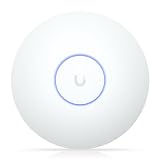
Ubiquiti Unifi U7 LonG-Range - Accesspoint | $189.99 | Buy on Amazon |
| 3 |

|
U7-PRO-Wall – UniFi High Capacity Wall-Mount WiFi 7 Access Point, White | $239.99 | Buy on Amazon |
This is a supported feature, not a claim that a particular wireless-backhaul setup has been tested or will deliver a specific speed. The U7 Pro specification lists three 2×2 radios for client Wi-Fi—2.4, 5, and 6 GHz—but does not identify a separate dedicated backhaul radio. Ubiquiti says UniFi mesh connections primarily use 5 GHz.
Free tools Windows power users keep installed
One-click scans. No signup required.
What performance should you expect?
Wireless backhaul uses airtime to carry traffic between access points as well as between an access point and its clients. Ubiquiti’s general Wi-Fi optimization guidance says each wireless hop reduces throughput by about 50%; that is vendor guidance, not a controlled U7 Pro test or a guarantee for every installation. Interference, signal quality, channel conditions, client capabilities, and the rest of the network affect actual results.
#1 Best Overall
- Wireless Standard: WiFi 7 technology enables ultra-fast data transfers with minimal latency for demanding network environments
- Number of Spatial Streams: 6 spatial streams provide enhanced performance and capacity for multiple simultaneous connections
- Range Coverage: Extended coverage up to 140 meters (1500 feet) ensures comprehensive wireless connectivity throughout large spaces
- Maximum Client Capacity: Supports 300+ concurrent client connections without compromising network performance in high-density user environments
- Network Uplink: 2.5 GbE uplink port delivers high-speed wired connectivity to support demanding bandwidth requirements
The U7 Pro’s published maximum band rates are product specifications, not measured wireless-uplink or internet speeds:
| Band | Manufacturer-listed maximum | Qualification |
|---|---|---|
| 6 GHz | 5.8 Gbps at BW320 | Published maximum; not measured throughput or a backhaul guarantee. |
| 5 GHz | 4.3 Gbps at BW240 | Published maximum; not measured throughput or a backhaul guarantee. |
| 2.4 GHz | 688 Mbps at BW40 | Published maximum; not measured throughput or a backhaul guarantee. |
These values are from Ubiquiti’s U7 Pro technical specifications, accessed October 7, 2026. They describe manufacturer-listed radio rates, not the speed a wireless-meshed client will receive. In particular, the 6 GHz client-radio figure should not be mistaken for a backhaul-rate claim: Ubiquiti’s mesh guidance says mesh connections primarily use 5 GHz.
Wired AP connections remain Ubiquiti’s preferred option for the highest performance and stability. Wireless mesh is useful when cable cannot reasonably be run, but each additional wireless hop adds another link competing for airtime.
The Tool Desk
Outbyte PC Repair FREEClear out junk files and repair common Windows errorsFree Scan →Outbyte Driver Updater FREEFix the driver behind crashes, sound loss and screen glitchesFind Drivers →Rank #2
How to set up a wireless mesh AP
- Check the controller and global setting. Use a gateway running UniFi Network, then open Settings > WiFi > Wireless Meshing and enable Wireless Meshing. This feature is not available in Standalone Mode.
- Set the AP roles. Enable Mesh Connect on an AP that will use a wireless uplink. Enable Mesh Parent on the AP that will provide that uplink. Do not enable Mesh Connect on an AP that already has a wired uplink; Ubiquiti warns that doing so can create unnecessary routing complexity or loops.
- Adopt the AP near its intended parent. Start with the new AP close to the uplink AP to establish a stable connection, then place it where coverage is needed and check the resulting parent signal.
- Check signal and topology. Ubiquiti recommends aiming for at least -60 dBm between the wireless AP and its parent, limiting the mesh to no more than two wireless hops where possible, and avoiding too many downstream APs on one parent.
- Review the RF environment. Mesh primarily uses 5 GHz. Ubiquiti suggests considering DFS channels where appropriate; channel availability and permitted use depend on local rules and the network environment.
For the full setup details, see Ubiquiti’s wireless mesh guidance. The technical specification lists UniFi Network 8.0.28 or later as an application requirement, but the cited official material does not settle every current controller and firmware combination for U7 Pro wireless uplink. Check current release notes and support guidance for the versions in your deployment.
Installation constraints: power, Ethernet, and placement
The U7 Pro is a PoE+ access point with a 2.5 GbE uplink and maximum power consumption of 21 W, according to Ubiquiti’s technical specifications. Wireless backhaul removes the need for an Ethernet data run to the AP, but it does not remove the need to power it. Plan for a suitable PoE+ source at the AP location.
If you do not have a suitable PoE+ switch, a compatible PoE+ adapter may be an option; confirm the exact adapter compatibility and what is included with the AP before buying. Ubiquiti’s PoE availability guidance explains its PoE modes. For a wired uplink, check that the switch provides the required PoE+ power and that its port supports the speed you need; wireless mesh does not itself require a 2.5 GbE switch port.
Ubiquiti lists an estimated coverage area of 140 m² (1,500 ft²) and a maximum client count of 300+. These are manufacturer specifications, not guarantees for a particular building, layout, or mix of clients. Walls, interference, placement, and the mesh link all affect usable coverage.
Do these 3 things before closing this tab:
1Scan for outdated or missing drivers - takes under a minute2Clear out junk files and repair common Windows errors3Fix the driver behind crashes, sound loss and screen glitchesIs the U7 Pro a good fit for a wireless-backhaul installation?
It is a reasonable fit if you already use UniFi Network, need to extend coverage without running Ethernet, and can place the AP where it maintains a strong link to its parent. The main trade-off is that wireless mesh shares radio resources and becomes less attractive as hops accumulate. Use a wired uplink if your priority is the best performance and stability or if the wireless path cannot maintain a suitable signal.
When evaluating Wi-Fi 7 features, keep client requirements separate from mesh setup. Ubiquiti lists 6 GHz support, but 6 GHz client operation requires a supported region, compatible client and AP, WPA3, and Protected Management Frames. Regional eligibility can change; consult Ubiquiti’s current 6 GHz setup guidance and supported-region information. This client-band eligibility does not change the general guidance that UniFi mesh primarily uses 5 GHz.
U7 Pro wireless-backhaul verdict
The UniFi U7 Pro supports wireless meshing, making it an option for a UniFi-managed installation where Ethernet is impractical. Treat it as a coverage extension rather than a promise of wired-equivalent throughput: keep the parent signal strong, minimize hops, and use Ethernet wherever maximum performance and stability are the goal.
Quick Recap
Product prices and availability are accurate as of the date/time indicated and are subject to change. Any price and availability information displayed on Amazon at the time of purchase will apply.

