
Windows Errors? Fix Them Before They Spread
Repair common Windows errors and clear accumulated junk for a smoother, more stable PC - no reinstall needed.Free scan · no reinstallCrashes, No Sound, or Screen Glitches?
Random freezes, missing sound and display glitches usually trace back to one bad driver. Find and replace yours safely.Free scan · under a minuteiTechGuides is reader-supported. When you buy through links on our site, we may earn an affiliate commission. As an Amazon Associate I earn from qualifying purchases. Learn more
Databricks is the strongest all-around data science company in this 2025 comparison, particularly for organizations that want data engineering, analytics, machine learning, governance, and AI development on one foundation. Microsoft, Google, and AWS follow closely for cloud-centered organizations, while IBM, Snowflake, Dataiku, SAS, DataRobot, and Domino Data Lab serve important enterprise and workflow-specific needs.
That answer needs an important qualification: “data science company” is not a standardized market category. This list combines cloud providers, data platforms, analytics vendors, AI-infrastructure companies, application platforms, and consulting firms. The ranking is therefore an editorial comparison of capability breadth, lifecycle coverage, enterprise reach, ecosystem importance, and relevance in 2025—not a revenue, valuation, market-share, or employer-quality ranking.
Top 20 data science companies in 2025 at a glance
The table below is a starting point, not a substitute for matching a company to your workload. A data scientist choosing a technical platform may prefer a different vendor from an enterprise buyer seeking implementation help or a job seeker comparing employer ecosystems.
Quick wins for a faster PC:
Fix the driver behind crashes, sound loss and screen glitchesFind Drivers →Clear out junk files and repair common Windows errorsFree Scan →| Rank | Company | Best fit | Main limitation to investigate |
|---|---|---|---|
| 1 | Databricks | Lakehouse data science, MLOps, and production AI | Requires architecture, governance, and skilled users |
| 2 | Microsoft | Azure-centered enterprise ML and business integration | Large, overlapping product landscape |
| 3 | Large-scale analytics, deep learning, and cloud-native ML | Regional availability, pricing, and integration need validation | |
| 4 | Amazon Web Services | Scalable cloud infrastructure and broad service choice | Potential architectural and billing complexity |
| 5 | IBM | Governed, hybrid, and regulated enterprise AI | watsonx components need to be evaluated individually |
| 6 | Snowflake | Analytics and AI close to governed enterprise data | May need separate specialist ML and orchestration tools |
| 7 | Dataiku | Collaborative, governed business and technical data science | Licensing and workflow fit can vary substantially |
| 8 | SAS | Statistics, forecasting, risk, fraud, and regulated analytics | Modernization, open-source integration, and total cost |
| 9 | DataRobot | Automated or assisted enterprise AI lifecycle management | Automation does not replace data and domain expertise |
| 10 | Domino Data Lab | Reproducible, governed data science at organizational scale | Most valuable for mature teams with operational needs |
| 11 | H2O.ai | Open-source flexibility, distributed ML, and AutoML | H2O-3 and commercial H2O AI Cloud are different offerings |
| 12 | Alteryx | Analyst-led preparation, repeatable workflows, and self-service analytics | Advanced ML may require connected specialist systems |
| 13 | Cloudera | Hybrid-cloud and highly controlled enterprise data environments | Hybrid operations require modernization and specialist skills |
| 14 | Altair | Engineering, simulation, HPC, and industrial analytics | Less natural fit for a general-purpose BI estate |
| 15 | MathWorks | Technical computing, simulation, controls, and research | MATLAB workflows need deliberate enterprise and Python integration |
| 16 | NVIDIA | GPU-accelerated analytics, deep learning, and inference | Hardware, compatibility, capacity, licensing, and power costs |
| 17 | Oracle | Oracle-centered enterprises and managed cloud ML | Needs comparison with the three major hyperscalers |
| 18 | Palantir | Operational data integration and decision workflows | Complex enterprise deployment and contracting model |
| 19 | Accenture | Strategy, implementation, migration, and managed transformation | Results vary by team, scope, partners, and client execution |
| 20 | Salesforce | CRM, customer analytics, personalization, and embedded AI | Not a general replacement for a full enterprise ML platform |
How this 2025 list was assembled
The formal market anchor is Gartner’s Magic Quadrant for Data Science and Machine Learning Platforms, published May 28, 2025. Gartner evaluated 16 vendors: Alibaba Cloud, Altair, Alteryx, AWS, Cloudera, Databricks, Dataiku, DataRobot, Domino Data Lab, Google, H2O.ai, IBM, MathWorks, Microsoft, SAS, and Snowflake.
#1 Best Overall

- 【14.0-inch diagonal, HD Display】Enjoy vibrant images and a comfortable viewing area that enhances productivity and entertainment on the go.
- 【Intel Processor N150】Deliver dependable speed for daily computing, paired with optimized power efficiency to keep your tasks running seamlessly.
- 【4GB DDR4 RAM】Get high-bandwidth performance for resource-intensive tasks. Run multiple applications at once and stay responsive.【1.12TB Storage】128GB UFS + 1TB Docking Station Set. Benefit from lightning-fast storage with a large capacity, allowing you to store a vast collection of files, applications, and multimedia content.
- 【Intel Graphics】Enjoy vibrant colors and sharp details that bring your everyday content to life.【Wi-Fi 6】Experience blazing-fast speed, reduced latency, and uninterrupted performance for seamless online gaming.【1 Year Office 365】Take your productivity and work mobility to the next level with the Microsoft 365 Office Suite (1 year subscription included).
- 【Windows 11 S】【Dimensions & Weight】12.76 x 8.86 x 0.71 inches, 3.24 lbs.【Ports】1x USB Type-C, 2x USB Type-A, 1x Headphone/microphone combo, 1x Media card reader, 1x HDMI 1.4b, 1x AC Smart pin. Wi-Fi 6, Bluetooth 5.4.【Bonus Docking Station Set】1x 7-in-1 Docking Station with 1TB Storage, 1x 32GB MicroSD Card with Adapter, 1x Type-C Data Cable, 1x 3-in-1 Charging Cable, 1x Suede Cleaning Cloth.
This article expands beyond that platform market because production data science is broader than a notebook or model-training product. NVIDIA supplies much of the accelerated computing and AI software layer; Oracle has a managed ML service; Palantir focuses on operational data and AI applications; Salesforce embeds analytics and AI in CRM workflows; and Accenture delivers implementation and transformation services. Alibaba Cloud was part of Gartner’s formal vendor set but is not included in this editorial top 20. That omission should not be read as a universal judgment about its technology or regional suitability.
The order weighs four factors:
- Capability breadth: data preparation, analytics, experimentation, machine learning, AI, governance, and related infrastructure.
- Lifecycle coverage: the ability to move from data access and model development through deployment, monitoring, and operational management.
- Enterprise reach: ecosystem significance, integration options, and relevance to large or complex organizations.
- 2025 relevance: documented product capabilities and market presence during the period covered by the list.
Because these companies serve different categories, rank 14 is not automatically “better” than rank 18 for every buyer. The useful question is: which type of data science problem are you trying to solve?
1. Databricks
Databricks is the clearest overall choice for organizations seeking a unified data-and-AI foundation. Its lakehouse approach brings data engineering, analytics, collaborative notebooks, feature engineering, model training, deployment, monitoring, governance, and MLOps into a connected environment.
It is particularly strong when data engineers, analysts, data scientists, and ML engineers need to work from shared data and move experiments into production without creating disconnected copies or isolated workflows. Its documented ML lifecycle spans ingestion, feature engineering, training, deployment, and monitoring.
Best fit: enterprise lakehouse programs, collaborative data science, MLOps, and production AI.
Watch-out: Databricks is a broad platform, not merely a hosted notebook. Buyers need a realistic architecture, governance model, cost-control plan, and team with the skills to operate it.
2. Microsoft
Microsoft combines Azure Machine Learning with Azure data services, Microsoft Fabric, Power BI, enterprise identity, security, and business applications. Azure Machine Learning covers model training, deployment, automation, experiment tracking, monitoring, and MLOps for classical ML and deep-learning workloads.
Do these 3 things before closing this tab:
1Fix the driver behind crashes, sound loss and screen glitches2Clear out junk files and repair common Windows errors3Scan for outdated or missing drivers - takes under a minuteMicrosoft is especially compelling for organizations already standardized on Azure or dependent on Microsoft identity, productivity, analytics, and enterprise application infrastructure. The surrounding ecosystem can make it easier to connect models to business processes, reporting, and production applications.
Best fit: Azure-centered organizations that need governed ML operations and integration with enterprise software.
Watch-out: Buyers must distinguish Azure Machine Learning, Microsoft Fabric, Microsoft Foundry, and adjacent services. They overlap in some workflows but are not interchangeable products.
3. Google
Google’s data science position rests on Google Cloud, Vertex AI, BigQuery, managed ML infrastructure, and a long-running research and AI ecosystem. It is a strong option for large-scale analytics, deep learning, generative AI, and teams that want to combine warehouse-scale data with managed model development and serving.
Organizations already using BigQuery or Google Cloud may benefit from keeping analytics and machine-learning workflows close to their existing data and identity controls. Google’s research heritage is also relevant to teams working with advanced models and large-scale computational workloads.
Best fit: cloud-native ML, deep learning, large-scale analytics, and BigQuery-centered data estates.
Watch-out: Service availability, regional controls, pricing, and integration requirements should be checked for the exact workload. Cloud features and product boundaries change quickly.
4. Amazon Web Services
AWS remains one of the most important data science companies because Amazon SageMaker provides managed services for data preparation, notebooks, feature engineering, model training, deployment, monitoring, and MLOps. It also offers built-in algorithms, pretrained models, and workflow components intended to support the path from experimentation to production.
AWS is a natural choice for organizations already operating on AWS or needing a wide menu of infrastructure and data services. Its scale and service breadth support everything from exploratory work to high-volume production systems.
Best fit: AWS-based organizations, highly scalable workloads, and teams that want extensive infrastructure choice.
Watch-out: Breadth can become complexity. Without platform standards, teams may create fragmented architectures, duplicated services, and difficult-to-control bills.
5. IBM
IBM’s watsonx portfolio combines data, AI development, governance, and foundation-model capabilities for enterprise use. Its strongest differentiation is often the combination of governance, hybrid-cloud support, established enterprise relationships, and experience in regulated industries.
What’s actually slowing this PC down?
Pick the symptom - the matching free tool is one click away.
Rank #2

- Sticks Well on Multiple Surfaces – Premium vinyl data science stickers designed to stick securely to water bottles, laptops, journals, phone cases, luggage, skateboards, and even car windows. Durable adhesive grips smooth and slightly textured surfaces with ease.
- Sticker Sheets – This data science sticker pack contains several sheets with colorful stickers. The sheet format is convenient for use and storage. Stickers can be reused several times by placing them back on the sheet.
- Long-Lasting & Waterproof – Made from outdoor-rated vinyl, these data analytics stickers are waterproof, scratch-resistant, and UV-resistant to keep colors bright and crisp through rain, sunlight, and everyday use.
- No Residue Left Behind & Easy to Remove – These data science decals peel off easily without leaving sticky residue or damaging surfaces. Although they hold securely, each sticker can be gently lifted and repositioned during application for smooth, accurate placement. Great for decorating notebooks, planners, scrapbooks, and other personal items.
- Great Gift Idea – Funny data scientist stickers make thoughtful data science gifts for coworkers, data analysts, data scientists, and anyone who works with data, statistics, analytics, coding, or programming. A fun choice for birthdays, graduations, new jobs, or team celebrations.
IBM can make sense for organizations that already operate substantial IBM technology, need hybrid deployment options, or must put unusually strong emphasis on controls, auditability, and responsible AI processes.
Best fit: regulated industries, hybrid-cloud environments, governed enterprise AI, and established IBM estates.
Watch-out: watsonx is a portfolio rather than one undifferentiated product. Evaluate the specific modules, integrations, deployment model, and commercial terms required for the project.
6. Snowflake
Snowflake began as a cloud data platform and has expanded toward machine learning, application development, data sharing, governance, and AI through Snowpark and Cortex capabilities. Its central advantage is the ability to work with analytics and AI close to governed enterprise data.
Recommended Free Tools
That architecture can reduce unnecessary movement of sensitive or high-value data and simplify access for teams already using Snowflake as their warehouse or data cloud. It is a particularly relevant platform for organizations treating the data layer as the center of their AI strategy.
Best fit: cloud data warehousing, governed analytics, feature and data access, and AI workloads near Snowflake data.
Watch-out: Snowflake is not identical to a full traditional data-science workbench. A team may still need separate notebook, orchestration, experiment-management, or specialist ML tools.
7. Dataiku
Dataiku is a purpose-built enterprise platform for collaborative analytics and data science. It covers data access and preparation, model development and evaluation, generative AI workflows, orchestration, deployment, monitoring, and governance. It supports Python, R, SQL, and Spark alongside more accessible visual workflows.
Free tools Windows power users keep installed
One-click scans. No signup required.
Its appeal is strongest when business-facing analysts and technical practitioners need to collaborate in the same governed environment. Dataiku can provide a bridge between code-first work and repeatable workflows that non-programmers can understand and operate.
Best fit: large organizations seeking collaborative business-and-technical data science with governance.
Watch-out: Test licensing and platform standardization against existing cloud-native and code-first workflows. A visual platform may complement, rather than replace, engineering practices already in place.
8. SAS
SAS remains a major analytics and data science company with deep expertise in statistics, forecasting, risk, fraud, clinical research, and regulated enterprise analytics. Its long history matters in environments where validated methods, explainability, repeatable processes, and domain-specific controls are more important than adopting the newest tool.
The Tool Desk
Outbyte Driver Updater FREEScan for outdated or missing drivers - takes under a minuteDriver Scan →Outbyte PC Repair FREEClear out junk files and repair common Windows errorsFree Scan →SAS is particularly relevant in financial services, healthcare, government, and other fields where statistical modeling and governance are central to business decisions. Existing SAS skills and model estates can also make modernization a gradual process rather than a wholesale replacement.
Best fit: regulated analytics, statistical modeling, forecasting, risk, fraud, healthcare, government, and established SAS teams.
Watch-out: Compare cloud deployment, open-source interoperability, modernization requirements, and total cost with newer platforms before making a long-term commitment.
9. DataRobot
DataRobot provides an enterprise AI platform covering predictive AI, generative AI, experimentation, governance, observability, and deployment. Its positioning spans data scientists, engineers, developers, IT, and governance teams, with deployment options that can include cloud, on-premises, and virtual private environments.
The platform is a good candidate for organizations seeking automated or assisted model development and a more consolidated AI lifecycle. It can help standardize processes across teams that otherwise use disconnected tools.
Best fit: assisted model development, automated ML, enterprise AI governance, and consolidated lifecycle management.
Watch-out: Automation does not solve a poorly defined business problem or bad data. Teams still need data-quality controls, appropriate validation, domain review, monitoring, and a plan for model change.
Rank #3

- [AI-OPTIMIZED POWER IN A COMPACT BUILD] The 14” Lenovo ThinkPad P14s Gen 6, a thin and light mobile workstation, boasts unmatched power with AMD Ryzen AI PRO 300 Series processors, delivering supreme AI performance for real-time workload optimization. This Copilot+ PC features AMD Radeon integrated graphics for intensive AI workflows for amplified productivity and efficiency. Features Zen 5 Gen Ryzen AI 7 350 2.00GHz Processor (upto 5 GHz, 16MB Cache, 8-Cores, 16-Threads) and AMD Radeon 860M Integrated Graphics
- [CLEAR AND COMFORTABLE VIEWING ALL DAY] Features 14.0" IPS WUXGA (1920x1200) 60Hz Display; 65W PSU, Type-C Power-In, 4-Cell 57 WHr Battery; Black Color
- [HIGH-SPEED COLLABORATION WITHOUT THE HASSLE] Stay ahead and connected with advanced WiFi with seamless speed. Designed with a robust port selection and lightning-fast memory, this device ensures you enjoy seamless, high-speed collaboration and rapid data transfers, making it perfect for juggling demanding tasks. Tailored for power users, it delivers reliable performance without any compromises. Features 64TB DDR5 SODIMM, 1TB PCIe NVMe SSD; 802.11be, Bluetooth 5.4, RJ-45, Webcam, 1 x HDMI 2.1, 2 Thunderbolt 4, Headphone/Microphone Combo Jack.
- [PROFESSIONAL-GRADE OPERATING SYSTEM] Windows 11 Pro 64-bit provides advanced security tools, business-class management features, and AI-powered Copilot to simplify everyday tasks. Ideal for professionals, educators, creators, remote workers, and anyone needing a dependable platform for virtual meetings, streaming, and multitasking.
- [PROFESSIONAL UPGRADE] The original seal has been opened only to perform authorized hardware upgrades. The upgraded RAM/SSD is covered by a 3-year warranty from MichaelElectronics2, while all remaining components continue under the original 1-year manufacturer warranty.
10. Domino Data Lab
Domino Data Lab focuses on the infrastructure around enterprise data science: collaboration, reproducibility, controlled environments, model development, MLOps, and governance. Its value is especially visible when many teams use different tools, languages, compute environments, or data sources but must still share work and meet production controls.
Domino is less about making an individual notebook convenient and more about making an organization’s data-science work repeatable and governable. That makes it a strong fit for mature teams operating AI at scale.
Best fit: organizations with multiple data-science teams, reproducibility requirements, controlled environments, and meaningful operationalization needs.
Watch-out: Smaller teams with only exploratory workloads may not gain enough value from an enterprise data-science infrastructure layer to justify its complexity.
11. H2O.ai
H2O.ai combines the open-source H2O-3 machine-learning platform with commercial H2O AI Cloud and related products. H2O-3 supports distributed, in-memory machine learning; Python and R interfaces; common algorithms; AutoML; and deployment options. The commercial cloud extends those capabilities into a broader enterprise environment.
Free tools Windows power users keep installed
One-click scans. No signup required.
This combination gives teams a path to experiment with open-source technology while considering commercial support and enterprise controls. Distributed ML and AutoML are particularly relevant when datasets or model-development workloads exceed the comfort zone of a single-machine workflow.
Best fit: open-source flexibility, distributed machine learning, AutoML, and enterprise support.
Watch-out: Do not treat H2O-3 and H2O AI Cloud as the same product. Compare their capabilities, support model, deployment requirements, and governance features separately.
12. Alteryx
Alteryx is strongest in data preparation, repeatable analytical workflows, automation, and self-service analytics. Its visual approach can broaden data work beyond code-first data scientists and help analysts build processes that are easier for business teams to inspect and reuse.
What’s actually slowing this PC down?
Pick the symptom - the matching free tool is one click away.
It is a useful fit when the main bottleneck is getting reliable data into a repeatable workflow rather than training the most sophisticated deep-learning model. Alteryx can also sit alongside specialized modeling and deployment systems.
Best fit: analyst-led preparation, workflow automation, self-service analytics, and repeatable business processes.
Watch-out: Advanced ML teams may need integration with separate modeling, engineering, experiment-tracking, or production-deployment platforms.
13. Cloudera
Cloudera supports enterprise data management, analytics, and machine learning across hybrid-cloud environments. It is particularly relevant to organizations that must operate across private infrastructure and public cloud, retain control over data location, or support highly governed and large-scale data estates.
Cloudera can be a practical choice for companies with significant existing data-platform investments, including Hadoop-adjacent environments, where migration must respect infrastructure, compliance, and operational realities.
Best fit: hybrid-cloud, regulated, large-scale, and infrastructure-controlled data environments.
Watch-out: Evaluate modernization effort and the operational skills required for a hybrid deployment. A flexible deployment model can also create more responsibility for the customer.
14. Altair
Altair sits at the intersection of data analytics, AI, simulation, high-performance computing, and engineering software. Its relevance to data science is strongest in industrial and scientific settings where models must interact with simulation, physical systems, engineering data, or HPC resources.
That makes Altair a more natural fit for engineering-led data science than for a general-purpose corporate BI program. It can support work where the question is not only “what does the historical data predict?” but also “how does the system behave under simulated conditions?”
Best fit: engineering, manufacturing, scientific computing, simulation, HPC, and industrial analytics.
Rank #4

- Intel Core i9-13950HX Processor for demanding professional applications and multitasking workloads. Includes Dell Manufacturer Warranty through March 2031.
- Professional Workstation Configuration – Designed for engineering, design, software development, data analysis, and other business applications.
- NVIDIA RTX 3500 Ada Generation: Featuring 12GB of VRAM, this professional-grade GPU delivers the stability and power required for advanced engineering, architectural design, and intensive content creation.
- Built for Business & Connectivity – Features HDMI, USB-C, Wi-Fi, Bluetooth, and Windows 11 Pro with AI Copilot for productivity, security, and modern workflows.
- ISV-Certified Workstation Performance – Optimized and tested for professional software applications used in design, engineering, and data science.
Watch-out: Confirm that the platform’s engineering and simulation strengths match the organization’s broader data architecture and business-analytics requirements.
15. MathWorks
MathWorks is foundational in technical computing, statistics, optimization, simulation, and model development through MATLAB and related products. It remains highly relevant to engineering, research, signal processing, controls, scientific workflows, and systems modeling.
Quick wins for a faster PC:
Scan for outdated or missing drivers - takes under a minuteDriver Scan →Repair Windows errors before they cause bigger problemsFix Now →Fix the driver behind crashes, sound loss and screen glitchesFind Drivers →MathWorks is often selected because the surrounding technical community, existing models, and domain workflows are already built around MATLAB. For those environments, continuity and specialized functionality may matter more than adopting a general-purpose enterprise data-science platform.
Best fit: engineering modeling, simulation, controls, signal processing, research, and technical data science.
Watch-out: MATLAB-centered teams should plan how models and data move into Python-based systems, cloud infrastructure, enterprise applications, and production MLOps.
16. NVIDIA
NVIDIA is an enabling data-science and AI-infrastructure company rather than a conventional analytics workbench. Its CUDA-X ecosystem, GPU-accelerated libraries, NGC catalog, AI Enterprise software, NIM microservices, and reference architectures underpin a large portion of modern deep learning, generative AI, computer vision, scientific computing, and accelerated inference.
The Tool Desk
Outbyte PC Repair FREERepair Windows errors before they cause bigger problemsFix Now →Outbyte Driver Updater FREEFix the driver behind crashes, sound loss and screen glitchesFind Drivers →NVIDIA AI Enterprise is positioned as a supported software platform for developing, deploying, and managing AI applications across cloud, data-center, and edge environments. Its importance is therefore felt across many of the other companies on this list: organizations may use NVIDIA hardware and software underneath a cloud or data platform.
Best fit: deep learning, GPU-accelerated analytics, generative AI, computer vision, scientific computing, and production inference.
Watch-out: GPU availability is only one part of the decision. Compatibility, capacity planning, licensing, power consumption, cooling, and the economics of utilization all need to be modeled.
17. Oracle
Oracle participates directly in data science through OCI Data Science, a managed service for building, training, deploying, and managing machine-learning models. Its documented capabilities include Python, JupyterLab, GPUs, pipelines, model monitoring, and MLOps features.
Recommended Free Tools
OCI Data Science is most compelling for enterprises already using Oracle databases, applications, or Oracle Cloud Infrastructure. Keeping modeling close to Oracle data and enterprise identity can simplify some governance and integration requirements.
Best fit: Oracle-centered enterprises, database-adjacent modeling, managed notebooks, and governed cloud ML.
Watch-out: Compare OCI’s economics, regional footprint, tooling, and ecosystem with AWS, Azure, and Google Cloud before standardizing on it.
18. Palantir
Palantir is best understood as an operational data-and-AI platform rather than a traditional notebook-first data-science vendor. Its focus is on integrating complex data, representing business or mission concepts through an ontology, and deploying applications that support real operational decisions.
Outdated Drivers Are Slowing You Down
One free scan finds every outdated or missing driver and matches the right update for your exact hardware.Free scan · exact hardware matchWindows Errors? Fix Them Before They Spread
Repair common Windows errors and clear accumulated junk for a smoother, more stable PC - no reinstall needed.Free scan · no reinstallThat orientation is valuable when a model must be connected to workflows, permissions, human decisions, and changing operational conditions—not simply evaluated in an isolated experiment. It is especially relevant to government, defense, industrial, healthcare, and other complex operating environments.
Best fit: operational decision-making, data integration, ontology-driven applications, and applied AI in complex environments.
Watch-out: Palantir’s platform and contracting model are aimed at complex enterprise deployments. It is not generally a lightweight choice for individual experimentation.
Independent reader supportYour contribution helps us test, update, and keep practical guides available for everyone.19. Accenture
Accenture belongs on this list as a services and implementation leader, not as a pure software vendor. Its data, analytics, cloud, and AI practices help enterprises select platforms, migrate workloads, integrate systems, design operating models, and run large transformation programs involving vendors such as Microsoft, AWS, Google, and Databricks.
For a large organization, the implementation partner can influence the outcome as much as the underlying platform. Accenture may be useful when internal teams need strategy, change management, architecture, delivery capacity, or managed services.
Best Value
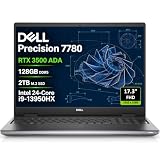
- POWERFUL FOR CREATIVITY - The Dell Precision 7000 series stand at the top of the Precision lineup, delivering higher performance and expandability than the 3000 and 5000 series for demanding professional workloads. As a flagship model, the Precision 7780 showcases Dell’s high‑end workstation design with powerful, scalable capabilities, aligned with the evolution of the Dell Pro Max series. Equipped with an NVIDIA RTX 3500 Ada 12GB GPU, it delivers the performance and stability required for professionals in design, architecture and photography.
- HIGH PERFORMANCE - Powered by Intel Core i9-13950HX vPro Processor (up to 5.5GHz) for superior efficiency and speed. 128GB DDR5 CAMM RAM and 2TB PCIe NVMe M.2 SSD for seamless multitasking and fast storage. CAMM was designed specifically to overcome the performance limits of SODIMM while reducing both Z height and routing traces on the PCB to ultimately allow for laptops with both faster RAM and thinner profiles.
- CRISP DISPLAY - The 17.3" FHD (1920×1080) IPS anti‑glare display with 99% DCI‑P3 color gamut and 500‑nit brightness delivers sharp, vivid visuals for professional work. Support for up to four external monitors via HDMI, USB‑C, and Thunderbolt ports at 4K@60Hz (without docking station), enables flexible multi‑screen setups. A built‑in 1080p FHD IR webcam with privacy shutter supports facial recognition ensures clear, reliable video calls and security.
- VERSATILE CONNECTIVITY - Equipped with two Thunderbolt 4, USB-C, two USB-A, HDMI, Ethernet (RJ-45), and an Audio combo jack for flexible connections. Wi-Fi 6E and Bluetooth ensure fast wireless connectivity and compatibility with a wide range of peripherals, while the numeric keypad enables quick and efficient data entry.
- OPERATING SYSTEM - Windows 11 Pro 64‑bit, with AI‑powered Copilot, offers intelligent assistance to streamline complex professional workflows, enhance productivity, and support advanced multitasking across demanding applications. Built for workstation‑class computing, it delivers enterprise‑grade security and IT manageability.
Best fit: enterprise strategy, platform implementation, migration, operating-model design, and managed transformation.
Watch-out: Consulting quality varies by team, scope, partner ecosystem, staffing, and client execution. Vendor marketing or a case study is not independent performance testing.
20. Salesforce
Salesforce is relevant to data science through Data Cloud or Data 360, Einstein, CRM analytics, predictive use cases, personalization, and embedded generative AI. Its analytics capabilities can collect Einstein audit and feedback data, monitor retrieval quality, and expose AI-performance information through dashboards.
Salesforce is strongest when the data-science problem is tied directly to customer, marketing, sales, or service workflows. The value comes from connecting insight to the CRM process where employees already act on it.
Best fit: customer analytics, CRM data science, marketing, sales, service, personalization, and embedded AI.
Watch-out: Salesforce should not automatically be treated as a replacement for a general-purpose enterprise ML platform. Teams with broad scientific, industrial, or non-CRM workloads may need a separate data and ML foundation.
Which type of data science company should you choose?
The ranking becomes more useful when divided by the job each company performs.
- Broad cloud and data platforms: Databricks, Microsoft, Google, AWS, IBM, Snowflake, and Oracle. Choose among them based heavily on existing cloud commitments, data location, identity, security, and production integration.
- Enterprise data-science workbenches: Dataiku, SAS, DataRobot, Domino Data Lab, H2O.ai, and Alteryx. These are more focused on collaboration, analytics, model development, automation, governance, or reproducibility than on being a complete hyperscale cloud.
- Hybrid and specialist platforms: Cloudera, Altair, and MathWorks. They are strongest where deployment constraints, engineering, simulation, technical computing, or scientific workflows shape the problem.
- AI-enabling infrastructure: NVIDIA. It supplies accelerated computing and software used by many other platforms.
- Operational and domain platforms: Palantir and Salesforce. Their value is greatest when predictions and AI must be embedded in a particular operating workflow.
- Services and transformation: Accenture. It helps organizations plan and execute the surrounding change rather than selling one primary data-science workbench.
A practical buying framework
Use these questions before comparing feature checklists or requesting demonstrations.
- Where does the data live? Identify warehouses, lakes, databases, SaaS systems, edge devices, and data that cannot leave a particular country, region, or private environment.
- What must reach production? Separate an exploratory notebook, a scheduled forecast, a real-time API, an embedded CRM recommendation, and a safety-critical or regulated model. They have different deployment and monitoring requirements.
- Who will use the system? A platform for Python-heavy ML engineers has different usability requirements from one intended for analysts, domain experts, executives, or application developers.
- How will models be governed? Define experiment tracking, lineage, access controls, approval, explainability, drift monitoring, audit records, rollback, and retirement before selecting a tool.
- What is the existing ecosystem? Existing Azure, AWS, Google Cloud, Oracle, Snowflake, SAP, Salesforce, IBM, or open-source investments can affect integration cost more than a single feature comparison.
- Can the team operate it? Account for data engineering, cloud operations, security, platform engineering, model risk, and domain expertise. A broad platform can be powerful but still fail if no one owns the operating model.
- What is the full cost? Include storage, compute, GPU capacity, data movement, software licenses, support, implementation, observability, training, and the labor required to govern the environment.
- How will success be measured? Define business outcomes such as reduced loss, faster experimentation, better forecasting, improved customer retention, or safer operations—not merely the number of models created.
Career implications: skills that travel across these companies
For job seekers, the largest employer ecosystems are likely to be the hyperscalers, enterprise software vendors, consulting firms, and platform companies. However, company size alone does not establish that one employer offers better pay, culture, stability, or career progression. Those factors vary by role, location, business unit, hiring cycle, and individual team.
The most transferable technical skills across this list include:
- Python and SQL: data manipulation, feature preparation, analysis, and production scripting.
- Statistics and experimentation: probability, inference, forecasting, evaluation design, and communicating uncertainty.
- Data engineering: batch and streaming pipelines, distributed processing, warehouses, lakehouses, data quality, and lineage.
- Machine-learning lifecycle management: experiment tracking, model packaging, deployment, monitoring, retraining, and rollback.
- Cloud and platform concepts: identity, networking, containers, storage, APIs, infrastructure, and cost management.
- Governance and responsible AI: privacy, security, documentation, explainability, bias assessment, access control, and auditability.
- Communication: translating a business or operational problem into a measurable modeling problem and explaining results to non-specialists.
A data science interview book can be a useful supplement for practicing statistics, case questions, SQL, modeling discussions, and communication. It should support—not replace—projects, fundamentals, and research into the specific role. No book guarantees employment.
Do these 3 things before closing this tab:
1Fix the driver behind crashes, sound loss and screen glitches2Repair Windows errors before they cause bigger problems3Scan for outdated or missing drivers - takes under a minuteCertification preparation can also be relevant for candidates targeting AWS, Azure, Google Cloud, Databricks, or NVIDIA ecosystems, but the value depends on the role and the employer. A certificate is evidence of structured study; it is not proof of production experience or employer quality.
Important cautions about the ranking
- It is not Gartner’s exact ranking. Gartner evaluated 16 data-science and machine-learning platform vendors; it did not rank these 20 companies in the order shown here.
- The companies are not directly interchangeable. NVIDIA is infrastructure, Accenture is services, Salesforce is CRM-centered, Palantir is operational, and the platform vendors vary in abstraction level.
- Features and names change quickly. Product names, ownership, pricing, availability, deployment options, and the boundaries between services can change after the 2025 snapshot. Confirm current details for your geography and edition.
- Case studies are not neutral tests. Customer logos, vendor claims, and published success stories can demonstrate a use case but do not prove universal superiority.
- Geography matters. Cloud regions, data-residency controls, support, training, pricing, and public-sector eligibility vary by country and sometimes by account or contract.
- Job-seeker conclusions require separate research. This list identifies employer ecosystems and technology relevance; it does not measure compensation, workplace quality, hiring volume, or job security.
This article is a 2025 market snapshot. The underlying research was checked on August 12, 2026, but current product and commercial details should still be verified before a purchase, implementation, or career decision.
Frequently Asked Questions
Is Databricks definitely the best data science company?
Databricks is the strongest overall choice in this editorial ranking for organizations seeking a unified data, analytics, machine-learning, governance, and AI platform. It is not universally best. An Azure-centered company may prefer Microsoft, a regulated organization may favor SAS or IBM, an engineering team may need MathWorks or Altair, and a CRM-focused team may get more value from Salesforce.
Why are NVIDIA and Accenture included when they are not traditional data-science platforms?
Modern data science depends on more than a notebook platform. NVIDIA supplies GPU hardware and software infrastructure used for accelerated AI, while Accenture helps enterprises select, integrate, modernize, and operate data and AI platforms. Their roles are different from those of Databricks, Dataiku, or AWS, so they should be compared within their categories.
Recommended Free Tools
Which data science company is best for a career?
There is no reliable universal answer. Hyperscalers, enterprise software vendors, consulting firms, and platform companies can offer large employer ecosystems, but role quality varies by team, location, business unit, hiring cycle, compensation, and work. Compare the actual job description, technical stack, mentorship, growth path, and team—not just the company name.
How is this different from Gartner’s 2025 evaluation?
Gartner’s May 28, 2025 Magic Quadrant evaluated 16 data-science and machine-learning platform vendors. This article uses that market anchor but adds NVIDIA, Oracle, Palantir, Accenture, and Salesforce because they materially support production data science and AI. The 20-company order is an editorial synthesis, not Gartner’s ranking.
Should a small team buy a full enterprise data-science platform?
Not necessarily. Start with the workflow that creates the most value and assess the minimum required capabilities: data access, reproducible experiments, deployment, monitoring, security, and cost controls. A managed cloud service or focused open-source stack may be more appropriate than a broad enterprise platform until team size and operational requirements justify it.
The Bottom Line
Bottom line: Choose Databricks for the broadest unified data-and-AI platform, Microsoft, Google, or AWS when cloud alignment is decisive, IBM or SAS when governance and regulated analytics dominate, and Dataiku, DataRobot, Domino, H2O.ai, or Alteryx when the priority is a focused enterprise data-science workflow. Look to Cloudera, Altair, MathWorks, NVIDIA, Oracle, Palantir, Salesforce, or Accenture when infrastructure, engineering, operational deployment, CRM, or transformation services define the problem. The best choice is the one your team can govern, integrate, afford, and operate in production.
What’s actually slowing this PC down?
Pick the symptom - the matching free tool is one click away.
Quick Recap
Product prices and availability are accurate as of the date/time indicated and are subject to change. Any price and availability information displayed on Amazon at the time of purchase will apply.

