
iTechGuides is reader-supported. When you buy through links on our site, we may earn an affiliate commission. As an Amazon Associate I earn from qualifying purchases. Learn more
Formula 1 teams rely on technology, software, strategy, and data specialists to turn information into decisions under race-weekend pressure. At Atlassian Williams F1 Team, trackside technology is described as the “pit crew” of its Technology & Innovation Group—but the work is spread across distinct roles, not one all-purpose AI engineer. And while broadcast operations and FIA race control also use remote technical systems and automation, those are separate operations from a team’s engineering and strategy work.
What does an F1 “AI engineer” actually do?
There is no single job that covers all the technical work associated with AI and data in a modern F1 team. Williams describes several related functions within its Technology & Innovation Group: trackside technology, strategy and operations, software engineering, and data and AI. Each contributes differently to performance and decision-making. Williams’s Technology & Innovation Group calls trackside technology its “pit crew” for technology and software deployment, real-time performance insights, and split-second decision support.
| Function | What it contributes | Typical time horizon |
|---|---|---|
| Trackside technology | Deploys and supports technology and software, and helps make performance insight available at the track. | Immediate: systems must work when needed during a race weekend. |
| Strategy and operations | Supports strategic direction and the operational decisions involved in running the team. | Live race-weekend decisions, alongside preparation and coordination. |
| Software engineering | Builds and maintains software systems that support team work. | Ongoing development and reliable deployment, including at the track. |
| Data and AI | Works with data and AI to help produce analysis, performance insight, and decision support. | Analysis can support immediate decisions as well as longer-term work. |
That role map comes from Williams; it should not be treated as a universal org chart for every team. Public descriptions do not establish how many AI engineers an F1 team employs, what specific models teams use, or a measured effect of those systems on race results.
Recommended Free Tools
Why is the deadline part of the job?
Race-weekend engineering combines rapid analysis with the need to deliver dependable systems and useful information when it can still inform a decision. The “deadline” in the title captures that pressure, not a standard countdown shared by every job or team. A trackside system that fails at the wrong moment, or an analysis that arrives too late to be useful, cannot support the people making decisions.
#1 Best Overall
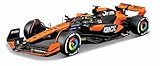
- Authentic Formula 1 Styling – Realistic race-inspired design and proportions
- Authentic Race Car and Driver's Helmet Details
- Collector-Scale Model – 1:24 scale ideal for shelves, desks, and displays. Includes Acrylic Box with Decorative Sleeve
- Authentic Race Car and Driver's Helmet Details for #4 Lando Norris
- Free-Rolling Wheels – Smooth-rolling wheels for display or light play
That does not mean AI independently chooses a race strategy. The public role descriptions support a picture of software, data, and technology enabling human decision-makers; they do not establish autonomous AI control of team strategy or sporting decisions.
How is team engineering different from F1’s broadcast technology?
Formula 1’s broadcast operation has its own onsite and remote technical infrastructure. According to Formula 1’s account of its broadcast operations, an onsite Event Technical Centre (ETC) acquires content, data, and feeds at an event and sends them to a UK-based Remote Technical Centre (RTC) for processing and publishing. Backup connectivity supports critical broadcast services.
Rank #2
- Officially Licensed Replica – Authentic styling and branding from the original manufacturer
- Die-Cast Metal Construction – Durable metal body with detailed plastic components
- Highly Detailed Design – Realistic exterior styling and interior details
- Free-Rolling Wheels – Smooth movement for display or play
- Perfect for Collectors & Kids – Great gift for automotive fans
This is a broadcast workflow, not evidence that F1 team race engineers generally work remotely or that the RTC makes team strategy decisions. Formula 1’s 2025 sustainability article says approximately 140 personnel work remotely at each race weekend; that figure refers to the organisation’s remote broadcast operation, not team engineering headcount. Formula 1’s sustainability progress report gives that operational context.
Free tools Windows power users keep installed
One-click scans. No signup required.
Formula 1 also reported that its remote broadcast transition reduced travelling staff by 36% and freight by one-third. Those figures describe the organisation’s historical transition to remote broadcast operations, as reported in its account of that change; they should not be read as current staffing reductions for F1 teams. The broadcast operations account describes that transition.
Rank #3
- Ferrari Die-Cast Race Vehicle in 1/43 scale
- Authentic Race Car and Driver's Helmet Details
- Acrylic Box with Decorative Sleeve
- 2025 Season Car
What does AI automation do in FIA race control?
The FIA has described computer-vision and automated workflows at its Remote Operations Centre (ROC) for processing race incidents. This is official race-control support, distinct from both team engineering and Formula 1’s broadcast RTC.
FIA Head of the Remote Operations Centre Tim Malyon described how an automated workflow can help staff process an incident: “What we’ve done this year is develop the systems to be a lot more automated so that from the ROC, we can pause the video, press a button, check the data is right and hit send to add the incident into the Race Control systems.” The FIA’s description of its Remote Operations Centre presents this as an incident-processing workflow. It does not show AI autonomously directing a team’s race strategy.
Rank #4

- FERRARI F1 TOY CAR – Boys and girls ages 10 and up and Ferrari fans can build, display and race the LEGO Speed Champions Ferrari SF-24 F1 Race Car and driver set
- 1 DRIVER MINIFIGURE – This vehicle set includes a driver minifigure wearing a special Ferrari outfit and a winged helmet for kids to place inside the cockpit and role-play thrilling race action
- AUTHENTIC DETAILS – F1 race car with design details from the real-life 2024 version, including a rear wing, a halo bar, sponsor stickers and wider rear tires imprinted with “Pirelli”
- F1 FUN FOR THE WHOLE FAMILY – Race for the checkered flag alongside the whole family with other building sets (sold separately) in the LEGO F1 range
- BUILD & DISPLAY – After kids have enjoyed playing out racing stories with the Ferrari F1 toy, they can display it on a shelf or bedside table
What can a separate motorsport AI example tell us?
OpenAI’s account of its collaboration with Chip Ganassi Racing says the first-year focus was using AI to make sense of car-sensor data and race- and pit-crew performance data. OpenAI’s account of the collaboration offers an example of how data analysis can be applied in professional motorsport, but Chip Ganassi Racing is not an F1 team and the account does not establish how F1 teams use AI.
Do these 3 things before closing this tab:
1Repair Windows errors before they cause bigger problems2Fix the driver behind crashes, sound loss and screen glitches3Clear out junk files and repair common Windows errorsHow do the 2026 rules affect the context?
The FIA’s 2026 overview describes changes involving car design, power, and aerodynamics. The FIA’s explanation of the 2026 Formula One regulations is useful context for the evolving engineering environment, but it does not disclose any team’s AI roadmap or prove that a particular data or AI system is being developed for the new rules.
Quick Recap
What is known—and what remains private?
- Official team descriptions show technology, software, strategy, operations, and data/AI as related but distinct areas of work.
- Public sources describe decision-support and operational automation, not autonomous AI control of team strategy.
- Formula 1’s broadcast remote-centre staffing figures belong to broadcast operations, not team engineering.
- Public information does not establish a reliable team-side AI engineer headcount or a quantified improvement in race outcomes.
- Specific team systems, staffing, algorithms, and performance results are not fully disclosed publicly.
Product prices and availability are accurate as of the date/time indicated and are subject to change. Any price and availability information displayed on Amazon at the time of purchase will apply.

