
Free tools Windows power users keep installed
One-click scans. No signup required.
iTechGuides is reader-supported. When you buy through links on our site, we may earn an affiliate commission. As an Amazon Associate I earn from qualifying purchases. Learn more
Yes—but the first images were not ordinary photographs. In 2013, researchers used a force-sensing atomic-force microscope to map individual bonds in a molecule on a silver surface before and after it reacted when heated above 90 °C. Later techniques have gone further, mapping controlled bond breaking, watching catalytic atoms move and capturing electron dynamics on femtosecond timescales.
What did the 2013 images actually show?
The Berkeley Lab and UC Berkeley team imaged a surface-bound oligo-enediyne derivative containing 26 carbon atoms and 14 hydrogen atoms. Its carbon framework included three connected benzene rings. The researchers recorded the molecule before and after a reaction that began when the sample temperature exceeded 90 °C. The published images used three-ångström scale bars for structures about a nanometer across.
The result was significant because the images resolved the molecule’s covalent-bond structure at the single-bond level on both sides of a complex organic reaction. Felix Fischer, the study’s lead researcher, described it as direct, single-bond-resolved imaging of individual molecules immediately before and after such a reaction. It was a before-and-after view of a controlled surface reaction—not a continuous movie of the reaction happening.
What’s actually slowing this PC down?
Pick the symptom - the matching free tool is one click away.
Why the team changed instruments
The researchers first tried scanning tunneling microscopy (STM), but its resolution was not sufficient to identify the roughly one-nanometer reaction products reliably. They switched to noncontact atomic-force microscopy (nc-AFM), attaching a carbon-monoxide molecule to the microscope tip. As the tip passed over the surface, the instrument registered tiny changes in force caused by interactions between the tip and the molecule.
#1 Best Overall

- FOR BASIC TEACHING TO ADVANCED SCIENCE: 444 pieces molecular model kit, including 136 atoms, 158 bonds and 150 parts for Carbon-60(Fullerene), provides to students from Grade 7 to Graduate level.
- TWO CHEMICAL STRUCTURE MODELS: The ball-and-stick models use spheres to represent atoms and sticks to represent chemical bonds. In the space-filling model, the spheres are drawn to scale and are next to one another as atoms are in real molecules.
- CHEMISTRY EDUCATIONAL MOLECULE MODEL IN 3D: It can display chemical structure, molecular bond, and bond angle in all directions. Demonstrate fundamental molecular geometry, chemical molecular structure, stereochemistry with 3D modeling studies.
- EASY TO LEARN: The universal standard adopted for each atom's color makes it easier for you to use and learn. Atoms and chemical bonds combine tightly and firmly and can be easily disassembled by disconnecting tools.
- If you’re not in love with it for whatever reason, we’ll give you a full replacement or refund—no questions asked. If you have any doubt, please tell us. With nothing to worry about, or even to share with your friends, try it now.
The resulting signal was a force map, not a camera image. The researchers reported that the contrast let them distinguish single, double and triple bonds. In Fischer’s words, “What you see is what you have – the effects of the electron forces among the atoms, and even the bond order.”
Are these actual photographs of molecules?
No. A visible-light camera does not resolve the covalent bonds in an individual molecule. In the 2013 work, the microscope measured short-range forces with a functionalized probe and rendered those measurements as an image. Other methods convert tunneling current, vibrational signals, transmitted electrons or X-ray absorption into maps or time-resolved records.
Rank #2

- Visualize Molecular: The molecular model kit simplifies complex chemistry concepts into tangible 3D structures improve learning efficiency, suitable for students from Grade 7 to Graduate level.
- 444 Pcs Complete Set: The atom model kit includes with 136 atoms,158 bonds, and 150 fullerene model parts, explore most the molecules structures from simple compounds to complex polymers.
- Effortless Assembly: Embedded component design ensures easy to construct Ball-and-stick and Space-filling models that maximizes focus on exploration without complex assembly.
- Durable & Portable: Built to last, the chemistry set is crafted from high-quality materials. Plus, its portable Snap-Lock design allows you to take your experiments learning anywhere, between the home, classroom and lab.
- Essential Study Tool: Whether you're studying organic chemistry, biochemistry, or molecular biology, molecule building kit is an perfect learning tool for you deeper comprehension of molecular science.
Those outputs can resemble familiar line-bond diagrams or ball-and-stick models, but the resemblance is a way to interpret measured signals—not an optical view of colored atoms. “Bond-resolved image,” “force map” and “atomic-resolution movie” are more precise descriptions than “photograph.”
How later methods extended molecular imaging
Subsequent work addressed different questions from the 2013 before-and-after experiment. Some studies mapped bonding, one used STM electrons to induce a particular dissociation, and others followed catalysis or electronic dynamics over time.
Rank #3

- UNLOCK YOUR CHEMISTRY POTENTIAL: Our comprehensive molecular model kit includes 238 pieces, featuring 84 atoms, 153 bonds and a remover tool. Suitable for chemistry learners from beginners to advanced levels. Manufacturer recommended age: 15 years and up
- ORGANIZED STORAGE AND EASY LOCATING: Experience hassle-free organization with our storage box, complete with divided compartments and labeled sections. Say goodbye to clutter and quickly find the components you need
- EXTRA LEARNING MATERIALS FOR EXCELLENCE: Enhance your studies with our bonus 6-page learning guide and stencils. From grade 9 to college, from organic to inorganic, finish and master your assignments faster and create numerous molecular structures with ease
- IMMERSIVE 3D VISUAL LEARNING: Explore chemistry in a captivating way with our 3D visual learning approach. The universal color-coded Atomic Balls provide a better understanding of molecular structure, boosting your chemistry knowledge. It's also a perfect gift for someone who are going to learn those complex molecule
- EASY-TO-USE DESIGN: Crafted from smooth, burr-free plastic, our molecular science kit ensures easy assembly. With the included remover tool, disassembling is a breeze
| Method or study | What it measured or did | What it established | Time information |
|---|---|---|---|
| 2013 nc-AFM, Berkeley Lab and UC Berkeley | Short-range forces sensed by a carbon-monoxide-functionalized tip over a molecule on silver. | Bond-resolved images of a molecule before and after a heat-triggered reaction; reported contrast distinguished single, double and triple bonds. | Before and after heating above 90 °C; not a continuous reaction movie. |
| DOE itProbe | An STM tip carrying a single carbon-monoxide molecule mapped cobalt phthalocyanine on silver. | Two-dimensional bonding maps that gave a physical basis for the familiar ball-and-stick representation. | Not stated in the cited DOE account. |
| STM-induced dissociation, RIKEN | STM electrons excited C–H vibrations in dimethyl disulfide (CH3S–SCH3) on copper. | The excitation provided an indirect route to breaking the S–S bond, producing two methyl-thiolate fragments. | Not stated in the cited RIKEN account. |
| SMART-EM, 2025 | Low-dose electron microscopy recorded atoms moving during alcohol dehydrogenation catalysis. | The study reported direct atomic-level observation of catalysis, short-lived intermediates and a previously hidden reaction pathway. | Videos followed atomic motion; a frame rate or numerical temporal resolution is not stated in the cited study summary. |
| LCLS X-ray study, 2026 | Two precisely timed X-ray flashes produced measurements at multiple delays. | Recorded early electronic dynamics, including Coster–Kronig decay and quantum electron coherence, followed by the onset of bond breaking and formation. | Ten timestamps within the first 10 femtoseconds; bond changes began at about 10 femtoseconds. |
What is different about AFM, STM, SMART-EM and X-ray measurements?
Atomic-force microscopy: map forces
In nc-AFM, a sharp probe scans above a sample without relying on ordinary photographic light. Its mechanical response changes with short-range interactions between the tip and the surface. A chemically functionalized tip, such as the carbon-monoxide tip used in the 2013 study, can sharpen the bond-related contrast. This approach supported the 2013 claim about bond order and the molecule’s structure before and after reaction.
Scanning tunneling microscopy: map tunneling signals and, in some experiments, induce reactions
STM detects tunneling current between a conductive tip and a surface. In the 2013 work, STM did not resolve the reaction products well enough for reliable identification, so the team moved to nc-AFM. In separate RIKEN work, STM electrons were used to excite molecular vibrations and trigger dissociation. That experiment showed a specific route from C–H vibrational excitation to S–S bond breaking; it was not a general demonstration that STM can film arbitrary bonds breaking.
Rank #4
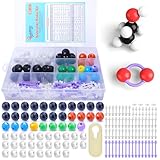
- ADVANCED LEARNING SCIENCE EDUCATION KIT --- Perfect chemistry model kit for modeling simple and small to more advanced and complex chemical structures for schools and college level, students of all ages, researchers and enthusiasts. Fun and interactive early learning molecular set for kids of all years and for use in the classroom.
- HIGH QUALITY --- Made from high quality durable materials designed for easy construction and perfect fit. These Molecular Model Kit pieces are color coded to national standards for easy ID. Organic Chemistry Model Kit includes box for easy storage and transport with your other textbooks, notes, and books. Excellent for the classroom.
- POWERFUL FUNCTIONS --- This Molecular Model Kit has a total of 136 pieces including short link remover tool. Super easy to build models for organic and inorganic chemistry, This model contains C, H, O, N, S and a variety of single and double bonds, Can be put high school, university chemistry in most of the organic or inorganic molecular structure model for the study of experimental operation.
- QUICK AND EASY ASSEMBLY OF COMPLEX STRUCTURES --- Atoms and bonds that are perfectly suited to being connected and disconnected easily without making your fingers hurt. We've also included a link remover to make the task of easy.
- CONVENIENT STORAGE --- The pieces come in a slim plastic box for convenient storage. See the pictures on this listing for a full understanding of what's inside
SMART-EM: follow atomic motion during catalysis
The 2025 SMART-EM study used low-dose electron microscopy to record atoms moving during alcohol dehydrogenation. Its reported contribution was seeing catalytic activity and short-lived intermediates in motion, revealing a pathway that had previously been hidden. The cited study summary does not specify a numerical frame rate, so it should not be treated as a measurement of electron motion on the attosecond scale.
Recommended Free Tools
Timed X-rays: probe the earliest electronic changes
In the 2026 LCLS work, two precisely timed X-ray flashes captured a sequence of measurements within the first 10 femtoseconds. The early measurements included Coster–Kronig decay and quantum electron coherence; bond breaking and new bond formation began at about 10 femtoseconds. This probes the electronic events that precede or accompany chemical rearrangement, rather than providing the same kind of surface-bond map as nc-AFM.
Best Value

- Visualize Molecular: The molecular model kit simplifies complex chemistry concepts into tangible 3D structures improve learning efficiency, suitable for students from Grade 7 to Graduate level.
- 240 Pcs Complete Set: The atom model kit includes with 86 atoms and 154 bonds, explore most the molecules structures from simple compounds to complex polymers.
- Effortless Assembly: Embedded component design ensures easy to construct Ball-and-stick and Space-filling models that maximizes focus on exploration without complex assembly.
- Durable & Portable: Built to last, the chemistry set is crafted from high-quality materials. Plus, its portable design allows you to take your experiments learning anywhere, between the home, classroom and lab.
- Essential Study Tool: Whether you're studying organic chemistry, biochemistry, or molecular biology, molecule building kit is an perfect learning tool for you deeper comprehension of molecular science.
What can a molecular movie reveal that static images cannot?
A before-and-after image identifies structural differences, but it cannot by itself show the sequence connecting them. Time-resolved measurements can reveal motion, transient intermediates and reaction pathways that a pair of endpoint structures might miss. The SMART-EM alcohol-dehydrogenation videos, for example, showed atoms moving during catalysis and supported identification of short-lived intermediates. The LCLS measurements addressed an earlier timescale still, tracking electronic events within the first 10 femtoseconds.
These methods answer complementary questions rather than offering interchangeable pictures. A force map can resolve bonding in a molecule on a surface; an STM experiment can test how injected electrons or vibrational energy trigger a reaction; electron microscopy can follow atomic rearrangement during catalysis; and timed X-rays can probe ultrafast electronic dynamics. The kind of conclusion each supports depends on what the instrument measures and how the experiment is timed.
What the “first-ever” claim does—and does not—mean
The 2013 milestone was the first reported direct, single-bond-resolved imaging of an individual molecule immediately before and after a complex organic reaction, according to the Berkeley Lab account. It did not mean scientists had taken ordinary photographs of bonds, watched every chemical reaction in real time or imaged arbitrary molecules under everyday conditions. The molecule was on a silver surface, and the reaction was initiated by heating above 90 °C.
Crashes, No Sound, or Screen Glitches?
Random freezes, missing sound and display glitches usually trace back to one bad driver. Find and replace yours safely.Free scan · under a minutePC Slower Than It Used to Be?
A free scan shows the junk files, broken settings and background clutter dragging Windows down - then fixes them in one click.Free scan · Windows 10 & 11Later studies expanded the kinds of molecular events researchers could observe, but they did so with different instruments, samples and timescales. The 2013 result remains a specific advance in bond-resolved imaging; subsequent movies and ultrafast measurements should be understood on their own terms.
Quick Recap
Product prices and availability are accurate as of the date/time indicated and are subject to change. Any price and availability information displayed on Amazon at the time of purchase will apply.

