
iTechGuides is reader-supported. When you buy through links on our site, we may earn an affiliate commission. As an Amazon Associate I earn from qualifying purchases. Learn more
The capacitor plague was a wave of unusually early failures in some low-ESR aluminum electrolytic capacitors used in computers and other electronics. Affected parts could bulge, vent or leak, then lose electrical function. The failures were real; the often-repeated story that a stolen, incomplete electrolyte formula caused all of them is a reported theory, not a proven explanation for every case.
What happened to the capacitors?
Some aluminum electrolytic capacitors failed far earlier than expected. These components store and release electrical energy and help stabilize power in electronic circuits. The failures drew particular attention when capacitors on desktop PC motherboards began swelling or leaking.
CALCE’s 2004 conference-paper abstract describes bulging as the most obvious sign before electrical function was lost. A capacitor with a bulged can or ruptured vent is not merely cosmetically damaged: it may no longer work properly, and its failure can disable or damage the board around it. CALCE’s 2004 abstract
Do these 3 things before closing this tab:
1Repair Windows errors before they cause bigger problems2Scan for outdated or missing drivers - takes under a minute3Clear out junk files and repair common Windows errorsWhen did the capacitor plague occur?
Reports of early failures began in late 2001, with PC motherboard problems receiving attention in 2002 and 2003. Later accounts often associate suspect components with products made around 1999–2003 and describe failures continuing into the middle of the decade, sometimes as late as 2007. Those dates describe the broad episode, not a precise boundary: a component’s manufacture date alone does not prove that it was defective or part of the plague. IEEE Spectrum’s 2003 report and Ars Technica’s 2025 retrospective document the varying timelines.
#1 Best Overall

- ALLECIN Electrolytic Capacitors Kit contain 24 Different Values In-line Aluminum Capacitors - Perfectly suitable for variety electronic experiments.
- Features & Advantages : Large capacity and small size. Ripple current resistance - small loss tangent, small leakage current, low internal resistance and low ripple.
- Dielectric material: aluminum electrolytic. Lead description: long lead = positive "+"; short lead = negative "-".
- Wide Application : In-line electrolytic capacitors are widely used in household appliances and various electronic products, and are also very suitable for DIY circuit boards.
- Humanized packaging for easy storage and use. # Please confirm the capacitance, voltage and volume before purchasing.
How widespread was it?
CALCE’s 2004 abstract says susceptible capacitors were produced in the millions under contract to multiple suppliers and used in mass-produced products from several companies. It warned that the problem could potentially cause early failure in hundreds of thousands of end units. “Potentially” matters: that figure is an estimate of possible impact, not a verified count of computers or other devices that ultimately failed. The sources do not establish a reliable aggregate failure total or total financial loss. CALCE
Contemporary reporting documented motherboard repairs and company responses, but its examples are not a complete industry census. IEEE Spectrum reported that repairer Gary Headlee had fixed 1,200 boards and at one point received as many as 10 broken boards by mail each day. Those figures describe one repairer’s experience, not the rate of failures across the industry. The same article identified ABIT as the only motherboard maker then admitting the problem and IBM as the only major PC maker then acknowledging an impact; those were the article’s reported acknowledgments at the time, not proof that only those companies were affected. IEEE Spectrum, 2003
Rank #2
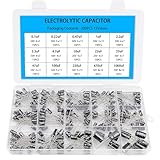
- Comprehensive Kit of 200PCS Includes 15 commonly used capacitor values from 0.1uF to 1000uF, with voltage ratings of 10V, 16V, 25V, and 50V. Each value is neatly organized in a labeled plastic storage box for easy access and use.
- Clear Polarity Markings Aluminum electrolytic capacitors with radial leads. Long lead = positive (+), short lead = negative (−), making installation easier and safer.
- Durable and Stable Designed with an operating temperature range of -40℃ to +105℃ and ±20% tolerance, ensuring stable and reliable performance under harsh conditions.
- Low ESR & Ripple Resistance Features low equivalent series resistance (ESR) and high ripple current resistance, ideal for smoothing, filtering, and timing circuits in power supply and audio applications.
- Wide Applications Perfect for hobbyists, engineers, and technicians working on TVs, monitors, speakers, game consoles, amplifiers, and other consumer electronics
What caused the failures?
Investigations focused on electrolyte composition in certain capacitors. In a widely repeated account reported by IEEE Spectrum in 2003, an unnamed source said a formula allegedly taken from a Japanese employer was incomplete and lacked additives. Passive-components publisher Dennis Zogbi described the alleged formula by saying, “It didn’t have the right additives,” and explained that the resulting gas generation could make capacitors burst. The companies accused in the account denied the allegations. The article’s key claims about the formula depended in part on an unnamed source. IEEE Spectrum’s contemporary account
That account is a reported explanation, not a conclusive finding that one stolen formula caused every failure associated with the period. Ars Technica’s 2025 retrospective cautions against treating the story as proven or sufficient to explain the whole range of failures later grouped under the capacitor-plague label. Heat, component design, supply-chain complexity and other failure modes may be relevant context, but the available sources do not establish their relative contribution. Ars Technica, 2025
Rank #3

- 🟦 0.1uF - 2200uf 20 value 304 pcs capacitor set
- 🟦 See through the bottom of the transparent trays
- 🟦 0.1, 0.22, 0.47, 1, 2.2, 3.3, 4.7, 10, 22, 33, 47, 100, 220, 470, 1000, 2200uf capacitance
- 🟦 10V, 16V, 25V, 50V voltage limit
- 🟦 Each compartment has a plastic cover/door that opens and closes with a nice positive snap
Was every broken PC from that era affected?
No. The term refers most usefully to early failures of certain low-ESR aluminum electrolytic capacitors, not all capacitors made in the early 2000s or every computer that failed during those years. Ars Technica notes that some failures were folded into the plague story even when the component type or timing did not match the familiar problem. A failure from the period, by itself, does not identify its cause. Ars Technica’s retrospective
Independent reader supportYour contribution helps us test, update, and keep practical guides available for everyone.Could an affected board be repaired?
Some boards were repaired by replacing failed capacitors. IEEE Spectrum reported that ABIT offered repair or replacement for defective boards sent to the company. Whether another board is repairable depends on its condition, the surrounding circuit and the repairer’s skill; historical reports do not provide a universal repair procedure or a standard replacement-part list. IEEE Spectrum, 2003
Rank #4
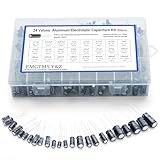
- 24 Values & 500pcs Comprehensive Kit: Covering 0.1uF to 1000uF with voltage ratings from 10V to 50V, this kit includes 24 essential capacitance values and 500 pieces total. Perfect for prototyping, repairs, and diverse electronic projects.
- Optimized Quantity for Practical Use: Each value is carefully curated with higher quantities for commonly used capacitors (e.g., 30pcs of 0.1uF, 2.2uF, 3.3uF) and balanced stock for specialized values (e.g., 10pcs of 680uF, 1000uF), ensuring you always have what you need.
- Premium Quality & Durability: Made with high-purity aluminum and rated for -40℃ to +105℃ operation. Features low leakage current (±20% tolerance) and long lifespan, ideal for power supplies, amplifiers, and industrial applications.
- User-Friendly Transparent Storage Box: All capacitors are organized in a sturdy, labeled compartment box. Clear lids and anti-slip design make storage effortless and components easily accessible.
- Versatile for Professionals & Hobbyists: Repair TVs, motherboards, game consoles, or build DIY circuits. Perfect for engineers and electronics enthusiasts seeking a reliable, all-in-one capacitor solution.
A replacement must suit the actual circuit, not just look similar or fit the holes. Check the original design or reliable board documentation for the required specifications:
- Capacitance and rated voltage
- Polarity, physical dimensions and lead spacing
- Temperature and ripple-current ratings
- ESR or impedance requirements
A generic capacitor assortment is not a guaranteed fix. Incorrect parts or an unsuitable repair can leave the circuit unreliable or cause further damage.
Quick Recap
Best Value

- 24 Values, 480pcs Total: Includes 20pcs of each value (10pF, 22pF, 30pF, 47pF, 100pF, 220pF, 330pF, 470pF, 1nF, 2.2nF, 3.3nF, 4.7nF, 6.8nF, 10nF, 22nF, 47nF, 68nF, 100nF, 220nF, 470nF, 1uF, 2.2uF, 4.7uF, 10uF), covering a wide range for diverse electronics projects.
- Premium Quality & Durability: Multilayer monolithic ceramic capacitors with 50V withstand voltage, ±10% tolerance, and epoxy resin coating for humidity resistance and long-term reliability.
- Organized Storage Box: Compact re-sealable plastic case with labeled compartments to prevent mixing and ensure easy access. Ideal for hobbyists and engineers.
- Versatile Applications: Perfect for bypass circuits, filtering, signal coupling, DIY electronics, industrial control systems, and electron experiments.
- Clear Markings & Easy Identification: Each capacitor features printed capacitance codes (e.g., 104=100nF=0.1uF), simplifying component selection during assembly.
Product prices and availability are accurate as of the date/time indicated and are subject to change. Any price and availability information displayed on Amazon at the time of purchase will apply.

