
Outdated Drivers Are Slowing You Down
One free scan finds every outdated or missing driver and matches the right update for your exact hardware.Free scan · exact hardware matchWindows Errors? Fix Them Before They Spread
Repair common Windows errors and clear accumulated junk for a smoother, more stable PC - no reinstall needed.Free scan · no reinstalliTechGuides is reader-supported. When you buy through links on our site, we may earn an affiliate commission. As an Amazon Associate I earn from qualifying purchases. Learn more
The best way to work with Cursor is to match how much you deliberate to how big the task is. For substantial work, such as a feature that spans several files, a change with competing approaches, or a request with unclear requirements, take time to let Cursor understand the codebase and draft a plan before any code is written. For small, familiar edits, skip the planning step and ask Agent to make the change directly. Slowing down helps when it prevents a badly scoped implementation. It adds nothing when the task is already clear.
Decide first: planning or direct Agent mode
Cursor’s own guidance draws the line in a simple place. Plan Mode is meant for complex features, changes that span multiple files or systems, requirements that are still unclear, and architectural choices. Quick, routine, or familiar tasks can go straight to Agent mode. The point of “slowing down” is to pick the right path for the job, not to put a formal planning step in front of every request.
| Situation | Start with | Why |
|---|---|---|
| Rename a variable, fix a typo, adjust a style value in one file | Agent mode | The change is small, local, and easy to review in the diff |
| Add a routine endpoint that follows an existing pattern in the project | Agent mode | The approach is already established, so a plan adds little |
| Feature touching several files, such as UI, API, and data layer | Plan Mode | Scope errors are expensive to unwind once code is spread across the project |
| Request where two or more designs are plausible | Plan Mode | You want to choose the approach before the code commits to one |
| Vague request, such as “make onboarding better” | Plan Mode | Planning gives Cursor room to ask clarifying questions before it guesses |
| Architectural change, such as moving state management or splitting a service | Plan Mode | The decision has long-term effects that deserve a review before edits begin |
Plan Mode has a cost: it adds a round of reading, questions, and review before anything changes. That cost is worth paying when a review of the approach can prevent a mis-scoped implementation. When the task is quick and familiar, the same review adds time without reducing risk.
Do these 3 things before closing this tab:
1Repair Windows errors before they cause bigger problems2Fix the driver behind crashes, sound loss and screen glitches3Clear out junk files and repair common Windows errorsHow Plan Mode works
Cursor’s official Plan Mode documentation describes the feature this way: “Plan Mode creates detailed implementation plans before writing any code.” In practice, Plan Mode has three stages. Agent explores the codebase, may ask clarifying questions, and then produces a plan for you to review. You can edit that plan before Cursor builds anything. The documentation says Agent may ask clarifying questions; it does not promise that it will always do so, so do not rely on that step alone to catch every ambiguity.
#1 Best Overall

- Cut Repetitive Keystrokes Down to One Press: Built with 3 mechanical keys and multi-mode switching, this keypad lets developers trigger AI prompts, commands, and macros for Claude Code, Cursor, Codex, and other AI coding assistants without leaving the keyboard — switch modes to access 9+ custom shortcuts from the same 3 keys.
- Voice Input That Stays Clear Wherever Your Keypad Sits: Unlike keypads with a microphone built into the body, ours detaches and clips onto your collar so it stays close to your mouth no matter where the keypad sits on your desk. An onboard DSP chip with intelligent noise reduction and ~30ms latency keeps dictated code comments and voice commands accurate, even with keyboard noise or office chatter in the background.
- Built to Fit Your Existing Setup, Not Replace It: Connects via Bluetooth 5.4 or the included USB-C receiver and works across Windows, Mac, and Linux, so the same unit runs on every machine your team uses. It's designed as a dedicated shortcut and dictation companion that sits alongside your primary keyboard, not a replacement for it.
- Reprogram It for How You Actually Work: Use the companion app to record macros and remap all 3 keys per mode — one profile for AI assistant commands, one for IDE actions, one for your own custom sequences. Built for solo developers working late and teams running multiple AI tools side by side.
- PWhat's in the Box: Includes 1x multi-mode macro keypad, 1x detachable clip-on microphone, 1x USB-C receiver, 1x furry windshield, 2x USB-C cables, and 1x user manual. Built-in 380mAh battery charges via the included USB-C cable; wall adapter not included.
Step-by-step: a planned change
- Classify the task. Ask whether it touches several files, has more than one reasonable approach, or depends on requirements you have not yet pinned down. If none of these apply, use Agent mode.
- Switch to Plan. Open the chat panel and choose Plan from the mode selector near the prompt box. The exact label and location can change between Cursor releases, so check the current interface if the menu looks different.
- State the outcome and the constraints. Describe what should change, what must not change, and any limits such as a framework version, a file you want left alone, or an existing pattern to follow.
- Let Cursor inspect before it edits. Agent reads the relevant parts of the codebase and may ask clarifying questions. Answer them in specific terms rather than repeating the original request.
- Review the plan. Check the scope, the assumptions, and the chosen approach. Remove steps you do not want, correct wrong assumptions, and add missing constraints. Build only once the plan matches the change you intend.
- Run the implementation and check the result. Compare the output with the plan and the original goal, not only with whether the code compiles.
Write the goal before you ask for code
Most planning problems start with an underspecified request. Before you invoke Agent or Plan, write one or two sentences that state the outcome, the scope, and the constraints. Cursor’s CLI documentation explicitly recommends a clear statement of intent, and it identifies Plan mode as the place to design an approach before coding. The same habit works in the editor. “Add pagination to the orders table, keep the existing sort order, and do not change the API response shape” gives Cursor far more to work with than “improve the orders page.”
Keep project context in rules, not in every prompt
If you find yourself repeating the same expectations in every session, such as which test command to run, which folders hold generated code, or which libraries are off limits, move them into persistent instructions. Cursor’s current documentation describes project rules stored in the .cursor/rules folder, user rules, and AGENTS.md. Cursor’s Rules documentation states: “Good rules are focused, actionable, and scoped.”
Use that principle to keep rules short. A rule that says “run npm test before reporting a task as done” is useful. A rule that copies the whole README into the rules folder is not, because it duplicates documentation that already exists and makes the instructions harder for Cursor to apply. Add a rule when a specific expectation keeps recurring, and remove it when the project changes.
Recommended Free Tools
Rank #2
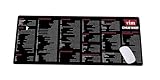
- Extra Large & Comfortable: Measuring 31.5 x 11.8 inches with a 3mm thickness, this XL mouse pad offers ample space for your mouse, keyboard, and more - ensuring comfort and reducing noise.
- Smooth & Precise Control: Enjoy effortless mouse movement with the ultra-smooth surface, perfect for both gaming and office work.
- Non-Slip Rubber Base: The anti-slip rubber base keeps the pad securely in place during intense gaming or work sessions.
- Durable & Stylish Design: Invisible stitching prevents edge wear while maintaining a sleek look, extending the pad’s lifespan.
- Waterproof & Easy to Clean: The water-resistant coating allows for quick cleaning—spills and stains wipe away easily.
When the result misses the goal
If an implementation does not match what you wanted, the usual reflex is to send a follow-up prompt that patches the mistake. Cursor’s Plan Mode guidance suggests a different response: return to the plan, refine it, and run it again. A plan that was wrong about scope will keep producing wrong code if you only correct the output one prompt at a time. Revising the plan fixes the cause, and it also leaves a clear record of what was intended.
Use this sequence when a result misses:
- Check whether the plan itself was wrong. If it was, edit the plan and run the implementation again.
- Check whether the plan was right but the goal was vague. If so, state the outcome more precisely and plan again.
- Check whether the mistake is a repeated project convention. If so, add a short rule so the expectation carries into later sessions.
- Only send a narrow follow-up prompt when the fix is small and the rest of the change is correct.
Common mistakes
- Planning every edit. A plan for a one-line fix wastes time and makes the workflow feel slow without making the result safer.
- Accepting a plan without reading it. The plan is only useful if you check its scope and assumptions before building.
- Treating questions as a guarantee. Agent may ask clarifying questions, but you still need to state the goal clearly.
- Using rules as a dumping ground. Long, overlapping rules are harder to follow than a few focused ones.
The short version
Plan first when the task is large, uncertain, or structurally important, and use Plan Mode to review the approach before edits begin. Go straight to Agent for small, familiar work. Whichever mode you choose, state the goal clearly, keep recurring expectations in focused rules, and revise the plan when the result misses rather than patching it one prompt at a time.
Cursor’s interface, shortcuts, and feature details change over time, so confirm the current labels in your installed version before following any step-by-step instructions.
Quick Recap
The Bottom Line
“”
Product prices and availability are accurate as of the date/time indicated and are subject to change. Any price and availability information displayed on Amazon at the time of purchase will apply.
What’s actually slowing this PC down?
Pick the symptom - the matching free tool is one click away.

