
iTechGuides is reader-supported. When you buy through links on our site, we may earn an affiliate commission. As an Amazon Associate I earn from qualifying purchases. Learn more
No verified account identifies a $5 item as the cause of the outage in this title. The closest detailed match is a homelab owner’s report that a desktop Solarflare 10GbE network card locked up a UniFi US-16-XG switch, taking multiple services offline. The owner later traced the repeated problem to outdated NIC firmware and says updating it stopped the issue. That is a useful case study in shared dependencies, but it is not a confirmed account of a $5 failure.
What is known about the outage behind this title?
The exact first-person incident implied by “the $5 problem” could not be matched to a published account. The closest documented network incident is described by the author of “My Homelab Journey: Part 1 – Hardware & Lessons Learned”, published in 2025. It does not mention a $5 component.
In that account, a desktop Solarflare 10GbE NIC locked up a US-16-XG switch. The switch was a shared path for a Proxmox cluster, storage, home automation, and other services, so its failure interrupted them together. The owner says the lockups recurred and required hard power cycles. Later, the owner found that the NIC firmware was three major versions behind and reports that updating it stopped the problem. This is one owner’s diagnosis and outcome, not evidence of a general failure rate or proof that every similar outage has the same cause.
The author described the realization as “This was my ‘oh no’ moment about single points of failure.” In the same account, the author wrote: “One misbehaving NIC could take down my entire infrastructure (Well most that mattered).”
#1 Best Overall

- Entry-level NAS Personal Storage:UGREEN NAS DH2300 is your first and best NAS made easy. It is designed for beginners who want a simple, private way to store videos, photos and personal files, which is intuitive for users moving from cloud storage or external drives and move away from scattered date across devices. This entry-level NAS 2-bay perfect for personal entertainment, photo storage, and easy data backup (doesn't support Docker or virtual machines).
- Set Your Devices Free, Expand Your Digital World: This unified storage hub supports massive capacity up to 64TB.*Storage drives not included. Stop Deleting, Start Storing. You can store 22 million 3MB images, or 2 million 30MB songs, or 43K 1.5GB movies or 67 million 1MB documents! UGREEN NAS is a better way to free up storage across all your devices such as phones, computers, tablets and also does automatic backups across devices regardless of the operating system—Window, iOS, Android or macOS.
- The Smarter Long-term Way to Store: Unlike cloud storage with recurring monthly fees, a UGREEN NAS enclosure requires only a one-time purchase for long-term use. For example, you only need to pay $459.98 for a NAS, while for cloud storage, you need to pay $719.88 per year, $2,159.64 for 3 years, $3,599.40 for 5 years. You will save $6,738.82 over 10 years with UGREEN NAS! *NAS cost based on DH2300 + 12TB HDD; cloud cost based on 12TB plan (e.g. $59.99/month).
- Blazing Speed, Minimal Power: Equipped with a high-performance processor, 1GbE port, and 4GB RAM on Board, this NAS handles multiple tasks with ease. File transfers reach up to 125MB/s—a 1GB file takes only 8 seconds. Don't let slow clouds hold you back; they often need over 100 seconds for the same task. The difference is clear.
- Let AI Better Organize Your Memories: UGREEN NAS uses AI to tag faces, locations, texts, and objects—so you can effortlessly find any photo by searching for who or what's in it in seconds. It also automatically finds and deletes similar or duplicate photo, backs up live photos and allows you to share them with your friends or family with just one tap. Everything stays effortlessly organized, powered by intelligent tagging and recognition.
Why can one failed component take down a redundant lab?
Redundancy only protects against failures in the parts that are actually redundant. Multiple servers or storage devices can still depend on one switch, one power source, one DNS resolver, or one route for administration. If that shared dependency fails, otherwise healthy systems may become unreachable together.
- Shared network: A switch or uplink can connect several hosts and services. In the 2025 account, the switch lockup affected the cluster, storage, home automation, and other services at once.
- Shared power: A UPS can extend runtime, but it cannot sustain a lab indefinitely if an outage lasts longer than its available runtime.
- Shared name resolution or startup dependency: A service that cannot resolve a backend may fail to start even when the service itself is healthy.
- Shared access path: Remote management is not useful if the host or network required to reach it is down.
These are different failure domains. A network-card firmware issue, a depleted UPS, and a DNS-dependent proxy are not interchangeable explanations for one incident.
Rank #2
- 【Build Your Own NAS & Homelab — Not Just Storage】 More than a traditional NAS, ZimaBlade 7700 is a flexible x86 mini server for building your own homelab, personal cloud, or Docker host. Perfect for DIY NAS, self-hosting, container apps, and even retro systems — not limited like typical ARM-based NAS devices.
- 【x86 Platform — Broad Compatibility, Real Freedom】 Powered by an Intel quad-core x86 processor, it runs a wide range of operating systems and software with native compatibility. Ideal for Linux, Docker, CasaOS, and more — designed for flexibility and experimentation rather than locked-down appliance use.
- 【16GB RAM for Smooth Multi-Service Workloads】 Handle file sharing, media streaming, backups, and multiple lightweight services at once. Optimized for low-power, always-on operation — a great fit for home labs and personal servers running 24/7.
- 【Smooth 4K Media Streaming — Plex Direct Play Ready】 Stream your personal media library smoothly with Plex and similar media servers. Supports 4K playback on compatible devices via direct play, delivering a reliable home media experience without the need for heavy transcoding.
- 【Complete 2-Bay NAS Kit — Ready to Build】 Includes power supply, 16GB RAM, metal drive cage for 2 HDD/SSD, and dual SATA cables — everything you need to start building your own NAS right out of the box.
How separate homelab outages show dependency failures
A UPS runtime exceeded during generator repairs
In a 2022 account, a homelab owner expected generator work to take 5–10 minutes while the rack UPS had about 15 minutes of runtime. The repair lasted long enough for the UPS to run down, and the lab shut off without a controlled powerdown. The owner describes spending several hours checking hardware and RAID arrays, reinstalling VMware to SD cards, and troubleshooting before a Dell Lifecycle Manager firmware/BIOS process allowed the server to post. A backup server kept DNS and web service available for a time, while home automation and media services remained unavailable. The owner’s account is at “Homelab Outage and Recovery”.
The Tool Desk
Outbyte Driver Updater FREEScan for outdated or missing drivers - takes under a minuteDriver Scan →Outbyte PC Repair FREERepair Windows errors before they cause bigger problemsFix Now →This was not a report of a UPS causing a network failure: the UPS ran out of power because the work took longer than expected. The owner’s takeaway, “Backups are important!”, reflects that individual recovery experience rather than a quantified rule about homelabs.
Rank #3

- 【Advanced Home Data & Media Hub】For advanced home users who need phone backup, file storage, and centralized data management. Centralize family photos, 4K videos, movies, computer backups, and personal files in one place while running multiple apps for home entertainment and everyday data management. Suitable for households with growing digital libraries and multiple NAS use cases.
- 【Built for Creators, Media Servers & Advanced Apps】Powered by the Intel N100 Quad-Core CPU, 8GB DDR5 RAM, 2.5GbE networking, and dual M.2 NVMe slots, DXP2800 handles large files and heavier workloads with ease. Run Docker, virtual machines, and media server applications compatible with Plex—ideal for content creators, tech enthusiasts, and advanced home users managing 4K videos, RAW photos, personal media libraries, and multiple NAS apps.
- 【Up to 80TB for Growing Digital Libraries】 Supports up to 80TB of storage using two HDD bays and two M.2 NVMe SSD slots for family photos, movies, RAW photos, 4K videos, work files, and device backups. AI photo management supports recognition of people, objects, scenes, and locations, album organization, and duplicate photo detection. HDDs and SSDs are not included.
- 【AI-powered Home Surveillance】Turn DXP2800 into a centralized home surveillance hub by connecting compatible network cameras and storing recordings locally on your NAS. AI-powered features include Face Recognition, People Detection, and Pet Detection, helping advanced home users review important events more efficiently while managing home surveillance and personal data in one place.
- 【One data Center Across Your Devices】Keep files from desktops, laptops, phones, tablets, and other devices together instead of scattered across cloud accounts and external drives. Access, back up, organize, and share data across Windows, macOS, Android, iOS, web browsers, and compatible smart TVs—ideal for creators and advanced home users working across multiple devices.
An UPS, split DNS, and a proxy crash loop
A July 17, 2026 postmortem describes an UPS that stopped passing power to an Incus host. Remote access depended on that affected host, and the home network exposed no ports, so recovery required physical access. The author reports approximately 52.5 hours of disruption to services backed by the host. The incident is documented in “Post Mortem: Incus Host Offline After UPS Failure (and HAProxy Crash-Loop)”.
The outage then spread through a separate software dependency. Split DNS for .incus names ran on the failed Incus system. HAProxy’s startup name-resolution sequence waited on those names; when the combined wait exceeded its startup timeout, systemd restarted HAProxy, which entered a crash loop. The postmortem says the author changed the configuration to init-addr last,none, allowing unavailable backends to remain parked rather than preventing the proxy from starting.
Rank #4

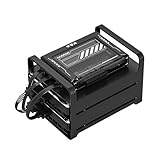
- 【DeskPi RackMate T1】It's made of aluminum alloy and acrylic frame mini chassis which you can setup your own cluster or home assistant server. For 10 inch 4U Server Cabinet (DeskPi RackMate T0), please refer to ASIN B0DPGZPTPP. For 10 inch 12U Server Cabinet (DeskPi RackMate T2), please refer to ASIN B0DT2XM22G.
- 【10-inch width】The cabinet has a width of 10 inches, which is a relatively small size that saves space while accommodating sufficient equipment. With dimensions of 11x7.8x16 inches, it is suitable for small offices, home environments, and large enterprises looking to save space.
- 【Open Design】The cabinet adopts an open design, allowing easy access to all devices inside. This design facilitates equipment installation and maintenance, aids in device cooling, and maintains optimal working conditions.
- 【8U Standard】The cabinet has a height of 8U, which is a standard unit size. With 1U equaling 1.75 inches, 8U implies a height of 14 inches.
- 【Translucent Design】Both sides are made of translucent acrylic, providing dust resistance and reduced weight. This design allows direct observation of the cabinet's interior, and users can add ambient lights for decoration.
The author also found that the local TrueNAS backup box had a dead NVMe drive. RAIDZ-2 and off-site backups remained intact, and the postmortem credits a tested disaster-recovery restore and backup MX with limiting data loss and providing a fallback. Those details describe that setup, not a guarantee that the same measures will produce the same recovery time elsewhere.
What can reduce the impact of a similar failure?
The useful question is not simply whether a lab has redundant servers. Map which components, services, and recovery tools still depend on the same network, power, resolver, or host.
- Map shared failure domains. Trace the path between hosts, storage, DNS, proxies, monitoring, and management access. Mark components whose loss would disable several of them at once.
- Keep a way to observe or reach the lab outside its main dependency. In the 2025 network account, the owner later placed a monitoring server on a closet switch separate from the main switch and added an emergency management NIC to the router. Those were that owner’s design choices; the general test is whether monitoring and access remain available when the primary path fails.
- Let services degrade when a backend is unavailable. Review startup behavior for dependencies such as DNS and proxy backends. The 2026 postmortem shows how waiting for unavailable names could prevent a proxy from starting at all.
- Make backups independent and test restoration. Copies on the same failed host are not a recovery path from that host’s outage. The 2026 account describes off-site backups and a tested restore; the 2022 owner also emphasized backups and practicing failover to a backup host.
- Plan for power outages longer than the estimate. Check whether the UPS can report status, what happens as runtime falls, and whether shutdown behavior has been tested. A UPS addresses power continuity, not a NIC or switch lockup.
- Rehearse recovery, including physical access. If remote management relies on the failed host or network, decide who can reach the equipment and what steps they can take without those services.
What the accounts do—and do not—establish
These reports demonstrate several ways a small number of shared dependencies can create broad outages: a NIC-related switch lockup, power loss after UPS runtime was exceeded, and a DNS dependency that caused a proxy to crash-loop. They do not establish what the title’s alleged $5 problem was, nor do they show how often any of these failures occur across homelabs. The network account attributes its repeated lockups to old NIC firmware and says an update resolved them; it does not recommend replacing the switch.
Quick Recap
Product prices and availability are accurate as of the date/time indicated and are subject to change. Any price and availability information displayed on Amazon at the time of purchase will apply.

