
Do these 3 things before closing this tab:
1Repair Windows errors before they cause bigger problems2Scan for outdated or missing drivers - takes under a minute3Clear out junk files and repair common Windows errorsiTechGuides is reader-supported. When you buy through links on our site, we may earn an affiliate commission. As an Amazon Associate I earn from qualifying purchases. Learn more
A good first telescope is one you can set up and use regularly. Start by comparing aperture, mount stability, portability, and the objects you want to see—not by chasing the highest magnification number. Binoculars can also be a useful first step, while a telescope offers more detailed views of selected targets.
1. What a telescope does
A telescope gathers light and brings it to focus so you can examine an image with your eye or a camera. It is not simply a zoom lens: what you see depends on the instrument’s aperture and optics, how steadily it is mounted, the target, and the observing conditions. A view through an eyepiece also will not look like a long-exposure space photograph.
2. Aperture: the specification to understand first
Aperture is the diameter of a telescope’s main lens or mirror. A larger aperture gathers more light and can reveal fainter objects and finer detail, all else being equal. It does not by itself make one telescope the best choice: size, optical quality, mount, and how often you will use it matter too. Astrophysicist Cheyenne Polius calls aperture the main specification to consider when choosing a telescope (Space.com).
Free tools Windows power users keep installed
One-click scans. No signup required.
More aperture usually means a larger instrument to carry, store, and set up. Judge the complete telescope and mount in the context of your routine rather than treating the biggest aperture as an automatic winner.
#1 Best Overall

- Superior Optics: 400mm(f/5.7) focal length and 70mm aperture, fully coated optics glass lens with high transmission coatings creates stunning images and protect your eyes. Perfect full positive telescope for astronomers to explore stars and moon.
- Magnification: Come with two replaceable eyepieces and one 3x Barlow lens.3x Barlow lens trebles the magnifying power of each eyepiece. 5x24 finder scope with mounting bracket and cross-hair lines inside make locating objects easily.
- Wireless Remote: This refractor telescope includes one smart phone adapter and one Wireless camera remote to explore the nature of the world easily through the screen and take amazing celestial images.
- Adjustable Tripod: This telescope allows for many different viewing positions with a adjustable aluminum alloy tripod and a carry bag, the telescope and tripod can fit inside the bag for easy traveling and storage.
- Satisfaction: Buy with confidence from a leading manufacturer.
3. Focal length and magnification
Focal length
A telescope’s focal length is an optical specification used to calculate magnification. A longer focal length is not a quality score; the right choice depends on the telescope’s design and the views you want.
Magnification
Calculate magnification by dividing the telescope’s focal length by the eyepiece’s focal length, using the same units. For example, a 1,000 mm telescope used with a 10 mm eyepiece gives 100× magnification. Higher magnification makes the image appear larger, but it also narrows the field of view and can make the image dimmer or less sharp. The optics and atmosphere limit how much magnification is useful.
4. Eyepieces: begin with what is included
Eyepieces of different focal lengths provide different magnifications and fields of view. Many telescopes come with one or two, which are enough to learn the instrument before deciding whether you need another. Check that any additional eyepiece is compatible with your telescope; a larger magnification is not automatically a better view.
The Tool Desk
Outbyte Driver Updater FREEFix the driver behind crashes, sound loss and screen glitchesFind Drivers →Outbyte PC Repair FREEClear out junk files and repair common Windows errorsFree Scan →Rank #2

- 【Excellent Optics】Astronomical telescope features 80mm aperture 600mm(f/6.7) focal length-The big aperture can capture more light; high transmission multi-fully coated optical lens can improve light transmittance, reduce the reflection of light. It will bring you more bright and clear images.
- 【Portable & Stable】Our refractor telescope has a backbag, an adjustable aluminum tripod and an upgraded phone adapter. All accessories can be packed into the bag, which is convenient for you to carry and storage for traveling. The tripod is stable and the height can adjust from 17.7" to 52", which is suitable for adults and kids. With the phone adapter, you can take amazing photos through your phone.
- 【Easy to Operate】 This telescope is easy to assemble even for astronomy beginners and kids. You can set up easily with the detail installation manual and video. No tools are required. It’s a great astronomy gift telescope for adults, astronomy enthusiasts, beginners and kids 8-12.
- 【Optimum Magnification】Our telescope for kids and adults is equipped with two replaceable excellent-quality eyepiecesa (20mm and 9mm) for 30X and 66X magnification. A moon filter transmits only 13 percent of the incoming light and improving contrast. Also with 5x24 finderscope, you can locate objects easily. A great option for astronomy lovers to explore the moon, Saturn and Jupiter.
- 【Satisfaction Service】We provide 3 years satisfaction service. If you have any questions about the product and service, please feel free to contact us to get 24-hour technical support from our expert team. Whether observing moon or viewing planets, our telescope can meet your all needs. It’s a great telescope for adults & 8-12 kids & astronomy beginners.
5. The three common telescope designs
Refractors use lenses, reflectors use mirrors, and catadioptric telescopes combine optical elements. Each design comes in instruments with different sizes, prices, and intended uses, so compare the specific telescope and its mount rather than assuming one category is best for every beginner.
| Design | Optical approach | What to weigh |
|---|---|---|
| Refractor | Lenses | Compare the instrument’s size, price, and intended use; the design label alone does not establish quality or suitability. |
| Reflector | Mirrors | Dobsonian telescopes are reflectors paired with a simple mount, a combination that can provide substantial aperture for the cost. |
| Catadioptric | Combined optical elements | Compare the specific instrument’s package, portability, and price; those vary by model. |
6. The mount: steady and easy to move
The mount holds the telescope, affects how smoothly you can aim it, and can determine whether the view stays steady. A shaky or awkward mount can make observing frustrating even when the optics are capable.
| Mount type | Movement and use | Trade-off |
|---|---|---|
| Alt-azimuth | Moves up and down and left and right. | Intuitive to point, especially for learning the sky. |
| Equatorial | One axis is aligned with Earth’s rotation. | Can make tracking an object easier after alignment, but setup requires that extra alignment. |
When comparing telescopes, assess the mount as part of the package. Smooth movement and stability are more useful than features you will not use.
Rank #3

- The children's telescope adopts a 70mm objective lens, 400mm focal length, and high transmittance fully coated glass optical element, which can produce clear and sharp images. It is very suitable for viewing celestial and terrestrial objects.
- The astronomical telescope is equipped with two interchangeable eyepieces (12.5mm and 20mm) for powerful eyepiece and magnification. Children can enjoy magnifications ranging from 20x to 32x. The 5x24 viewfinder with crosshairs makes it easy to locate targets.
- The telescope is equipped with a custom phone adapter that allows for free adjustment of the phone's camera focus, capturing stunning images and sharing them with friends.
- The beginner telescope adopts an adjustable aluminum alloy tripod, which can be freely adjusted from 12 inches to 38 inches to achieve different observation positions. Installation is very simple and does not require additional tools.
- The perfect gift for astronomy beginners and children. Put it at home to see the moon, or take this travel telescope on the road to see the scenery. Enjoy various family happy moments around this cool technology gift. And provide timely service to customers, answering any questions about telescopes.
7. Finders help you aim
A finder is a small aiming aid attached to the telescope. It helps point the main telescope toward a target that may be difficult to locate through the narrower main eyepiece. Learn how to align and use the finder before an observing session.
8. What can you see as a beginner?
The Moon, bright planets, star clusters, and double stars are approachable early targets. NASA notes that binoculars or a small telescope can add detail to skywatching, including views of Jupiter’s large moons and Saturn’s rings. What you can see depends on the instrument, target, and sky conditions—not just magnification. NASA’s skywatching resources can help you find objects to look for.
Expect many deep-sky objects to appear faint and subtle through an eyepiece rather than vivid like processed photographs. A larger aperture can make fainter targets accessible, but it does not remove the effects of light pollution or observing conditions.
Rank #4
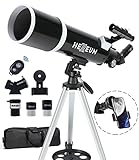
- Optimum Magnification: Our telescope for kids and adults is quipped with two replaceable excellent-quality eyepieces (25mm and 10mm) for 24X and 60X magnification. 3x Barlow lens trebles the magnifying power of each eyepiece. magnificate moon up to 72 or 180 times. Also with 5x24 finder scope makes locating objects easy.
- Excellent Quality Optics: This telescope is 600mm(f/6.7) focal length and 80mm aperture, 80mm aperture to capture more light picture and multi-fully high transmission coated all-optical lens enhance image brightness and clarity.
- Portable And Convenient: Comes with a phone adapter and an adjustable aluminum tripod. Wireless remote control and carrying bag make it easier for you portable and capture amazing images.
- Easy To Set Up: In order to save your time. Even for novices, no tools are required to set up the telescope. quick and easy to focus. Truly realize a no-tool-set telescope
- Satisfaction Quality: Lifetime maintenance. If you have any questions about the product and service, please feel free to contact us, we will do our best to help you in 24 hours. c
9. Your observing site matters
Urban and suburban light brightens the sky, washing out faint stars and making the Milky Way harder to see. A darker location can improve visibility of faint targets, while bright objects such as the Moon and planets remain practical from more places. A filter should not be treated as a way to turn a city sky into a dark one.
10. Binoculars can be a sensible first instrument
Binoculars are straightforward to use, portable, and versatile; they can also help you find targets later if you buy a telescope. They show a wider area of sky than many telescope-and-eyepiece combinations, though a telescope can provide more detailed views of selected objects. Higher-power binoculars are harder to hold steady, so ease of use matters as much as magnification. NASA explains the role of binoculars in astronomy skywatching.
11. Visual observing and astrophotography are different goals
A telescope that works well for looking through an eyepiece is not automatically suited to long-exposure astrophotography. Photographing faint objects brings camera, tracking, and workflow requirements that go beyond choosing visual aperture and magnification. Decide which activity matters most before choosing equipment.
Best Value
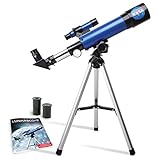
- INSPIRE CURIOSITY – The NASA Lunar Telescope allows your child to see the moon in incredible detail; the perfect gift for girls and boys interested in space, the moon, and astronomy!
- HIGH-QUALITY OPTICAL GLASS AND FINDER SCOPE – This easy-to-use telescope comes with a finder scope, low power, and high-power eyepieces; when used correctly, this combination will allow your child to easily locate the moon then zoom in for a close-up view.
- TABLETOP TRIPOD & SMOOTH MOUNT SYSTEM – Use the included tripod to steady your Lunar Telescope for optimal viewing, with a smooth mounting system that allows easy scanning of the entire lunar surface.
- PERFECT FOR BEGINNERS – This telescope is easy to assemble and use, making it ideal for young scientists and parents to enjoy together.
- AMAZON EXCLUSIVE - Blue Marble has developed this product exclusively for Amazon.
12. Choose for the way you will use it
Before buying, consider the entire observing routine: where you will store the telescope, how far you will carry it, how much setup you are comfortable with, and what you hope to observe. If possible, visit an astronomy-club event to see different instruments in use before choosing.
- Targets: Are you most interested in the Moon and planets, or in faint objects that benefit from darker skies and more aperture?
- Portability and storage: Can you move and store the complete telescope and mount conveniently?
- Setup: Do you want intuitive pointing, or are you comfortable aligning an equatorial mount?
- Budget: Compare the whole instrument and mount, not an aperture or magnification figure in isolation.
- Future use: Are you choosing for visual observing, or do you have separate photography requirements?
13. A practical first-session plan
- Set up the telescope and mount in daylight, following the manufacturer’s instructions. Learn the controls and how the finder is aligned without aiming at the Sun.
- Begin at night with a bright, easy target such as the Moon. Use a lower magnification eyepiece first to make locating and centering the target easier.
- Once you can aim steadily, try bright planets, a star cluster, or a double star that is visible from your location.
- Move to a darker site when you want to look for fainter objects, and give yourself time to learn the sky and operate the instrument.
14. Avoid common beginner missteps
- Buying by magnification alone: Magnification is calculated from focal lengths and is limited by optics and conditions.
- Ignoring the mount: A capable telescope is difficult to use if it wobbles or moves poorly.
- Assuming every design suits every routine: Consider the complete instrument, storage, setup, and intended targets.
- Expecting photographic color and detail: Eyepiece views of faint objects are generally subtler than long-exposure images.
- Overlooking sky brightness: More aperture cannot eliminate light pollution; darker locations help with faint targets.
15. Keep expectations grounded
A first telescope is a tool for learning the sky, not a guarantee of dramatic views of every object. The most satisfying choice is one that is steady, manageable, and suited to the targets you can realistically observe. Learn its finder and eyepieces, start with accessible objects, and let experience guide any later upgrade.
Quick Recap
Product prices and availability are accurate as of the date/time indicated and are subject to change. Any price and availability information displayed on Amazon at the time of purchase will apply.
Recommended Free Tools

