
iTechGuides is reader-supported. When you buy through links on our site, we may earn an affiliate commission. As an Amazon Associate I earn from qualifying purchases. Learn more
Concrete mixed with conductive carbon black has powered tiny laboratory supercapacitors, and researchers have proposed using the material to store renewable electricity in structures. But it is not yet a proven home battery: the building-scale figures are estimates, and a 2025 report describes a small prototype rather than an operating foundation or commercial product.
How can cement store electricity?
The idea is to use cement as a scaffold for a conductive network, not to turn ordinary concrete into a conventional battery. In the 2023 study, cement, water and carbon black form an electrode material. As cement hydrates, its pore structure helps organize the carbon into a connected network with extensive internal surface area. That surface provides sites for storing electrical charge.
A working supercapacitor also needs mobile ions supplied by an electrolyte. MIT’s explanation describes two electrodes separated by a thin gap or insulating layer and saturated with an electrolyte such as potassium chloride. The resulting device stores and releases charge; it is not simply a block of concrete that absorbs solar power on its own. The 2023 paper in Proceedings of the National Academy of Sciences describes the electrode material and its measured behavior.
What’s actually slowing this PC down?
Pick the symptom - the matching free tool is one click away.
How much energy can concrete store?
Chanut and colleagues estimated a maximum volumetric storage capacity of 20–220 Wh/m³ in the 2023 PNAS study, depending on the specific surface area of the carbon black. This is a research estimate for the material, not a field measurement from a building or utility installation.
#1 Best Overall

- This is a multi-functional learning kit,three power generation modes, energy conversion, circuit learning, and understanding of the conversion between sound, light and electricity.
- Solar power generation, using solar panels to convert the solar energy into electrical energy.
- Hand-cranked generator, kinetic energy is converted into electrical energy to light an LED or turn the fan
- The windmill generator,harness wind power and light an LED
- An excellent Family & Kids program,great for Primary and secondary schools projects,With Paper Instructions
MIT News used that work to illustrate what a household-scale system might require: about 45 m³ of concrete doped with high-surface-area carbon black for approximately 10 kWh, framed as roughly one average day’s household electricity use. That is a calculation based on the researchers’ estimate, not a tested residential foundation or a guarantee of a home’s actual daily consumption. MIT’s July 2023 account gives the example and explains the laboratory demonstration.
What has actually been demonstrated?
The 2023 laboratory cells
The first devices described by MIT were small cells, about 1 cm in diameter and 1 mm thick, with a voltage of about 1 V per cell. Researchers connected three cells to light a 3 V LED. This demonstrated basic energy storage and discharge at small scale; it did not demonstrate a building-scale energy system.
Rank #2
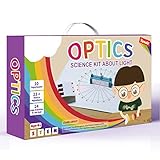
- Explore the Science of Light: Discover the fascinating world of optics with 15+ hands-on light experiments and learn how light travels, reflects, refracts, and forms images through real scientific exploration.
- Create Rainbows & Optical Effects: Use the included prism, lenses, mirrors, and transparent optical blocks to observe amazing optical phenomena such as rainbow formation, color mixing, and light refraction.
- Complete Optical Science Lab Kit: This STEM kit includes more than 25 experimental components, allowing kids to build their own mini physics laboratory and perform a wide variety of optics experiments at home or in school.
- Easy-to-Follow Experiment Guide: The 32-page full-color manual provides clear step-by-step instructions and explanations that help students understand key physics concepts while encouraging curiosity and scientific thinking.
- Perfect STEM Gift for Curious Kids: A fun and educational science kit designed for boys and girls ages 8-16, ideal for STEM learning, science projects, homeschooling, classroom demonstrations, birthdays, and holiday gifts.
The reported 2025 prototype
A 2025 PNAS search-result record reports a stacked-layer architectural prototype of about 0.003 m³, operating at 12 V and 304 Wh/m³. Those headline figures indicate further laboratory progress, but they do not establish a building installation, lifetime, structural performance or commercial readiness. The PNAS record is the available reference for that prototype.
Do these 3 things before closing this tab:
1Clear out junk files and repair common Windows errors2Fix the driver behind crashes, sound loss and screen glitches3Repair Windows errors before they cause bigger problemsCould a house foundation store solar energy?
It is a proposed possibility, not a demonstrated use. The researchers and MIT have discussed integrating the material into foundations, isolated shelters, roads or wind infrastructure. The 45 m³ household example is an extrapolation from estimated material capacity; the cited work does not show a house foundation storing and delivering power in everyday operation.
Rank #3

- 260+ Kid-Friendly Experiments, educational and pique kids’ natural curiosity with over 260 cool hands-on experiments, from chemistry erupting volcanoes, soap making to STEM Hand-operated Generator.
- Easy-to-Follow Instructions, include the “why” behind the science with an answer guide to explain the concepts at play when kids inevitably ask a million questions.
- Safe Quality Science Tools and Clearly-labeled Experiments Materials. Most children can to do the science experiment themselves or with a little help from a parent.
- Time to Splash, Play, and Learn! Supports and Encourages kids to test out new ideas that arise after doing the initial experiment.
- This is a great science kit allows children the opportunity to think and act like a scientist. They’ll tap into their creative side and practice important problem solving and critical-thinking skills, all while having fun.
Supercapacitors can be suited to rapid charge and discharge and frequent cycling, but the cited sources do not establish that this cement-based material can replace a household battery for sustained practical service. Nor do they establish installed cost, building-code approval, field maintenance needs or durability over a building’s service life.
Why adding more carbon is not a simple fix
More carbon black can increase storage capacity, but it can also reduce concrete strength. MIT reported around 10% carbon black as a potential balance for structural applications in the formulation context discussed in 2023. That is not a general construction recipe: an actual mix would need to meet both electrical and mechanical requirements for its intended structure.
Rank #4

- Brand New in box. The product ships with all relevant accessories
For a practical comparison with other storage technologies, capacity alone is not enough. A building system would also need verified charge and discharge performance, load-bearing behavior, installed-system cost, service life and maintenance data. The cited work does not provide comparable building-scale results across those measures.
What would make the technology ready for buildings?
A useful next step would be evidence from larger structures operating under realistic loads and environmental conditions. That would help establish whether the material can retain electrical performance while meeting structural requirements over time, and what it costs to install and maintain. The available reports describe promising material research and small prototypes, not an approved or commercially available structural energy-storage product.
Quick Recap
Best Value

- Description: This instrument is an experimental instrument for wind formation, used for scientific verification of wind formation experiments in elementary schools.
- Composition: The product only needs to be composed of glass cylinder, aluminum alloy bracket (candle holder), candle box, wind leaf, etc.
- How to use: Put the fan and frame at a certain position on the upper mouth of the air duct, place the lit candle under the air duct, and immediately observe that the fan gradually accelerate and rotate. This is the wind formed by the flow of air. The reason for pushing the to rotate.
- Material: 95 material glass + aluminum alloy
- Service: We attach great importance to customer experience, so you can us if you have any questions, and we will get back to you within 24 hours!
Product prices and availability are accurate as of the date/time indicated and are subject to change. Any price and availability information displayed on Amazon at the time of purchase will apply.

