
What’s actually slowing this PC down?
Pick the symptom - the matching free tool is one click away.
iTechGuides is reader-supported. When you buy through links on our site, we may earn an affiliate commission. As an Amazon Associate I earn from qualifying purchases. Learn more
Ataraxos, an AI system trained through self-play and equipped with search that reasons over possible hidden pieces, beat elite Stratego player Pim Niemeijer in a 20-game series: 15 wins, four draws and one loss. That is strong evidence that AI can play this unusually difficult hidden-information game at a very high level—but it is one match series, not proof that the system is unbeatable or that AI has solved every kind of strategic decision.
Why Stratego is difficult for AI
In Stratego, each player secretly arranges an army of pieces. Players can see where the opponent’s pieces are, but not what they are; identities are revealed when pieces fight. Capturing the opponent’s flag wins. A Stratego board game makes the basic rules and hidden setup easy to see, but the strategic challenge comes from what players cannot see.
The Ataraxos paper’s authors describe more than 1033 possible piece configurations. The AI cannot simply inspect the board and calculate the best move from a fully known position, as a chess program can. Nor can it practically enumerate all possible setups. It must infer what enemy pieces might be, decide how much confidence to place in those inferences, and account for how its own moves reveal information.
The Tool Desk
Outbyte PC Repair FREEClear out junk files and repair common Windows errorsFree Scan →Outbyte Driver Updater FREEScan for outdated or missing drivers - takes under a minuteDriver Scan →That uncertainty accumulates over a long game. A move may be valuable because it advances a piece, but it may also reveal that piece’s strength—or encourage the opponent to draw the wrong conclusion. In Ars Technica’s 2026 coverage, NYU researcher and co-author Eugene Vinitsky described Stratego as involving “a massive amount of hidden information that unfolds over a very long time scale.” Co-author Gabriele Farina told the publication that games can last 2,000 moves and that bluffing can change how credible a threat appears.
#1 Best Overall
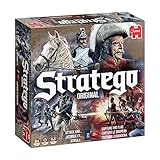
- Stratego is the strategic game where you challenge your opponents in the heat of battle
- Your task is to capture your opponent’s flag while defending your own
- Lead your men into battle, every move is crucial
- Includes 2 x 40 pre-printed playing pieces, Game board, Screen and 2 sorting trays for the pieces
- Suitable for 2 players, aged 8+
How Ataraxos learns and chooses moves
Ataraxos combines two processes: self-play reinforcement learning to develop strategies, and test-time search to assess possible moves immediately before playing them. Its neural networks use transformer architectures, and the system treats selecting an initial hidden army setup as distinct from choosing moves during the game.
Self-play builds the strategy
The setup-selection and move-selection systems train by playing games against versions of themselves. The authors describe adjusting regularization and update size as the policy improves: larger updates and stronger regularization are useful while the policy is weak, while smaller updates and weaker regularization are used as it becomes stronger. The aim is to keep learning stable rather than falling into cycles of strategic changes.
Rank #2
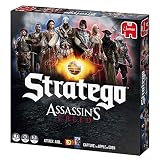
- Test your skill with Stratego, a classic game of battlefield strategy
- Let battle commence between Assassins and Templars in this ‘Stratego Assassins Creed’ special edition
- Attack and be the first to capture your opponent’s Apple of Eden Play three exciting variations of the game: Classic, Duel, and Special
- Includes 30 red playing pieces, 30 blue playing pieces, game board, screen, and sticker sheet
- Suitable for 2 players, aged 8+
A belief network supplies plausible hidden states
Before choosing a move, Ataraxos uses a belief network to estimate likely identities for unseen enemy pieces, based on the information revealed so far and the opponent’s observed play. It samples plausible hidden board states, explores candidate moves through depth-limited rollouts, and uses those results to adjust its policy for that turn. The method searches a selection of plausible possibilities rather than enumerating every possible army arrangement.
Recommended Free Tools
The search is a key part of the approach: the learned policy provides a strong starting point, while the rollouts let the system test moves against uncertainty at decision time. Farina called making this kind of test-time search work in Stratego “one of the things that we did figure out how to do,” in Ars Technica’s 2026 article.
Rank #3
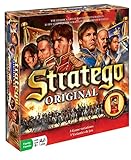
- The classic game of battlefield strategy!
- It's a light strategy game for two players
- Command your Army, devise plans using strategic attacks and clever deception!
- Be the first player to capture the other Army's flag to win!
- For ages 8 and up
What the reported matches show
The 20-game series against Pim Niemeijer
The authors report that Ataraxos played Niemeijer in July 2025 and finished with 15 wins, four draws and one loss. The paper describes Niemeijer as a four-time world champion, 15-time Dutch national champion and two-time online world champion, with more than 600 weeks ranked number one, as of its 2025 account. Counting each draw as half a win, the authors calculate an 85% effective win rate.
There is an important qualification to that result: Niemeijer was told that Ataraxos would not adapt to his play, giving him an opportunity to look for weaknesses without the system changing its strategy in response. The authors also caution that game outcomes are not independent and identically distributed, because play and adaptation change over a series. Their reported p-value below 0.00026 applies only if an independent-and-identically-distributed assumption is made; it should not be read as an assumption-free measure of statistical significance.
Rank #4

- Strategy Board Game
- Players: 2
- Age: 8 and up
A separate championship demonstration
At the 2025 Stratego World Championship, the authors report a separate demonstration in which Ataraxos recorded 38 wins, two losses and no draws in 40 games against attendees. This is a different event and opponent pool from the Niemeijer series, so it should not be combined with the 20-game result as though it were one continuous controlled evaluation.
Quick wins for a faster PC:
Clear out junk files and repair common Windows errorsFree Scan →Fix the driver behind crashes, sound loss and screen glitchesFind Drivers →Repair Windows errors before they cause bigger problemsFix Now →How Ataraxos compares with DeepNash
DeepNash was an earlier AI system for Stratego. The Ataraxos authors present their result as superhuman performance at substantially lower compute cost than earlier efforts. The figures below come from different kinds of reporting, not a controlled comparison using identical hardware or an identical training protocol.
Best Value

- Brand New in box. The product ships with all relevant accessories
- Includes gameboard, armies with 4 Infantry, 12 Cavalry, and 8 Artillery each, deck of 56 Risk cards, 1 card box, 5 dice, 5 cardboard war crates, and game guide.
- PLAY USING ALEXA SKILL: Players have the option of playing this Risk game using Alexa. (Alexa device sold separately. ) Note: sound comes from paired Echo device.
- DRAGON TOKEN: This Risk game includes a dragon token. Players must destroy the dragon before it destroys their troops. A lucky roll can subdue the dragon and get it out of a player's territory
| System | Stratego performance reported | Compute or cost described | Handling hidden information |
|---|---|---|---|
| Ataraxos | 15 wins, four draws and one loss in the authors’ 20-game July 2025 series against Pim Niemeijer; a separate 2025 championship demonstration recorded 38 wins, two losses and no draws against attendees. | The authors describe training as costing “a few thousand dollars.” Their final setup and move network training run used 16 Nvidia H100 GPUs for one week; belief-network training then used four H100s for four days. The paper reports a search averaging about 1.26 seconds per move for its 40-ply, 1,000-rollout evaluation setup. | Uses a belief network to sample plausible hidden states, then runs depth-limited search over candidate moves. |
| DeepNash | The Ataraxos paper’s comparison is described as a performance and compute comparison; a comparable match result is not stated in the reporting summarized here. | Ars Technica reports the Ataraxos team’s estimate that DeepNash’s two-to-three-month run on 1,024 Google specialized chips would cost $3 million to $4.5 million at 2025 prices. This is the team’s estimate, not a measured bill. | A directly comparable description of DeepNash’s search method is not stated in the reporting summarized here. |
The contrast is striking, but the costs should not be treated as a hardware-normalized benchmark: one figure is the Ataraxos authors’ approximate training-cost description, while the DeepNash amount is the team’s estimate reported by Ars Technica. Likewise, the H100 counts and DeepNash chip count describe different systems and runs, not directly interchangeable measures of compute.
Independent reader supportYour contribution helps us test, update, and keep practical guides available for everyone.What the results do—and do not—establish
The evidence supports a specific conclusion: self-play plus search over sampled hidden states can produce a strong Stratego player, and Ataraxos performed exceptionally in the match series and demonstration the authors report. It does not establish an unconditional win rate against every opponent, a guarantee of victory, or that the match series represents all competitive play. As Farina put it in Ars Technica’s 2026 coverage, “Even a perfect strategy, sometimes it will just lose.”
The paper also reports applying related techniques to Barrage Stratego, Hanabi and dou dizhu, describing results as superhuman for Barrage Stratego and state of the art for Hanabi and dou dizhu. The authors argue that the methods could be useful for other strategic problems when fast, accurate simulators are available. Those game results are research findings, not evidence that Ataraxos is ready for real-world military planning, negotiations or financial decisions.
Interpretability remains a limitation. The Ars Technica article reports that Ataraxos cannot explain why it chooses particular moves. Farina said, “We work on machines that produce strong but also interpretable and explainable strategies. I think we’re not quite there yet.” A system may make strong decisions without providing a clear human-readable account of the reasoning behind each one.
Quick Recap
Product prices and availability are accurate as of the date/time indicated and are subject to change. Any price and availability information displayed on Amazon at the time of purchase will apply.

