
iTechGuides is reader-supported. When you buy through links on our site, we may earn an affiliate commission. As an Amazon Associate I earn from qualifying purchases. Learn more
You don’t need to stop building portfolio projects. You should stop building them only to look impressive. A small tool that solves a real annoyance can teach you to handle feedback, failures, and maintenance—and it can still become a strong portfolio example. The headline’s claim that portfolio projects make developers worse is provocative, not a proven universal finding.
Should you keep building portfolio projects?
Keep building when a project helps you learn, demonstrates a skill you need to show, or solves a problem for someone. But if you are making another polished demo app with no intended user and no reason to operate it, consider changing the goal. A screenshot can show what you built; a project used to do a real task can also reveal what confused someone, what failed, and what you had to fix.

Mika Flowers makes this distinction in her article: “Portfolio projects optimize for looking impressive. Real projects optimize for being useful.” That is a useful design principle, not a research finding that demo projects harm developers. The sources reviewed do not establish that portfolio projects make developers worse, or that projects with external users teach everyone more.
Free tools Windows power users keep installed
One-click scans. No signup required.
What useful project work can add
A project made for an actual need creates opportunities to practice the less photogenic parts of development: reproducing a bug, tracing its root cause, making a focused change, controlling scope, and keeping commits understandable. Flowers recommends these habits as practical benefits of useful work; they are not quantified effects.
#1 Best Overall

- Confidently track and manage large jobs with ease
- Project ruling provides instant organization for notes, plans & deadlines
- Premium-weight paper is perforated to detach easily
- Snag-resistant coil and extra-strong back are perfect for notes on the go
- Gray, navy or maroon cover, 7-1/4" x 9-1/2", 84 sheets
Research on authentic project work offers limited, context-dependent support. A 2010 study of an open-source development environment in a graduate software engineering course found that the environment could motivate engagement with real-world projects. It also found that learners’ expectations, goals, beliefs, and characteristics interacted with the project context and shaped motivation, collaboration, commitment, and responses to coaching and feedback. The study does not compare self-directed portfolio projects with projects used by real customers. Read the study.
A 2022 study set out to evaluate real-world software projects with industry engagement, using a two-group, post-test quasi-experimental design. Its available abstract describes the aim and method, but not results, so it does not establish a learning benefit. Read the abstract.
Rank #2
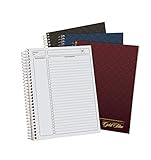
- 9-1/2 x 7-1/4
- Assorted Covers in Navy, Gray, Maroon
- Planner Ruled
- Designer Gold Fibre Series Planner Notebook. 84 Pages.
- INCLUDES 3 NOTEBOOKS: Each pack includes 3 notebooks that can be any combination of the three colors we offer: Navy, Gray, or Maroon; Your order may include 3 of the same color
How to choose and build a project people can use
- Notice a repeated annoyance. Look for a task you repeat, a workaround you dislike, or a small source of friction. It need not be a startup idea; a personal tool is a legitimate starting point.
- Name the user and task. At first, the user may be you. State what that person is trying to do and what a successful result looks like.
- Build the smallest useful version. Implement only what is needed to complete that task. Avoid adding accounts, settings, integrations, or infrastructure unless the task requires them.
- Put it into use. Use it yourself or, where practical, let another person try it. Watch for failure, confusion, unexpected input, and steps that are harder than you expected.
- Fix causes, not just symptoms. Reproduce a problem, identify its root cause, and make a small, targeted change. Keep the scope and commits clear enough that you can explain what changed and why.
- Earn additional complexity. Add generality, architecture, or scale when usage exposes a need for it—not because a hypothetical future version might need it. Flowers puts the principle this way: “Ship the small, useful version first, and let advanced architecture be earned by a real need — not anticipated in advance.”
Useful project versus demo-only project
These are not mutually exclusive categories: a useful tool can also demonstrate your skills. The distinction is what drives your decisions. A demo may be the right choice when the goal is to practice a framework or show a specific technique; a project intended for use should be shaped by the task and the experience of using it.
| Question | Demo-first project | Need-first project |
|---|---|---|
| What starts it? | A prompt, feature idea, or desired showcase | A concrete annoyance or workflow problem |
| What counts as success? | A working feature set and clear presentation | A user completing the task the project was built to solve |
| What informs changes? | The intended demonstration and your learning goals | Observed use, failures, confusion, and maintenance needs |
| When should complexity grow? | When it supports the intended demonstration or learning goal | When actual requirements justify it |
How to present a useful project in your portfolio
You do not need a public user count to show competence. A project can give you a concrete story about how you defined scope, handled constraints, debugged a problem, and changed your approach after feedback. That is a reasoned recommendation, not evidence that employers universally prefer deployed projects over polished demos; the sources here do not compare hiring outcomes.
Rank #3

- TURN YOUR IDEAS INTO REALITY: Unleash your creativity with this unique planning notebook, consisting of 224 pages divided into 112 Project Planner sheets. Each sheet is designed to step-by-step completion and management of your project.
- EMPOWER YOUR MANAGEMENT: This professional project organizer keeps all project-related information in one place. Stay on top of multiple projects with the convenient project tracker notebook feature, ensuring no detail is missed.
- ARCHIVE YOUR PROJECT GOALS: Stay focused on your projects with dedicated sections for objectives, tasks with deadline, essential supplies and tools notes, space for ideas and sketches illustration, and notes. Experience a simple yet powerful tool to ensure completion and accomplish more with ease.
- EFFICIENT BONUS STATIONARIES: You will receive either set of a ball pen and two cute sticky notes or a set of remind stick pads (randomly). The versatile design can be used for projects at home, work, school, or business to organize, manage a team, and to delegate tasks. This planner is a simple way to make sure you finish what you start and accomplish more.
- HANDLE SINGLE PROJECT IN HAND: Designed with tearable sheets allow you taking any single sheet for more convenient. 7x10 inch sheets are printed on 70 lb premium paper. With advanced printing technology and leather cover, our planner exudes a premium feel and long lasting.
- Explain who had the problem and what task the project supports.
- Describe the smallest version you shipped and the constraints that shaped it.
- Give one specific example of something that failed or confused a user, and how you investigated it.
- Show what you changed and why you did not add other features or architecture.
- If the project was only for learning or demonstration, say so plainly and describe what it was designed to demonstrate.
A 2010 Google onboarding case study, based on interviews with 24 stakeholders alongside observations and document analysis, describes practice-based learning and collaboration at one company. It can illustrate workplace learning, but it does not establish what hiring managers prefer in candidate portfolios. Read the case study.
Independent reader supportYour contribution helps us test, update, and keep practical guides available for everyone.When a portfolio project is still the right choice
A project does not need an external user to be worthwhile. Build a focused demo if you need to practice a technology, illustrate a particular capability, or work through a clearly bounded learning goal. The useful correction is not “never build portfolio projects”; it is to avoid confusing visual polish with evidence that you can respond to requirements. Where possible, give the project a real task, use it, and let what happens guide the next change.
Quick Recap
Best Value
Rank #4

- Sold Individually as 3 Each
- Numbered spaces with heading and action columns
- Microperforation, 84 White Sheets
- Sheet Size: 9-1/2"x7-1/4"
- Dark Green Cover
Product prices and availability are accurate as of the date/time indicated and are subject to change. Any price and availability information displayed on Amazon at the time of purchase will apply.
The Tool Desk
Outbyte PC Repair FREEClear out junk files and repair common Windows errorsFree Scan →Outbyte Driver Updater FREEScan for outdated or missing drivers - takes under a minuteDriver Scan →
