
iTechGuides is reader-supported. When you buy through links on our site, we may earn an affiliate commission. As an Amazon Associate I earn from qualifying purchases. Learn more
Some SSDs use capacitors for power-loss protection (PLP): when external power drops, the capacitors briefly keep the drive running so its controller can complete specified data-flushing and internal update tasks. This is a feature of particular designs, not a guarantee found in every SSD, and it does not promise to save every piece of data during every outage.
What capacitors do in an SSD
In a PLP-equipped SSD, capacitors charge while the drive has power. If the drive detects that its input voltage has fallen, stored energy can provide a short hold-up interval. During that time, the controller and firmware can carry out the work the drive is designed to protect, such as flushing relevant data from volatile DRAM to NAND flash.
DRAM can act as a cache, but it loses its contents when power is removed. Samsung explains that an abrupt outage can interrupt the normal process of moving cached data and updating drive information; depending on what was in progress, that interruption can cause data compatibility problems or even prevent the drive from being detected. Its application note describes PLP as using dedicated capacitors to create more time for flushing data during sudden power loss: Samsung Semiconductor’s explanation of PLP.
The capacitors are one part of a protection system, not a standalone fix. Voltage detection, controller behavior, firmware, and the drive’s design all affect what happens when power fails. Dell’s enterprise SSD FAQ likewise describes power-failure protection as involving detection, controller action, and onboard hold-up circuitry: Dell’s enterprise SSD FAQ.
#1 Best Overall

- 3D NAND flash are applied to deliver high transfer speeds
- Remarkable transfer speeds that enable faster bootup and improved overall system performance. The advanced SLC Cache Technology allows performance boost and longer lifespan
- 7mm slim design suitable for Ultrabooks and Ultra-slim notebooks.
- 3-year limited warranty. (Please register your product via SP official website to get the complete manufacturer warranty services, product support and more.)
What power-loss protection can—and cannot—protect
PLP gives a drive time to complete specified internal operations after power disappears. What is covered depends on the exact SSD: one manufacturer may describe protection for cached data, another may emphasize metadata or particular in-flight writes, and the implementation may combine hardware hold-up with firmware recovery behavior.
Do not read “power-loss protection” as a promise that every write acknowledged by the operating system, every item in a buffer, or all data on the drive will survive any failure. The outcome depends on the model and the failure conditions. A capacitor bank alone does not establish the drive’s protection scope.
Rank #2
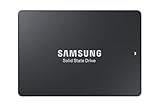
- HIGH-PERFORMANCE BUSINESS SOLUTION: With Samsung proprietary 3-bit MLC V-NAND, the 883 DCT delivers optimized performance for data center demands with end-to-end data protection to help ensure consistency over the entire data transfer path
- SEQUENTIAL READ WRITE SPEEDS: Sequential read/write speeds of up to 560/520MB/s, respectively, and random read/write speeds of up to 98K/28K IOPS are ideal for handling massive amounts of data
- POWER-LOSS PROTECTION: Protect data integrity from unexpected power loss with Samsung's advanced power-loss protection architecture
- SAMSUNG DATA CENTER TECHNOLOGY: Reliable SATA interface solid state drive with the endurance to handle heavy workloads for servers
- DATA SECURITY: Secure data without performance degradation thanks to AES 256-bit encryption
Capacitor-backed PLP versus stopping new writes
Power-failure features do not all work the same way. Transcend documents two different approaches in its products:
Do these 3 things before closing this tab:
1Fix the driver behind crashes, sound loss and screen glitches2Repair Windows errors before they cause bigger problems3Scan for outdated or missing drivers - takes under a minute| Approach | What the documented feature does | What it does not establish |
|---|---|---|
| Capacitor-backed PLP | Transcend says charged capacitors extend the time available to flush DRAM data to NAND. See Transcend’s PLP description. | It does not mean every SSD protects all data in every outage. |
| Power Shield | Transcend says voltage detection can stop the controller from accepting new write commands. | Transcend says this approach does not provide extra buffer time for NAND to finish a write. See Transcend’s Power Shield description. |
These are Transcend’s product-specific descriptions, not universal industry definitions. Check the manufacturer’s explanation for the exact feature and model rather than inferring its behavior from a label alone.
Rank #3

- 3D NAND flash are applied to deliver high transfer speeds
- Remarkable transfer speeds that enable faster bootup and improved overall system performance. The advanced SLC Cache Technology allows performance boost and longer lifespan
- 7mm slim design suitable for Ultrabooks and Ultra-slim notebooks.
- 3-year limited warranty. (Please register your product via SP official website to get the complete manufacturer warranty services, product support and more.)
Do all SSDs have PLP capacitors?
No. The documented examples establish capacitor-backed PLP in particular enterprise SSD designs, not a standard feature across SSDs. Samsung’s enterprise SSD white paper describes backup-power circuitry using tantalum capacitors, while Dell discusses hold-up circuitry in enterprise SSDs. Those examples do not show that every enterprise drive—or consumer SSD—has the same protection:
Capacitors can also serve other electrical roles in electronics; their presence alone does not prove that an SSD has PLP. Look for explicit documentation of power-loss protection and what it covers.
Rank #4
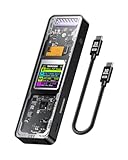
- Support SSD Life Prediction and Identify the Authenticity of Information to Avoid Buying Inferior Disks: DOCKCASE - The first smart SSD enclosure with an HD display screen, can complete the intelligent detection of SSD when the Smart SSD Enclosure is powered on. DOCKCASE can timely detect and display the SSD health status after power-on, disk life, disk power-on times, and remaining capacity at a glance. Safer data, more assured work
- Support Hot Swap, Can Provide 10s PLP Prevent Writing Data Loss: The Power Loss Protection of DOCKCASE Smart SSD Enclosure provides around 10 seconds of writing time after power failure (the actual time will be affected by the working state and power consumption of the SSD), no data loss, no disk damage
- Power Shortage Reminder: The newly added Power Shortage Reminder lets you grasp the current power supply situation. If the power is lower than 15W, there will be a yellow auxiliary power supply prompt in the upper left corner. It will turn blue after connecting to the auxiliary power supply Type-C port
- Support 10 Gbps HIGH SPEED: DOCKCASE M.2 NVMe SSD external case adopts Realtek RTL9210 control chip and latest USB 3.1 Gen 2 Type-C interface. Support UASP acceleration protocol and support theoretical data transmission speed of up to 10Gbps. When using high-performance NVMe media, the read/write performance can exceed 900 Mbytes/sec. It includes USB-C to USB-C cables and works with USB-C hosts
- Support Dual Heat Dissipation: In addition to supporting NVME, DOCKCASE RTL9210 control chip is equipped with temperature control with can be up to 10 degrees lower than other chips, reducing heat generation from the source. The first cover with the graphite thermal pad increased the heat dissipation area and blew away the heat timely enabling your SSD to maintain high transfer speeds and extend its longevity
How to check an SSD’s power-failure protection
- Find the exact model’s official specifications or product documentation. Do not infer PLP from an SSD’s form factor, interface, or enterprise branding.
- Look for explicit hardware details. Check whether the manufacturer specifies PLP, capacitor-backed hold-up power, or another power-failure feature.
- Read the stated protection scope. Determine whether the claim covers cached user data, in-flight writes, metadata, or only a narrower operation.
- Check whether the description includes firmware behavior. Hardware hold-up power and recovery behavior work together; a capacitor feature alone does not spell out the full result.
- Compare documentation for the particular workload and model. Do not assume two drives with similar marketing labels provide equivalent protection.
A UPS can reduce the chance that a computer loses power abruptly, but it is system-level backup power, not evidence that an SSD itself has PLP. It may complement drive-level protection; it does not substitute for checking the drive’s documented features.
Crashes, No Sound, or Screen Glitches?
Random freezes, missing sound and display glitches usually trace back to one bad driver. Find and replace yours safely.Free scan · under a minuteWindows Errors? Fix Them Before They Spread
Repair common Windows errors and clear accumulated junk for a smoother, more stable PC - no reinstall needed.Free scan · no reinstallQuick Recap
Best Value

- Support SSD health check and avoid inferior disks: DOCKCASE, the first smart SSD enclosure with HD screen – detects SSD status on power-on, showing health, lifespan, power cycles, and remaining capacity. Smarter protection, safer data, and worry-free work
- Support Hot Swap, Can Provide 10S PLP Prevent Writing Data Loss: The Power Loss Protection of DOCKCASE Smart SSD Enclosure provides around 10 seconds of writing time after power failure (the actual time will be affected by the working state and power consumption of the SSD), no data loss, no disk damage
- Support 10 Gbps HIGH SPEED: DOCKCASE M.2 NVMe SSD external case adopts Realtek RTL9210 control chip and latest USB 3.1 Gen 2 Type-C interface. Support UASP acceleration protocol and support theoretical data transmission speed of up to 10Gbps. When using high-performance NVMe media, the read/write performance can exceed 900 Mbytes/sec
- Support Dual Heat Dissipation: DOCKCASE with RTL9210 chip features smart temperature control, running up to 10°C cooler than others. A graphite thermal pad on the top cover expands the heat dissipation area, keeping SSD speeds stable and extending lifespan
- Compatibility: DOCKCASE M.2 to USB enclosure fits NVMe PCIe size 2230/2242/2260/2280,support M-Key and B+M Key UASP, Up to 4TB SSD
Product prices and availability are accurate as of the date/time indicated and are subject to change. Any price and availability information displayed on Amazon at the time of purchase will apply.

