
Windows Errors? Fix Them Before They Spread
Repair common Windows errors and clear accumulated junk for a smoother, more stable PC - no reinstall needed.Free scan · no reinstallOutdated Drivers Are Slowing You Down
One free scan finds every outdated or missing driver and matches the right update for your exact hardware.Free scan · exact hardware matchiTechGuides is reader-supported. When you buy through links on our site, we may earn an affiliate commission. As an Amazon Associate I earn from qualifying purchases. Learn more
800 VDC changes how electricity may be distributed through high-density AI data centers; it does not cool servers. The proposed architecture could reduce current and simplify power conversion as rack demand rises. Liquid cooling addresses the separate job of carrying heat away from processors and other components. As AI racks become denser, operators may need to rethink both systems—but one does not replace the other.
What is 800 VDC, and how would it power an AI data center?
800 VDC means distributing electrical power at 800 volts of direct current. In many existing data centers, utility medium-voltage alternating current (AC) is stepped down, then distributed as low-voltage AC through uninterruptible power supply (UPS) and power-distribution equipment. Power is converted to DC inside or near server racks for use by computing components.

The proposed 800 VDC design moves more of that conversion upstream. Medium-voltage AC would be converted to 800 VDC at the facility, then carried through the data hall toward racks. In NVIDIA’s Kyber example, a high-ratio 64:1 LLC converter steps rack voltage down to 12 VDC close to the GPU. This is a proposed architecture, not a description of every current data center or a universal installed standard.
Free tools Windows power users keep installed
One-click scans. No signup required.
The electrical rationale is straightforward: for a given power level, raising voltage allows current to fall. Lower current can reduce the amount of conductor material needed and ease distribution challenges for high-density racks. NVIDIA and the Open Compute Project (OCP) also describe fewer conversion stages as a potential advantage compared with existing 54 VDC rack and 480 VAC facility approaches. Those are architecture benefits and supplier or consortium claims; the sources cited here do not establish universal, realized savings across deployed facilities.
NVIDIA says its single-stage Kyber conversion approach occupies 26% less area than traditional multistage approaches. That is NVIDIA’s design comparison, not an independently measured reduction in total facility area or energy use.
How could a data center move to 800 VDC?
OCP describes two broad deployment paths. The right choice depends on the building’s existing electrical capacity and layout, as well as the disruption and safety work an operator can accommodate.
Rank #2

- Data Center Coolant
- 25% Inhibited Propylene Glycol
- JeffCool ISF 25
- High thermal conductivity
| Approach | How it works | When it may fit | Key considerations |
|---|---|---|---|
| Side power rack | Converts existing 480 VAC locally to ±400 VDC or 0–800 VDC beside the compute racks. | A facility with adequate upstream AC capacity and available row space; OCP presents it as a potentially faster route that can avoid upstream electrical changes. | Space for the additional rack, conversion and protection equipment, compatibility with existing distribution, and safe integration with the data hall. |
| Direct medium-voltage AC-to-DC conversion | Uses transformer rectifiers or solid-state transformer skids to supply 800 VDC to the data hall. | A new build or a substantial redesign where the electrical system can be planned around DC distribution. | Upstream design changes, protection and certification readiness, integration with storage, and deployment schedule. |
These approaches are not mutually exclusive across an entire site. OCP says DC distribution can coexist with existing AC, allowing phased adoption. An operator evaluating either path should check facility capacity, row space, the scope of installation disruption, conversion and protection requirements, safety and certification readiness, storage integration, and schedule. The available information does not establish one path as suitable for every facility.
Do these 3 things before closing this tab:
1Repair Windows errors before they cause bigger problems2Fix the driver behind crashes, sound loss and screen glitches3Clear out junk files and repair common Windows errorsDoes 800 VDC mean data centers need liquid cooling?
No. 800 VDC is a power-delivery architecture; liquid cooling is a heat-removal method. A higher distribution voltage does not lower a GPU’s heat output or carry heat out of a server. More powerful components and denser racks increase the cooling challenge independently of how electricity reaches them.
Rank #3

- Mayhems thermal performance focused premixed PC coolant for water cooling computer systems and loops.
- Mayhems longest operational lifetime coolant with great levels of thermal performance
- Prolongs the life and thermal cooling efficiency of your liquid cooling computer components
- Specially formulated to protect your liquid cooling computer components from corrosion and scale build up.
- Colour: Infinite Void Black
McKinsey’s 2025 report says conventional air-cooling systems struggle to remove heat efficiently above 50 kW per rack. That is the report’s stated threshold, not a universal cutoff for every room, rack design, or cooling system. Operators may combine air and liquid methods or choose among different liquid approaches according to rack load and site constraints.
| Cooling approach | How it removes heat | Practical factors to assess |
|---|---|---|
| Rear-door heat exchanger | A heat exchanger at the rear of a rack transfers heat from the exhaust air to a liquid loop. | How much rack heat it can handle, fit with existing air-cooling infrastructure, service access, and the facility’s ability to reject heat. |
| Direct-to-chip | Cold plates sit against heat-producing components. Coolant circulates through a loop connected to a coolant distribution unit (CDU). | Component and rack compatibility, serviceability, facility modifications, and provision for the CDU, manifolds, piping, connectors, sensors, and controls. |
| Immersion | Computing equipment is immersed in a liquid designed to remove heat from the hardware. | Equipment and fluid compatibility, maintenance procedures, changes to deployment and service workflows, and heat-rejection requirements. |
Direct-to-chip systems can be deployed incrementally, according to McKinsey. Their loop is more than a cold plate: the CDU manages coolant delivery, while manifolds, piping or quick connects, and sensors and controls help distribute and monitor it. The facility still needs a way to reject the captured heat. Selecting a method therefore means considering rack heat load, maintenance access, existing air-cooling compatibility, site modifications, and downstream heat rejection together.
Rank #4

- Efficient CPU Temperature Management: Our water cooling reservoir effectively reduces heat to maintain optimal operating temperatures for your computer ensuring stable performance during intensive tasks
- Quiet Operates for Focusing: Engineered with noise reduction technology this system works quietly to provide a peaceful environment without disturbing your work or study sessions
- Durable And Transparent Build: Constructed from premium POM and PMMA materials this 110 x 50mm cylinder is shock-resisting for long-lasting use and features a clear design for easy coolant monitoring
- Full Open And Secure Design: The reservoir features a fully open structure that allows for easy filling and maintenance and includes plastic brackets and L-type metal stands for a secure and stable installation in your case
- Complete Installation Kit: You will receive 1pc cylinder water reservoir 2 plastic brackets 2 L-type metal stands and a screws kit for a straightforward and reliable installation
What safety and readiness issues matter for 800 VDC?
800 VDC is a high-voltage system, so its deployment requires more than choosing a converter. Texas Instruments’ application note discusses voltage sensing, protection, and safety isolation, along with components such as solid-state relays, hot swaps, battery monitors, isolated gate drivers, and current and voltage sensors. These are examples of design needs and component categories, not a complete facility specification.
OCP says it is working with UL Solutions, NFPA, IEEE, and IEC on safety certification and regulatory frameworks. The sources here do not document a finalized global certification regime. Operators and equipment suppliers must account for applicable local requirements and interoperability rather than assume that a common voltage alone guarantees compatible or certified equipment.
Best Value
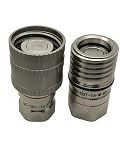
- Body Material: Stainless Steel 304 Valve Style: Flat Face Dry Break Connection Style: Thread-to-Connect Nominal Flow: 20 mm Seal Material: EPDM Application: Liquid Cooling Suitable Fluids: Water, Water/Glycol Coolants
OCP reports that Google, Microsoft, and NVIDIA are working through the consortium to align requirements, and that more than 80 partners are developing 800 VDC-compatible infrastructure. That figure describes OCP’s ecosystem activity; it does not mean all those products are commercially available or deployed at scale. NVIDIA vice president of data center infrastructure Vladimir Troy called 800 VDC “a foundational architecture for scaling AI factories.” Google Vice President of Data Center Technology and Systems Tom Garvens said, “Common 800 VDC interfaces can help the industry scale AI infrastructure while protecting the flexibility operators need in real deployments.” Both are industry participants describing the promise of the approach, not independent validation of its results.
NVIDIA describes a phased transition, but the sources do not establish a verified industry-wide adoption date. The practical question for a site is whether its equipment, safety design, facility electrical system, and deployment plan are ready for the specific implementation being considered.
What the forecasts say about liquid cooling
McKinsey’s 2025 report estimates liquid-cooling market spending at $2 billion to $3 billion in 2025 and projects $15 billion to $17 billion in 2030, with annual growth of 45% to 50%. It also projects direct-to-chip cooling will represent 30% of the cooling market by 2030. These are McKinsey estimates and forecasts, not audited future outcomes or guarantees of adoption at a particular facility.
The Tool Desk
Outbyte PC Repair FREERepair Windows errors before they cause bigger problemsFix Now →Outbyte Driver Updater FREEFix the driver behind crashes, sound loss and screen glitchesFind Drivers →The larger point is that electrical distribution and thermal management are parallel design problems. Higher-voltage DC may change how power is converted and delivered; rack-level heat still has to be captured, moved, and rejected by a cooling system matched to the equipment and building.
Quick Recap
Product prices and availability are accurate as of the date/time indicated and are subject to change. Any price and availability information displayed on Amazon at the time of purchase will apply.

