
iTechGuides is reader-supported. When you buy through links on our site, we may earn an affiliate commission. As an Amazon Associate I earn from qualifying purchases. Learn more
Spectrum Instrumentation’s DN6.33x digitizerNETBOX family brings four to 12 synchronized acquisition channels, 12-bit ADCs, 3.2–10 GS/s sampling, and 1–3 GHz analog bandwidth to a remotely controlled Gigabit Ethernet instrument. The crucial qualification is that the fastest rate is available on only some channels: the 12-channel DN6.335-12 reaches 10 GS/s on six channels, or 5 GS/s on all 12.
Spectrum announced the family in September 2025; All About Circuits covered it on October 14, 2025. The instruments target aerospace and defense, communications and RF research, semiconductor testing, scientific experiments, and automated test systems.
What Spectrum launched
The DN6.33x is a family of remote Ethernet digitizers in Spectrum’s digitizerNETBOX format. Instead of a front-panel oscilloscope workflow or a plug-in PCIe card, the acquisition hardware can sit near the signal source and be controlled over a network. The launch added 15 variants and expanded Spectrum’s digitizerNETBOX range to 94 variants, according to the company’s announcement.
Quick wins for a faster PC:
Fix the driver behind crashes, sound loss and screen glitchesFind Drivers →Clear out junk files and repair common Windows errorsFree Scan →Scan for outdated or missing drivers - takes under a minuteDriver Scan →Its intended applications include synchronized multi-channel RF measurements, aerospace and defense research, communications experiments, semiconductor validation, scientific instrumentation, and automated test. Spectrum’s launch description is available in its announcement, while the family overview is on the product page.
#1 Best Overall

- 【Key Specs】70 MHz digital oscilloscope with 4 analog channels, 1.25 GSa/s sampling, 12-bit vertical resolution and up to 25 Mpts memory depth—helps correlate multiple rails and timing signals with fine vertical detail.
- 【UltraAcquire & Search】UltraAcquire up to 1,000,000 wfms/s; 256-level intensity grading plus waveform search/navigation helps find intermittent glitches and review anomalies quickly using event/time/frame navigation.
- 【FFT & Decode】Peak detect captures glitches down to 1.6 ns; math includes FFT up to 1 Mpts, filters, and 41 automatic measurements. Standard serial trigger/decode supports CAN, RS232/UART, I2C, SPI and 4-bit parallel decode using analog channels.
- 【Connectivity & SCPI】LAN supports LXI‑C, browser Web Control and standard SCPI commands. USB Host/Device and HDMI improve documentation, data export and external display for lab or teaching use.
- 【Applications】Digital oscilloscope for switching power ripple/noise checks, embedded bring-up, sensor interface validation and protocol troubleshooting; 7" 1024×600 touch screen and Flex Knob support fast daily measurements.
Headline specifications
| Specification | DN6.33x range or feature |
|---|---|
| ADC | 12 bits per channel |
| Sampling rates | 3.2, 6.4, or 10 GS/s, model-dependent |
| Analog bandwidth | 1, 2, or 3 GHz, model-dependent |
| Channels | Four, six, eight, ten, or 12 |
| Input ranges | Four software-selectable ranges from ±200 mV to ±2.5 V |
| Interface | Gigabit Ethernet with LXI-compatible operation |
| Memory | 1 GiS per channel standard; 4 GiS per channel optional |
| Streaming | Up to 100 MB/s sustained, according to Spectrum literature |
The nominal 12-bit converter resolution is not the same as effective resolution. Spectrum reports typical SNR and ENOB that decline as sampling speed increases:
| Sampling rate | Typical bandwidth | Reported SNR | Reported ENOB |
|---|---|---|---|
| 3.2 GS/s | 1 GHz | 54.5 dB | 8.8 |
| 6.4 GS/s | 2 GHz | 54.0 dB | 8.7 |
| 10 GS/s | 3 GHz | 52.3 dB | 8.3 |
These figures come from Spectrum’s current datasheet download page; ENOB is a test condition, not a guarantee of 12-bit measurement accuracy.
The channel-rate matrix matters more than the headline
“Up to 12 channels” and “up to 10 GS/s” describe the family, not one universal operating point. The fastest ADC rate is assigned to fewer channels as channel count rises.
Outdated Drivers Are Slowing You Down
One free scan finds every outdated or missing driver and matches the right update for your exact hardware.Free scan · exact hardware matchWindows Errors? Fix Them Before They Spread
Repair common Windows errors and clear accumulated junk for a smoother, more stable PC - no reinstall needed.Free scan · no reinstallRank #2

- 【Key Specs】70 MHz digital oscilloscope with 2 analog channels + EXT TRIG input, 1.25 GSa/s sampling, 12-bit resolution and up to 25 Mpts memory depth—useful for long acquisitions and small ripple/noise inspection.
- 【UltraAcquire & Visibility】UltraAcquire up to 1,000,000 wfms/s with 256-level intensity grading; waveform search/navigation and event table reduce time spent scanning long captures for intermittent glitches.
- 【Trigger & Decode】Peak detect captures glitches down to 1.6 ns; 41 auto measurements and FFT up to 1 Mpts with filters. Standard serial trigger/decode supports CAN, RS232/UART, I2C, SPI and 4-bit parallel decode using analog channels.
- 【Remote Control SCPI】LAN offers Web Control and LXI‑C; standard SCPI command set supports automation. USB Host/Device and HDMI help save data and connect external displays for documentation and training.
- 【Applications】Digital oscilloscope for SMPS ripple/noise, embedded bring-up and CAN/UART/I2C/SPI bus troubleshooting; EXT TRIG supports flexible triggering, and 7" touch display improves daily bench use.
| Model | Fastest rate and channels | Maximum channel configuration | Bandwidth |
|---|---|---|---|
| DN6.335-04 | 10 GS/s on two channels | Four channels at 5 GS/s | 3 GHz |
| DN6.335-06 | 10 GS/s on three channels | Six channels at 5 GS/s | 3 GHz |
| DN6.335-08 | 10 GS/s on four channels | Eight channels at 5 GS/s | 3 GHz |
| DN6.335-10 | 10 GS/s on five channels | Ten channels at 5 GS/s | 3 GHz |
| DN6.335-12 | 10 GS/s on six channels | 12 channels at 5 GS/s | 3 GHz |
| DN6.333-12 | 6.4 GS/s on six channels | 12 channels at 3.2 GS/s | 2 GHz |
| DN6.332-12 | 3.2 GS/s on 12 channels | 12 channels at 3.2 GS/s | 1 GHz |
For the complete ordering matrix, consult Spectrum’s DN6.33x datasheet. A requirement for 12 simultaneous 10-GS/s channels is therefore not met by the DN6.335-12.
What synchronized channels provide
The channels use a common timing system and trigger functions so events can be compared with controlled relative timing. That is useful for phased-array and beamforming work, power-electronics measurements, time-of-flight experiments, correlated transient capture, semiconductor characterization, and repeatable automated tests.
Synchronization should not be read as a promise of zero skew or unlimited phase accuracy. A design review should separately check common-clock operation, trigger alignment, channel-to-channel skew, clock jitter, phase coherence, calibration, long-term stability, and—if needed—an external reference. The cited product material specifies synchronization, timestamps, triggers, and calibration, but does not establish one universal skew or phase-coherence number.
Rank #3

- 100MHz, 4 channels, 2GSa/s, 12-bit high resolution, 50Mpts memory depth mixed signal oscilloscope; 7 inch touch screen
- 4 analog channels / 100 MHz bandwidth
- 16 digital channels (requires option SDS800XHD-16LA and SLA1016 logic probe - sold separately)
- 12-bit analog/digital converter
- Waveform capture rate up to 80,000 wfm/s (normal mode), and 500,000 wfm/s (sequence mode)
Memory and acquisition modes
Each channel has 1 GiS of installed acquisition memory, with a 4 GiS-per-channel option. On a 12-channel configuration, that is 12 GiSamples installed or 48 GiSamples with the larger option; the per-channel figure is the meaningful purchasing specification.
Available modes include single-shot, FIFO/streaming, multiple recording, gated sampling, ABA acquisition, timestamping, averaging, and block averaging. Selective averaging can suit applications such as time-of-flight mass spectrometry.
Memory is essential because the ADC output is far faster than the network link. At 10 GS/s, one channel produces roughly 15 GB/s when 12-bit samples are packed, or about 20 GB/s when stored in 16-bit words. The advertised 100 MB/s sustained stream is an Ethernet-transfer figure, not full-rate raw streaming from every converter. Practical systems capture bursts locally, transfer records between acquisitions, stream reduced results, decimate, or average data.
Rank #4

- 【Key Specs】Digital oscilloscope with 100 MHz bandwidth, 4 analog channels, 1.25 GSa/s sampling, 12-bit vertical resolution and up to 25 Mpts memory depth for long records and clearer small-signal detail.
- 【UltraAcquire & Search】UltraAcquire Mode up to 1,000,000 wfms/s with 256-level intensity grading; waveform search and navigation help locate intermittent glitches faster and review results via event/time/frame navigation.
- 【Trigger Decode Analysis】Peak detect captures glitches down to 1.6 ns; 41 auto measurements and math including FFT up to 1 Mpts plus filters. Standard serial trigger/decode supports CAN, RS232/UART, I2C, SPI and 4-bit parallel decode using analog channels.
- 【Remote Control & SCPI】LAN supports LXI‑C and browser Web Control; standard SCPI commands support automation. USB Host/Device and HDMI simplify saving waveforms/screenshots and presenting on external displays.
- 【Applications】Digital oscilloscope for SMPS ripple/noise, multi-rail timing correlation, embedded bring-up and protocol troubleshooting; 7" 1024×600 touch display and Flex Knob improve daily bench workflow.
Choosing between the two signal paths
Buffered path
The buffered path is the flexible choice when a setup needs different termination arrangements, less constrained impedance behavior, or general-purpose bench connections.
High-bandwidth path
The high-bandwidth path is intended for maximum high-frequency signal integrity in a controlled 50-Ω environment. It is not automatically better: sources requiring high input impedance, unusual termination, or minimal loading may be better served by the buffered path. The datasheet documents both paths and the fixed 50-Ω impedance of the high-bandwidth path.
Do these 3 things before closing this tab:
1Clear out junk files and repair common Windows errors2Scan for outdated or missing drivers - takes under a minute3Repair Windows errors before they cause bigger problemsTriggering, timestamps, and remote operation
Trigger choices include edge, level, window, and pulse-width modes. The external trigger accepts analog or digital signals with selectable 50-Ω or 3-kΩ impedance, as reported in the launch coverage. Selecting the threshold and impedance to match the trigger source is important for repeatable burst and multiple-record acquisitions.
Best Value
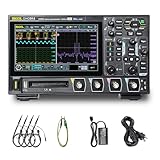
- 【Core Specs】125 MHz digital oscilloscope with 4 analog channels, 1.25 GSa/s real-time sampling, 12-bit vertical resolution and up to 50 Mpts memory depth for long captures and clearer small-signal detail.
- 【UltraAcquire & Review】UltraAcquire mode reaches 1,000,000 wfms/s; 256-level intensity grading plus waveform search/navigation with event table helps find intermittent glitches faster and review long records efficiently.
- 【MSO-Style Debug (Probe Req.)】16 digital channels (D0–D15) are standard for mixed analog/digital analysis, but require the PLA2216 logic analyzer probe (sold separately); digital channels do not support Slow sweep and Roll mode. Serial trigger/decode supports CAN/LIN/UART/I2C/SPI and parallel decode.
- 【Remote Control & SCPI】USB Host/Device, LAN (LXI‑C) and HDMI are standard. Web Control works in a browser via instrument IP, and the standard SCPI command set supports automation and integration in test setups.
- 【Applications】Digital oscilloscope for SMPS ripple/noise, embedded bring-up, timing correlation and protocol troubleshooting; 7" 1024×600 capacitive touch screen and Flex Knob improve bench productivity and teaching demos. [3][4]
Gigabit Ethernet and LXI compatibility allow the unit to be placed near a device under test or shared by several control computers. An embedded web server supports maintenance and updates. Ethernet control does not remove the need to plan network topology, transfer timing, and data retention: the instrument can acquire a burst much faster than it can export all samples continuously.
Software and programming
SBench 6 Professional is included. Spectrum lists support for Windows and Linux plus C/C++, Python, MATLAB, LabVIEW, LabWindows/CVI, .NET languages, Java, Delphi, Julia, and IVI through its drivers and programming interfaces. Product pages showed Windows driver and SBench 6 releases such as 7.09/6.5.14 and later 7.010/6.5.15 during 2026, so software numbers are date-sensitive; verify the live downloads linked from the DN6.333-10 page and consult the manual.
When the DN6.33x architecture fits
- Several inputs must be sampled synchronously at GHz-class bandwidth.
- The system is distributed, remotely controlled, or LXI-based.
- Long burst captures need substantial local memory.
- Repeated records, timestamps, averaging, and automated sequences matter more than a front-panel display.
- Python, MATLAB, LabVIEW, or C/C++ integration is part of the test architecture.
When to consider another instrument type
- Bench oscilloscope: preferable for immediate visualization, probing, and one-off debugging; less suited to very high synchronized channel counts or distributed deployment.
- PCIe digitizer: attractive when a dedicated host needs high transfer bandwidth and custom real-time processing; less portable and less convenient for remote shared-lab placement.
- PXI/PXIe: strong for large modular systems and chassis-level synchronization; it adds chassis cost and system complexity.
- Lower-channel-count digitizer: sensible when two or four channels meet the requirement and a 12-channel platform would be excessive.
These are architectural trade-offs, not a performance ranking against named competitors.
What’s actually slowing this PC down?
Pick the symptom - the matching free tool is one click away.
Buying questions that remain open
Spectrum’s reviewed pages provide specifications and a sales-contact route, but no public price. Confirm the exact model, memory option, channel-rate combination, delivery date, calibration, warranty, regional support, reference-clock needs, and software-maintenance terms in a quotation. “Available” in launch coverage does not establish current stock or lead time in every country.
The Bottom Line
The DN6.33x is a strong fit for synchronized, high-channel-count, burst-oriented GHz acquisition over Ethernet. Treat it as a configurable platform—not a 12-channel, 10-GS/s raw-streaming instrument—and select the model by the number of channels that must run at the required rate.
Quick Recap
Product prices and availability are accurate as of the date/time indicated and are subject to change. Any price and availability information displayed on Amazon at the time of purchase will apply.

