
iTechGuides is reader-supported. When you buy through links on our site, we may earn an affiliate commission. As an Amazon Associate I earn from qualifying purchases. Learn more
SpaceX has proposed an orbital data-center network of up to one million satellites, but the plan has not been approved and the system is not operating. The January 30, 2026 application describes satellites in orbital shells 500 to 2,000 km above Earth, using optical links to connect with one another and with Starlink. SpaceX says automation, propulsion, orbital-data sharing and end-of-life plans would help manage collision risk; those are proposed safeguards, not proof that collisions can be prevented at this scale.
As of October 7, 2026, the FCC had accepted the application for filing and sought public comment. That opened a review process; it did not authorize deployment.
What SpaceX has proposed
SpaceX’s January 30, 2026 application describes an Orbital Data Center system with a proposed maximum of one million satellites. The satellites would occupy narrow orbital shells up to 50 km wide, at altitudes between 500 and 2,000 km. Those figures are proposed limits in the filing, not an approved deployment plan or the number of satellites currently in orbit.
Outdated Drivers Are Slowing You Down
One free scan finds every outdated or missing driver and matches the right update for your exact hardware.Free scan · exact hardware matchPC Slower Than It Used to Be?
A free scan shows the junk files, broken settings and background clutter dragging Windows down - then fixes them in one click.Free scan · Windows 10 & 11In October 2026, Teslarati reported that SpaceX’s safety material described plans for up to 100,000 Starlink satellites and up to one million Starmind AI satellites. That reported description is distinct from an operational count: the million-satellite network remains a proposal.
#1 Best Overall

- HOBBY MODEL KIT – Unassembled model packed in an envelope with easy to follow instructions. Ideal for ages 14 and up.
- NO GLUE OR SOLDER NEEDED – Parts can be easily clipped from the metal sheets. Tweezers are the recommended tool for bending and twisting the connection tabs.
- VOYAGER – 1.5 Sheet Model with a moderate difficulty level. Assembled Size: 1.38 x 1.77 x 6.70 inches.
- FROM STEEL SHEETS TO 3D – Pop out the pieces and connect using tabs and holes. Includes illustrated instructions.
- HIGHLY DETAILED ETCHED MODEL – Display your 3D model once completed - collect and build them all.
How the orbital data centers would work
Satellites would link into a network
The application says the system would rely mainly on high-bandwidth optical links, both between the proposed satellites and between them and first- and second-generation Starlink satellites. Starlink would route traffic to authorized ground stations. The filing also describes backup telemetry, tracking and command communications.
Compute would be grouped into clusters
SpaceX vice president Michael Nicolls described a cluster-based concept in comments reported by Teslarati on October 6, 2026: “We need to operate clusters of satellites in tight formation to get enough coherent compute to run AI models efficiently.” He characterized a cluster as “10-ish satellites connected with 10 terabits or so of bandwidth between them, and interconnected to the broader constellation.” These are attributed descriptions of the concept, not confirmation of a final architecture or a demonstrated operating system.
Rank #2

- Model Kit
- May Require Paints and Glues to Assemble
- Accurate Scale Model
- Detailed Instructions Provided
- Decals/Transfers Included
Why put computing in orbit?
SpaceX’s application argues that satellites could use solar power and radiate waste heat in space, making orbit a place to perform energy-intensive computing. Those are the company’s stated reasons for the project; the application does not establish that orbital computing would be cheaper or environmentally superior to terrestrial data centers.
The Tool Desk
Outbyte Driver Updater FREEScan for outdated or missing drivers - takes under a minuteDriver Scan →Outbyte PC Repair FREERepair Windows errors before they cause bigger problemsFix Now →How SpaceX says it would reduce collision risk
The application describes a combination of automated assessment, maneuver capability, testing and disposal planning. SpaceX characterizes its proposed system as one that “will leverage SpaceX’s advanced, automated collision avoidance system for low-latency risk assessment and response.” The filing’s proposed measures include:
Rank #3

- HOBBY MODEL KIT – Unassembled model packed in an envelope with easy to follow instructions. Ideal for ages 14 and up
- NO GLUE OR SOLDER NEEDED – Parts can be easily clipped from the metal sheets. Tweezers are the recommended tool for bending and twisting the connection tabs
- APOLLO CSM – 3.5 Sheet Model with a challenging difficulty level. Assembled Size: 5.07 L x 2.28 W x 3.45 H inches.
- FROM STEEL SHEETS TO 3D – Pop out the pieces and connect using tabs and holes. Includes illustrated instructions
- HIGHLY DETAILED ETCHED MODEL – Display your 3D model once completed - collect and build them all
- Automated collision assessment and response: Software would assess collision risk and support timely avoidance decisions.
- Electric propulsion and maneuver reserves: Satellites would use propulsion for precise maneuvers, with maneuverability and propellant reserved for orbit raising, station-keeping, collision avoidance and disposal.
- Early testing at lower altitudes: SpaceX says it would test satellites at very low altitudes, where atmospheric drag would help a failed unit leave orbit.
- End-of-life plans: The application says satellites would re-enter or move to disposal orbits when their service ends.
- Coordination with other operators: SpaceX says it would share data and coordinate mitigation for high-risk conjunctions.
These are plans described in an application, not demonstrated safeguards for a million-satellite fleet.
Why orbital data sharing matters
Orbital-position information, often called ephemeris data, helps operators estimate where satellites will be and identify potential close approaches. Teslarati reported on October 6, 2026, that SpaceX had made a free ephemeris-sharing and screening platform available and objected to operators withholding maneuver plans. Sharing can improve coordination, but it cannot ensure that every operator participates or that a collision will not occur.
Rank #4

- HOBBY MODEL KIT – Unassembled model packed in an envelope with easy to follow instructions. Ideal for ages 14 and up.
- NO GLUE OR SOLDER NEEDED – Parts can be easily clipped from the metal sheets. Tweezers are the recommended tool for bending and twisting the connection tabs.
- JAMES WEBB SPACE TELESCOPE - 2.75 Sheet Model with a moderate difficulty level. Assembled Size: 4.13 L x 2.75 W x 2.75 H inches. 1:221 Scale. 62 Pieces
- FROM STEEL SHEETS TO 3D – Pop out the pieces and connect using tabs and holes. Includes illustrated instructions.
- HIGHLY DETAILED ETCHED MODEL – Display your 3D model once completed - collect and build them all.
In a message reproduced by Teslarati, Starlink urged operators to “not only share ephemeris data proactively the same way Starlink already does, but to also adopt the high standards of space safety that SpaceX and Starlink use every day.” That is the company’s appeal to other operators, not evidence that data sharing is universal.
What the reported collision figures do—and do not—show
SpaceX has cited experience with Starlink to explain its approach, but figures for that constellation do not demonstrate how a proposed Starmind fleet would perform. The reported numbers also differ in scope and source:
Best Value
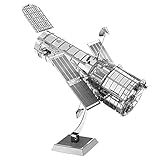
- HOBBY MODEL KIT – Unassembled model packed in an envelope with easy to follow instructions. Ideal for ages 14 and up.
- NO GLUE OR SOLDER NEEDED – Parts can be easily clipped from the metal sheets. Tweezers are the recommended tool for bending and twisting the connection tabs.
- HUBBLE TELESCOPE – 1 Sheet Model with a moderate difficulty level. Assembled Size: 3.00 x 2.00 x 2.50 inches.
- FROM STEEL SHEETS TO 3D – Pop out the pieces and connect using tabs and holes. Includes illustrated instructions.
- HIGHLY DETAILED ETCHED MODEL – Display your 3D model once completed - collect and build them all.
| Figure | What it refers to | Attribution and date |
|---|---|---|
| More than 1,000 automated collision-avoidance maneuvers per day in 2025 | Starlink maneuvers; not a measure of Starmind operations or collision outcomes | SpaceX, in its June 2026 prospectus |
| About 650 unique maneuvering third-party satellites; about half shared data | Collision-risk and data-sharing figures for 2026 | SpaceX figures reported by Teslarati on October 6, 2026 |
| Roughly 164,000 close approaches within four hours of an unannounced maneuver over six months | Close approaches associated with unannounced maneuvers, as described in the report | SpaceX figure reported by Teslarati on October 6, 2026 |
The latter figures are company disclosures as reported by Teslarati, not independently audited measurements. They indicate that SpaceX says data sharing is incomplete; they do not establish that the proposed AI fleet has operated or completed avoidance maneuvers.
What the FCC has decided
As of October 7, 2026, the FCC’s Space Bureau had accepted SpaceX’s application for filing and sought public comment. Acceptance for filing is a procedural step that brings a proposal into regulatory review. It is not a grant of authority to launch or operate the proposed million-satellite system.
Why astronomers and other stakeholders object
The American Astronomical Society’s petition to deny argues that the proposed constellation could harm optical and infrared astronomy, add to orbital congestion and collision risks, and create environmental effects that cannot be evaluated from the available application detail. The Society also says the filing does not provide enough information about satellite size and disposal frequency to assess some effects.
Those are arguments in an advocacy filing, not findings by the FCC or settled conclusions about the project’s effects. The disagreement is clear: SpaceX says automation, maneuvering, disposal planning and coordination can manage risk; the Society argues that the scale and gaps in available detail leave important risks unresolved. The material available as of October 7, 2026, does not settle which position will prevail in the proceeding.
Quick Recap
Product prices and availability are accurate as of the date/time indicated and are subject to change. Any price and availability information displayed on Amazon at the time of purchase will apply.

