
iTechGuides is reader-supported. When you buy through links on our site, we may earn an affiliate commission. As an Amazon Associate I earn from qualifying purchases. Learn more
A proposed change to how commercial launches coordinate radio frequencies has drawn objections from aerospace interests and GE Healthcare, according to an October 7, 2026 report. The existing Federal Communications Commission (FCC) rules remain in place: the report describes a petition seeking a different coordination model, not an FCC-approved replacement.
What the petition would change
The FCC’s Part 26 framework governs non-federal space-launch operations using specified spectrum. In an order adopted December 20, 2024, and released December 23, the Commission applied that framework to the 2360–2395 MHz band. The rules include coordination for each launch after a license is granted.
A Bloomberg report republished by Yahoo Finance on October 7, 2026 says the Commercial Space Federation petitioned the FCC to replace the role of the Aerospace and Flight Test Radio Coordinating Council (AFTRCC) with a self-coordination model. The report says the proposed replacement system had not yet been identified. The petition’s precise requested rule language and its docket status are not established by the report alone.
The Tool Desk
Outbyte Driver Updater FREEScan for outdated or missing drivers - takes under a minuteDriver Scan →Outbyte PC Repair FREEClear out junk files and repair common Windows errorsFree Scan →The federation’s vice president of regulatory affairs, Isaiah Wonnenberg, described the current process as “very time intensive and very manual,” according to the report. That is the proponent’s characterization of the process, not an FCC finding.
#1 Best Overall

- Upgraded ZS406 TinySA Ultra+:This New Version V0.4.6.1 Spectrum Analyzer is developed by Hugen, with 4.0 inch 480 x 320 large touchscreen display, 100kHz to 5.4GHz widely measure range, with the new ESD protection function, the product has a higher anti-static level and a longer service life, and built-in 32Gb micro SD card, can directly record data to the card ,which is convenient for your data sharing and storage
- Widely Frequency Range: Compared to the tinysa (100kHz to 960MHz), the upgraded tinysa ULTRA+ has 100kHz to 5.4GHz ultra-wide measuring frequency range, spectrum analyzer for 0.1-800MHz, with Ultra mode up to 0.1MHz-6GHz.Switchable resolution band pass filters for both ranges between 200Hz to 850kHz. Color display showing 450 scan points covering up to the full low or high frequency range. Faster and more accurate measurement performance, you can easily cope with measurement testes in various fields
- 2 in 1 Multifunctional Frequency Analyzer & Signal Generator:When not used as Spectrum Analyzer it can be used as Signal Generator,with sine wave output between 0.1-800MHz or square wave or dual tone output up to 4.4GHz.Built-in calibration signal generator that is used for automatic self test and low input calibration
- PC Control: Connected to a PC via USB it becomes a PC controlled Spectrum Analyzer or Signal Generator.Tinysa-APP transfers data directly to the computer.The USB interface implements CDC protocol and there is a large set of commands that can be invoked over the serial interface. These command can be used to perform measurements or update internal settings. The driver for Windows will install automatically after connecting to a Windows PC. The driver for Linux is built into the kernel
- Ultra-long Battery Life: The upgraded tinysa analyzer built-in 5000mAh battery,with type-C charging cable and LED charging indicator,it can be fully charged within 3 hours,no need to charge frequently
How the existing coordination framework works
The FCC’s 2024 order describes federal and non-federal aeronautical telemetry and telecommand users in the 2360–2395 MHz band. It requires licensees to cooperate and avoid harmful interference, and retains post-license, per-launch frequency coordination intended to protect co-channel users.
The Commission wrote that it believed “our part 26 space launch operations licensing framework, including the post-license grant, per-launch frequency coordination requirement, will aid in ensuring that co-channel entities operating in the LCA bands, whether federal or non-federal, are protected from harmful interference.” This is the FCC’s explanation of the framework’s purpose; it is not a guarantee that interference cannot occur.
Rank #2

- 7.3GHz Wide Spectrum Analysis: AURSINC TinySA Ultra+ ZS407 is a handheld spectrum analyzer covering 100kHz–7.3GHz frequency measurement. It features a base frequency range of 0.1–900MHz and reaches up to 7.3GHz when Ultra mode is enabled, with level calibration up to 7.3GHz. This device helps users to quickly identify, analyze and monitor RF signals across MF, HF, VHF and UHF bands to handle diverse complex RF testing scenarios
- Clear RF Data Visualization: Equipped with a 4-inch IPS-TFT LCD (480x320) display and up to 450 scan points per sweep, this RF analyzer presents signal details and measurement results clearly for efficient signal observation and measurement analysis
- 2-in-1 Analyzer & Signal Generator: Beyond spectrum measurement, TinySA Ultra+ ZS407 delivers signal generation functions. It offers sine wave output ranging from 0.1 MHz to 900 MHz, square wave output, and RF test signal output up to 7.3 GHz, supporting RF testing workflows, signal verification, and electronic troubleshooting tasks
- Enhanced Signal Reception with Built-In LNA: The integrated LNA provides up to 20dB gain up to 7.3GHz, helping improve weak signal reception during spectrum analysis. TinySA Ultra+ ZS407 features low phase noise that delivers superior signal purity, enabling accurate analysis of signal frequency stability and spectral purity for high-precision RF measurement and communication system performance evaluation
- Long-Lasting Battery: Equipped with a 3.7V 5000mAh Li-polymer battery, the ZS407 Spectrum Analyzer offers substantially extended battery life compared with earlier models. It satisfies demands for prolonged continuous testing and outdoor operations, supports convenient field measurement, and boosts work efficiency
AFTRCC says it provides frequency-coordination recommendations to the FCC for non-government flight-test voice and telemetry frequencies. It also cautions that coordination does not guarantee a frequency will be interference-free. The proposal described in the news report would change AFTRCC’s third-party role, but the report does not establish what procedures or accountability would take its place.
Quick wins for a faster PC:
Fix the driver behind crashes, sound loss and screen glitchesFind Drivers →Repair Windows errors before they cause bigger problemsFix Now →Why aerospace and federal users object
The reported opposition centers on protecting users already operating in shared spectrum. Aerospace interests include flight-test and telemetry operations. In a 2024 filing, the National Telecommunications and Information Administration (NTIA) argued that commercial launch use of the band could create an untenable situation for Department of Defense ranges, which use it daily. NTIA pointed to sensitive aeronautical telemetry receivers and safety-of-life uses as reasons interference could not be tolerated. This is NTIA’s warning, not evidence that harmful interference has occurred.
Rank #3
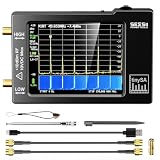
- Frequency Range :Tiny Spectrum Analyzer with two inputs, high quality MF/HF/VHF input for 0.1MHZ-350MHz, lesser quality UHF input for 240MHz-960MHz. Switchable resolution bandpass filters for both ranges between 2.6kHz and 640kHz. Color display showing 290 scan points covering up to the full low or high frequency rangefrequency range. The tinySA contains all the components of a conventional heterodyne swept spectrum analyzer
- Built-in Calibration Signal Generator:When not used as Spectrum Analyzer it can be used as Signal Generator, MF/HF/VHF sinus output between 0.1MHZ-350MHz, UHF square wave output between 240MHz-960MHz. Built-in calibration signal generator that is used for automatic self test and low input calibration
- Tiny Spectrum analyzers & ESD Function: Switchable resolution bandpass filters for both ranges between 2.6kHz and 640kHz.Color display showing 290 scan points covering up to the full low or high frequency range. Bulit-in rechargeable battery allowing a minimum of at least 2 hours portable use.The performance of the 2021 latest version 3.1 will be more stable and sensitive, with a new ESD protrcted function enable the product to have a higher antistatic level and a longer service life
- PC Control: Connected to a PC via USB it becomes a PC controlled Spectrum Analyzer.The USB interface implements the Serial over USB (CDC) protocol and there is a large set of commands that can be invoked over the serial interface. These command can be used to perform measurements or update internal settings. The driver for Windows will install automatically after connecting to a Windows PC. The driver for Linux is built into the kernel
- Package List: 1x Tiny Spectrum Analyzer; 2 x 20cm RF Cable;1 x USB Cable;1 x SMA Female to Female Connector;1x Touchscreen Pen;1 x SMA Telescopic Antenna.It's very useful as an antenna analyzer for your ham station, easy to set without fancy calibration.The firmware of the tinySA can be updated by the user. New versions of the firmware needed please contact seller for download link
The objections raise practical questions for any replacement coordination system: who would identify affected users, resolve conflicts, document an operating plan, monitor for problems, and provide remedies? The available account does not establish answers or technical details for the proposed model.
Why healthcare systems are part of the dispute
The October 7 report says GE Healthcare urged the FCC to protect medical body area networks (MBANs), hospital-based wireless sensor systems used to monitor patient vital signs. The report characterizes GE Healthcare’s concern as a risk that new or expanded launch access could degrade these systems’ efficacy and reliability. That description should be understood as the company’s reported position; the underlying filing was not available in the cited account.
Rank #4

- Upgraded TinySA Ultra+ ZS406: Built on the latest HW V0.4.6, the AURSINC TinySA Ultra+ ZS406 features a 4.0 inch 480*320 touchscreen display for intuitive operation. It comes with a pre-installed 32GB micro SD card for convenient on-site data storage and sharing, and a built-in 5000mAh rechargeable battery that delivers at least 3 hours of continuous operation on a full charge
- Wide Frequency Range & Adjustable RBW: Covers a measurement range of 100kHz to 5.4GHz, with Ultra mode extending up to 6GHz. Switchable resolution bandwidth from 200Hz to 850kHz enables fast and accurate measurements; the 200Hz minimum RBW clearly separates adjacent signals and supports SSB two-tone intermodulation testing. It includes a 0–31dB input step attenuator and displays up to 450 points for gapless full-band coverage
- 2-in-1 Analyzer & Signal Generator: Doubles as a signal generator when not used for spectrum analysis. It outputs MF/HF/VHF sine waves from 100kHz to 900MHz, UHF square waves from 800MHz to 4.4GHz, and mixed signals from 4.4GHz to 5.4GHz. A built-in calibration signal generator supports automatic self-test and low-input calibration for sustained measurement accuracy
- Excellent Phase Noise performance: -108dB/Hz at 100kHz offset and -115dB/Hz at 1MHz offset (at 30MHz), with a DANL as low as -166dBm/Hz. An integrated LNA provides 20dB of extra gain for low-level signals (effective only below 3.5GHz). The default 800MHz maximum frequency eliminates the need to switch between low and high ranges, enabling full-band monitoring in a single sweep
- PC Control: Connects to a PC via USB for data transfer and device control through the TinySA-APP, using Serial over USB (CDC) protocol with a full command set for measurements and internal settings. Drivers install automatically on Windows and are natively built into the Linux kernel
What the FCC decision would need to balance
| Issue | Existing framework | Reported proposal |
|---|---|---|
| Launch access and scheduling | Post-license coordination is required for each launch under the Part 26 approach. | Supporters reportedly argue that the current process is manual and time-intensive; the report does not specify how self-coordination would improve scheduling. |
| Coordination accountability | AFTRCC provides coordination recommendations for non-government flight-test voice and telemetry frequencies. | The report says AFTRCC’s third-party role would be displaced, but does not identify the replacement process. |
| Protection of existing users | The FCC order requires cooperation and avoidance of harmful interference; coordination is intended to help protect co-channel federal and non-federal users. | Aerospace and healthcare objections, as reported, focus on maintaining reliable access for existing users. |
| Evidence and enforcement | The FCC order describes the coordination framework; AFTRCC says its recommendations are not a guarantee of interference-free operation. | The report does not establish monitoring, complaint-handling, or enforcement details for the proposed model. |
The central policy choice is whether a different process can reduce launch scheduling burdens while still identifying and protecting affected users. That depends on the details of any replacement system and the evidence presented to the FCC, rather than on the label “self-coordination” alone.
Keep this proceeding separate from SpaceX’s 2 GHz petition
A separate FCC proceeding can sound similar but concerns different spectrum and rules. The FCC’s DA 24-299 notice addresses a SpaceX petition about sharing rules for 2000–2020 MHz and 2180–2200 MHz mobile-satellite-service spectrum. It is not the Part 26 launch-coordination issue involving 2360–2395 MHz.
Quick Recap
Best Value

- 【TinySA ULTRA+ and 4 inch Protective Case】:This TinySA ULTRA+ ZS406 4GHz Spectrum Analyzer Kit comes with a heavy-duty EVA storage case, providing complete protection for your precision RF testing equipment. Compact and practical, this case is a must-have for engineers, hobbyists, or ham radio enthusiasts. Perfect for business trips, workshops, or outdoor testing
- 【2-in-1 Functionality: Spectrum Analyzer + Signal Generator】:Use it as both a high-performance spectrum analyzer and signal generator with sine/square wave output (0.1-800MHz standard, up to 4.4GHz). The built-in calibration signal and switchable resolution filters (200Hz-850kHz) make it ideal for antenna tuning, EMI testing, and RF circuit debugging
- 【Complete Protection & Connectivity】:Your spectrum analyzer stays protected in the waterproof/shockproof EVA case with custom foam insert, while enjoying PC connectivity via USB (Windows/Linux/Mac compatible) and long-lasting 3000mAh battery with Type-C charging - all enhanced by the included 32GB microSD card for convenient data storage and transfer
- 【Frequency Range】:Compared to the tinysa (100kHz to 960MHz), the upgraded tinysa ULTRA+ has 100kHz to 5.4GHz ultra-wide measuring frequency range, spectrum analyzer for 0.1-800MHz, with Ultra mode up to 0.1MHz-6GHz.Switchable resolution band pass filters for both ranges between 200Hz to 850kHz. Color display showing 450 scan points covering up to the full low or high frequency range. Faster and more accurate measurement performance, you can easily cope with measurement testes in various fields
- 【PC Control】: Connected to a PC via USB it becomes a PC controlled Spectrum Analyzer or Signal Generator.Tinysa-APP transfers data directly to the computer.The USB interface implements CDC protocol and there is a large set of commands that can be invoked over the serial interface. These command can be used to perform measurements or update internal settings. The driver for Windows will install automatically after connecting to a Windows PC. The driver for Linux is built into the kernel
Sources
- FCC 24-132, Allocation of Spectrum for Non-Federal Space Launch Operations (adopted December 20, 2024; released December 23, 2024).
- NTIA comments on allocations for non-federal space launch operations (2024).
- Federal Register, Allocation of Spectrum for Non-Federal Space Launch Operations (90 FR 11480, March 12, 2025).
- Bloomberg report republished by Yahoo Finance, “SpaceX Push on Spectrum Access Gets Aerospace Industry Backlash” (October 7, 2026).
- AFTRCC frequency coordination.
- FCC DA 24-299, request for comment on a petition regarding revision of the Commission’s 2 GHz MSS sharing plan (March 26, 2024).
Product prices and availability are accurate as of the date/time indicated and are subject to change. Any price and availability information displayed on Amazon at the time of purchase will apply.

