
iTechGuides is reader-supported. When you buy through links on our site, we may earn an affiliate commission. As an Amazon Associate I earn from qualifying purchases. Learn more
Space-based solar power (SBSP) is a proposed energy infrastructure concept that is still under development. It is not a source that supplies grid electricity today. The idea is to collect sunlight in orbit, convert it into a microwave or laser beam, and send that energy to a receiving site on Earth. Neither NASA’s assessment nor JAXA’s current pages describe a commercial plant in operation. The most specific public dates are planning references, not schedules. NASA modeled conceptual systems that could begin operation in 2050. The Japan Aerospace Exploration Agency (JAXA), which calls the concept space solar power systems (SSPS), aims for practical application in the latter half of the 21st century.
Where SBSP stands today
SBSP has been studied and partly tested, but the complete chain has not been shown end to end. The evidence falls into three groups:
- Conceptual analysis: NASA’s Office of Technology, Policy, and Strategy published an assessment of conceptual systems in 2023. NASA summarized it publicly on January 11, 2024.
- Ground transmission and beam pointing: JAXA reports ground work on microwave wireless transmission and beam pointing. A 2025 JAXA report covers demonstration work carried out in Japanese fiscal years 2023 and 2024.
- Not shown by these agency sources: orbital collection at utility scale, delivery of commercial power from orbit to Earth, a grid-scale receiving site, or a verified cost per delivered kilowatt-hour.
A ground transmission experiment or a component-level demonstration shows that one part of the chain works under test conditions. It does not by itself prove the full space-to-Earth system at utility scale, and it is not orbital delivery of commercial power.
Quick wins for a faster PC:
Repair Windows errors before they cause bigger problemsFix Now →Scan for outdated or missing drivers - takes under a minuteDriver Scan →Clear out junk files and repair common Windows errorsFree Scan →How the system works
NASA describes the path as in-space energy collection, transmission to one or more stations, conversion to electricity, and delivery to a grid or to batteries. JAXA describes the same logic: solar energy is converted into a microwave or laser beam, transmitted to Earth, and converted back into electrical power. Treated as one chain, SBSP has six linked stages:
#1 Best Overall
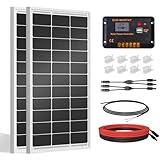
- [Wide Application]: Daily Output 800wh/day under 4 hours full sunshine condition. Perfect for RV, Caravan, Marine, Camper, Electric scooter, Golf Carts, Power wheels, Trolling motor, Tool trailer, Backup power supply for cabin shed home etc.
- [Excellent Performance]: ECO-WORTHY solar panels use high-performance monocrystalline solar cells, which can provide up to 21.5% higher efficiency sufficient light conditions.size:35.2*23.1.37in
- [Durable]: Corrosion-resistant aluminum alloy frame, so that the panel can be used for decades, and can withstand strong wind (2400Pa) and snow load (5400Pa), with a long service life. Ip65 rated junction box provides complete protection.:
- [Complete and Easy]: The back of the pre-drilled and plug-and-play cables allow quick installation, the kit can be connected in series (24V) or parallel (12V) if you need. What you will get: 2 pcs 100W mono solar panel + 2 set of Z mounting brackets + 30A solar controller + 1 pair of 16.4ft 10 awg solar cables + 1 pair of 2-in-1 connectors + 1 pair of 4.92ft tray cable.
- [Support]: 1 year with 24/7 tech support, if any problems or questions about the product,please do not hesitate to let us know through Amazon or call ECO-WORHTY hotline for solution.
- Collection: hardware in orbit captures solar energy.
- Conversion: that energy is converted into a microwave or laser beam.
- Beam control and transmission: a transmitter and pointing system aim the beam at a ground station.
- Ground reception: an antenna or other conversion facility on Earth receives the beam.
- Conversion to electricity: the received energy becomes usable electrical power.
- Delivery or storage: the electricity goes to a grid or into batteries.
Each stage is a separate engineering problem, and a shortfall in any one of them limits the whole system.
Why the idea attracts planners
JAXA lists flexible delivery and reduced vulnerability to ground-based natural disasters among the possible benefits. It also points to less dependence on terrestrial transmission infrastructure. These are potential advantages. JAXA’s own pages pair them with the unresolved challenges covered below, and no performance guarantee exists yet.
Microwave or laser: the transmission trade-off
JAXA treats microwave and laser as candidates for long-distance wireless power transmission, and says its team works on both. Neither has been selected. The table sets out the trade-offs described in JAXA’s FAQ and marks where the agency sources give no comparison.
| Factor | Microwave | Laser |
|---|---|---|
| Weather and atmosphere | At selected frequencies, clouds and rain have little effect (JAXA FAQ) | Clouds, rain and atmospheric conditions have more effect (JAXA FAQ) |
| System size | The longer wavelength means larger space-side and ground-side systems (JAXA FAQ) | Shorter wavelengths may allow comparatively compact equipment (JAXA FAQ) |
| Receiver compatibility | Not stated separately for microwave. JAXA’s gigawatt-scale concept mentions an imagined ground receiving site 2–3 km in diameter, without specifying the receiver design for either beam type | Existing terrestrial solar facilities might be usable as receiving sites (JAXA FAQ) |
| Beam-control and conversion efficiency | No comparative figure stated in the agency sources | No comparative figure stated in the agency sources |
| Safety requirements | Covered by JAXA’s general concerns about high-intensity beams: people, aircraft, the ionosphere and electronic equipment. No microwave-specific limits are stated | Eye safety requires careful consideration (JAXA FAQ), in addition to the general high-intensity concerns |
| Ground work reported | Ground transmission and beam-pointing tests (JAXA 2025 report on Japanese fiscal years 2023–2024) | Not stated in the agency sources |
Neither approach is established as the better choice. JAXA continues work on both, so the trade-offs above describe open questions rather than a verdict.
Rank #2

- 【Efficient Performance】This Starter Kit can generate an average of 500Wh of electricity per day (varies with sunlight). The solar panel boasts a 22.5% cell efficiency, 1.3% higher than other counterparts. Each panel dispatched from our facility undergoes 100% EL testing, ensuring that your panel is completely free from any hidden cracks.
- 【Market-Leading Service Plan】Enjoy worry-free usage with our market-leading service plan, providing 10 years of coverage for solar panel material and workmanship, along with a 2-year plan for the charge controller. Additionally, benefit from a 25-year service plan for the power output of the panel.
- 【Exceptional Safety】Certified by UL 61730, CSA C22.2#61730, IEC 61730/IEC 61215, our solar panel withstands 2400Pa wind and 5400Pa snow loads. Featuring IP65-rated J-box and IP67-rated solar connectors, rest assured, it can tackle any weather challenge.
- 【Remote Monitoring】The Wanderer PWM Charge Controller features an RS232 Bluetooth port. By adding a Renogy BT-1 Bluetooth Module, you can remotely monitor your solar system on the Renogy DC Home app. Keep track of voltage and current at any time, and receive timely warnings for over-voltage, under-voltage, and over-discharge.
- 【Excellent Compatibility】The solar kit with the Wanderer 30A PWM Charge Controller, supports expansion up to 400W with additional solar panels and is compatible with AGM, Gel, Flooded, and Lithium batteries.
What the dates mean
NASA’s 2050 modeling
NASA’s 2023 assessment examined conceptual systems that could begin operation in 2050. That is the modeled start year used in the analysis. It is not a scheduled deployment, a funding commitment, or a forecast that these systems will be built.
JAXA’s shifting target
JAXA’s current English overview says its research aims at practical application in the latter half of the 21st century. Its FAQ says it had earlier targeted realization in the 2030s for a 1-GW-class system. Development showed that timing to be difficult, and JAXA reviewed its research plan as a result. The newer horizon is an agency aim, not a launch date or a guaranteed service date.
The barriers between concept and deployment
NASA and JAXA identify overlapping engineering and economic obstacles. Each is described below in the agencies’ own terms.
What’s actually slowing this PC down?
Pick the symptom - the matching free tool is one click away.
Launch and heavy transport
JAXA names low-cost, high-volume space transport as one of its main challenges. Its FAQ discusses a gigawatt-scale concept with a facility mass of tens of thousands of tonnes and transport capacity on the order of 100 tonnes per day. These are planning figures inside JAXA’s described concept, not operating statistics or a settled design. NASA also points to the launch and manufacturing costs of moving substantial mass to space.
Rank #3

- Max Battery Voltage: 32V
Assembly, maintenance and autonomy
NASA identifies the need to assemble and maintain large systems in orbit and to operate them autonomously. Both requirements grow with system size. A facility of the mass JAXA describes would have to be built and kept working in orbit.
Efficient long-distance, high-power transmission
Both agencies treat efficient, long-distance, high-power power-beaming as a core problem. NASA lists efficient power-beaming among its capability gaps, and JAXA lists long-distance, high-power transmission among its main challenges. The beam must be generated efficiently, held precisely on target, and converted efficiently at the receiving end. The agency sources give no end-to-end efficiency figure, so overall losses are not established.
Orbit and frequency access
NASA notes that some concepts may require geostationary orbit, which adds challenges compared with low Earth orbit. JAXA also lists orbital-slot availability and frequency allocation as issues. These are regulatory and physical constraints a commercial system would have to clear, in addition to engineering tasks.
PC Slower Than It Used to Be?
A free scan shows the junk files, broken settings and background clutter dragging Windows down - then fixes them in one click.Free scan · Windows 10 & 11Crashes, No Sound, or Screen Glitches?
Random freezes, missing sound and display glitches usually trace back to one bad driver. Find and replace yours safely.Free scan · under a minuteGround receiving sites
The receiving facility needs land, a placement decision, authorization and safe day-to-day operation. JAXA’s gigawatt-scale concept imagines a site 2–3 km in diameter. JAXA lists site placement as an open issue. The agency sources do not say where such a site could be located or what it would cost.
Rank #4

- 【High Conversion Rate】This 20W solar panel with monocrystalline A+ solar cell has an excellent cell efficiency of 21%-30%. Designed to charge and maintain 12V rechargeable batteries like LiFePO₄, Lithium Ion, AGM, SLA, GEL, EFB, MF, etc. Keep batteries in charged for trailer, tractor, truck, boat, motorcycle, RV, car, lawn mower, water pump, gate opener, electric fence, etc
- 【Built to Last】 Low-iron tempered glass surface and corrosion-resistant aluminum frame, make this solar panel 100% waterproof and rustproof, and provide the prolonged lifespan up to 25 years. This 12V solar panel can withstand all weather conditions such as sandstorm, strong wind, thunderstorm, blizzard, hail, etc. It can withstand up to 2400Pa wind pressure and 5400Pa snow load
- 【Smart MPPT Controller】The charging efficiency of this upgraded 10A controller is 30% higher than other controllers on the market. Its intelligent three-stage charging design effectively prevents the battery from overcharging, over-voltage and short circuit. It takes no power from the battery. You will clearly know the charging status of the battery through the two indicator lights on the controller
- 【360° Adjustable Bracket & Plug-and-Play Installation】Comes with a fully 360° angle adjustable mounting bracket, which allows you to adjust the solar panel to the optimal sun-facing angle for maximum solar energy absorption and higher charging efficiency. Pre-drilled mounting holes and matched screws greatly simplify the installation process, no complicated tools or professional skills are required. All cable connections support plug-and-play, enabling quick and effortless installation and disassembly for both indoor and outdoor scenarios.
- 【Complete Accessories & Reliable After-Sales Service】Our SOLPERK Solar Panel kit includes 1*20W solar panel, 1*smart MPPT charge controller, 1*adjustable mounting bracket, 1*alligator clip, 1*O-ring and a full set of mounting accessories to meet your diverse installation and use needs. We offer 1-year professional after-sales service and lifetime technical support, with 7×24-hour online customer service to respond to your questions and solve problems within 24 hours, bringing you a worry-free shopping and using experience.
Safety: what is required and what is unresolved
JAXA says high-intensity microwaves or lasers raise safety concerns. It names people, aircraft, the ionosphere and electronic equipment as areas that need consideration. It describes safeguards such as restricting access to receiving equipment, and states that safety research must continue. Neither agency describes the beam as inherently harmless, and safety is not presented as a solved question.
How the barriers reinforce each other
The barriers are linked. The following is an editorial reading of the agency sources, not a finding stated in them:
- A large orbital station needs affordable transport and assembly, so launch cost sets how large a station can realistically be built.
- The beam needs efficient conversion and precise control, so transmitter size and complexity depend on how well the beam can be aimed and sized.
- The receiving facility needs land, authorization and safe operation, so the ground footprint and permitting limit where power can come down.
- These capital and operating demands feed directly into cost, discussed next.
Cost: what the evidence does and does not show
NASA’s lifecycle comparison
NASA’s assessment compared the lifecycle cost of conceptual SBSP systems with their potential for net emissions reductions. Under the study’s assumptions, the modeled systems would cost more than terrestrial sustainable alternatives. NASA says costs could fall if the capability gaps are addressed. This is the result of one modeled comparison. It is not a universal cost forecast, and it does not show that every future SBSP design would be uneconomic. NASA’s announcement attributes this framing to Charity Weeden, who leads the Office of Technology, Policy, and Strategy:
“This analysis compares the lifecycle cost of two conceptual space-based solar power systems versus their potential for net emissions reductions.”
Best Value
Sale Portable Solar Generator 300W Portable Power Station with 60W Solar Panel
- Portable Generator with 60W Solar Panel Included: with a big battery pack, ZeroKor 300W solar powered generator are powerful enough to charge smartphones,tablets,laptops,headphones or other outdoor small camping supplies(Tips:Using electrical appliances over 300W may damage the portable solar generator, especially some devices that are prone to heat or built-in air compressor such as coffee maker,Hair dryer, water pump etc )
- Multiple Charging outlets for camping gear with SOS Flashlight: with 2* 300W Max wall AC outlets, 1* DC port (9V-12.6V/10A max ), 3* 5V/3A Max USB ports, 1*quick charge USB port (5V/3A 9V/2A Max), Flashlight with reading mode and SOS mode for your outdoor Adventures, our portable solar power station offers a versatile charging solution,allowing you to charge your outdoor smart devices directly from a wall AC outlet
- Multiple Charging Optional, Solar Panel Charger 60W Included: ZeroKor portable power bank generator can be recharged by Home AC outlet, DC5521 13V-23V Solar Panel (Portable Power Station built-in MPPT), 12V Carport. Take the portable solar power bank generator with you on-the-go and never worry about power shortage,the portable AC outlet design makes it more suitable for Tent camping OFF-Grid
- Built in BMS(Battery Management System) : ZeroKor portable power station features short circuit protection, over-current protection, over-voltage protection, overload protection and overheating protection. The built-in cooling fan system will automatically start and stop according to the portable battery pack internal temperature during use. Acting as a portable solar power bank, it accommodates multiple devices simultaneously, making it perfect for indoor and outdoor use
- HIGH CONVERSION EFFICIENCY: ZeroKor solar panels 60W monocrystalline solar cell have a high conversion efficiency of 20.5%, and its performance is better than that of polycrystalline solar panels under the condition of insufficient light
JAXA’s older construction-cost target
JAXA says it has not calculated the cost of realizing SSPS. It does report an older conditional target. For a 1-GW plant operated for 40 years, with electricity supplied at 8 yen per kWh, construction cost would have needed to stay below 1.2 trillion yen. JAXA explicitly says this did not establish that construction at that cost was feasible. The figure is a target under stated assumptions, not a demonstrated or estimated project cost.
The agency sources also do not provide a verified cost per delivered kilowatt-hour for a deployed SBSP system, an operating commercial plant to measure, or a current global market-size figure.
Emissions and climate claims
NASA: similar emissions, more assessment needed
NASA says SBSP emissions could be similar to those of terrestrial alternatives, and that this requires more detailed assessment. Treat that as an open question. It is not a finding that SBSP is cleaner or more polluting than other options.
The Tool Desk
Outbyte Driver Updater FREEScan for outdated or missing drivers - takes under a minuteDriver Scan →Outbyte PC Repair FREEClear out junk files and repair common Windows errorsFree Scan →JAXA: a hypothetical fleet
JAXA’s FAQ argues that the energy added by a hypothetical fleet of roughly 100 one-gigawatt SSPS units would be small relative to the total solar energy reaching Earth. That is JAXA’s analysis of a hypothetical scenario, not a measured climate impact. The two agencies address different questions. NASA compares emissions with terrestrial alternatives. JAXA considers the physical energy scale of a hypothetical fleet.
What would count as real progress
Future announcements can be judged against tests that the agency sources themselves point to:
- An orbital collection and transmission demonstration that delivers energy to a ground receiver, going beyond ground-only tests.
- A published cost per delivered kilowatt-hour with its assumptions stated.
- Credible plans for heavy-lift transport and in-orbit assembly at the scale JAXA describes.
- Confirmed orbital-slot and frequency arrangements for the proposed systems.
- Safety and emissions assessments that go beyond the current high-level statements.
The Bottom Line
SBSP is a serious engineering proposal that NASA and JAXA are studying, with no commercial plant in operation in the agency sources. The title’s word “revolutionize” describes a hope the evidence does not yet support. Launch capacity, in-orbit assembly, long-distance beam transmission, safety, ground siting, and cost all remain open. The 2050 and latter-half-of-the-century dates should be read as planning horizons that could move.
Quick Recap
Product prices and availability are accurate as of the date/time indicated and are subject to change. Any price and availability information displayed on Amazon at the time of purchase will apply.
Do these 3 things before closing this tab:
1Fix the driver behind crashes, sound loss and screen glitches2Clear out junk files and repair common Windows errors3Scan for outdated or missing drivers - takes under a minute
