
The Tool Desk
Outbyte PC Repair FREEClear out junk files and repair common Windows errorsFree Scan →Outbyte Driver Updater FREEFix the driver behind crashes, sound loss and screen glitchesFind Drivers →iTechGuides is reader-supported. When you buy through links on our site, we may earn an affiliate commission. As an Amazon Associate I earn from qualifying purchases. Learn more
The Soviet-era Meteor 2-7 weather satellite has fragmented again, according to a report published by Space.com on 8 October 2026. LeoLabs, a commercial space-tracking company, detected debris near the satellite’s known orbit and estimated that there are tens of fragments. The cause has not been established in the reporting reviewed, and the fragment count is an early estimate. The event matters less for the satellite itself than for what it adds to a sequence of recent breakups and a long-running debris problem.
What happened to Meteor 2-7
Space.com identifies the object as Meteor 2-7, a Soviet-era weather satellite that launched in 1981. LeoLabs detected the debris-generating event as the satellite passed over its Western Australia radar site. The company’s estimate of “tens of fragments” is the only fragment figure in the reporting, and no final catalog count or official event bulletin had been published at the time of the report.
The report places the breakup at around 855 km (530 miles) altitude. It also says that Jim Shell, an orbital-debris expert, pointed out that Meteor 2-7 had broken apart once before, in March 2004. Shell’s observation that debris density is high at that altitude is attributed to him in the report, and it is a general statement about that orbital region rather than a measurement of this event.
Outdated Drivers Are Slowing You Down
One free scan finds every outdated or missing driver and matches the right update for your exact hardware.Free scan · exact hardware matchWindows Errors? Fix Them Before They Spread
Repair common Windows errors and clear accumulated junk for a smoother, more stable PC - no reinstall needed.Free scan · no reinstallSeveral things are not established yet. The reporting does not identify what caused the breakup. It does not say whether the satellite was struck by another object or whether it was operating at the time, and it does not provide the orbits of individual fragments. Those points should be treated as open until a primary tracking notice or a detailed analysis is published.
#1 Best Overall

- HOBBY MODEL KIT – Unassembled model packed in an envelope with easy to follow instructions. Ideal for ages 14 and up.
- NO GLUE OR SOLDER NEEDED – Parts can be easily clipped from the metal sheets. Tweezers are the recommended tool for bending and twisting the connection tabs.
- VOYAGER – 1.5 Sheet Model with a moderate difficulty level. Assembled Size: 1.38 x 1.77 x 6.70 inches.
- FROM STEEL SHEETS TO 3D – Pop out the pieces and connect using tabs and holes. Includes illustrated instructions.
- HIGHLY DETAILED ETCHED MODEL – Display your 3D model once completed - collect and build them all.
Why LeoLabs calls it a trend
LeoLabs placed the Meteor 2-7 event in a list of recent incidents and described the group as a worrying trend for space safety and security. In a statement posted on X and quoted in the Space.com report, the company said: “Together, they point to a worrying trend for space safety and security, and underscore the critical need for persistent sensing.” The statement is attributed to the company, and no individual is named.
The list is a selected cluster, not a measured rate. It includes:
Rank #2

- Model Kit
- May Require Paints and Glues to Assemble
- Accurate Scale Model
- Detailed Instructions Provided
- Decals/Transfers Included
- The September 2026 disintegration of the U.S. satellite USA 32.
- A Chinese rocket-body disintegration in late August 2026.
- A Starlink fragmentation event earlier in 2026.
- A Russian inspector satellite breakup in January 2026 in geostationary orbit.
- The Meteor 2-7 event itself.
These objects differ in type and orbit, so they should not be read as one comparable series. The reporting does not show that breakup frequency has risen statistically. What the list does show is that several fragmentation events are being detected within a short period, and that LeoLabs views the pattern as a reason to improve monitoring.
Do these 3 things before closing this tab:
1Fix the driver behind crashes, sound loss and screen glitches2Clear out junk files and repair common Windows errors3Scan for outdated or missing drivers - takes under a minuteThe wider debris numbers
The Meteor 2-7 event sits inside a larger picture that comes from agency reporting. The figures below are useful for scale, but each one has a specific definition and date range, and they do not measure the October event.
Rank #3

- HOBBY MODEL KIT – Unassembled model packed in an envelope with easy to follow instructions. Ideal for ages 14 and up
- NO GLUE OR SOLDER NEEDED – Parts can be easily clipped from the metal sheets. Tweezers are the recommended tool for bending and twisting the connection tabs
- APOLLO CSM – 3.5 Sheet Model with a challenging difficulty level. Assembled Size: 5.07 L x 2.28 W x 3.45 H inches.
- FROM STEEL SHEETS TO 3D – Pop out the pieces and connect using tabs and holes. Includes illustrated instructions
- HIGHLY DETAILED ETCHED MODEL – Display your 3D model once completed - collect and build them all
| Figure | What it measures | Source and scope |
|---|---|---|
| More than 3 intact satellites or rocket bodies re-entered per day on average, against about 10 new payloads launched daily | Average daily re-entries and launches | European Space Agency, 2026 environment report; data through the end of 2025; rounded averages |
| More than 300 launches placing over 4,000 new payloads in orbit | Launch activity in 2025 | European Space Agency, 2026 environment report |
| Space Environment Health Index rising from about 4 to 50 in one year | ESA’s own index of the long-term effect of current activity, roughly tenfold worse than its 2014 sustainability reference scenario | European Space Agency, 2026; this is an index, not a count of debris objects |
| Two major collisions (2007 Fengyun-1C anti-satellite test; 2009 Iridium 33 and Cosmos 2251 collision) more than doubled cataloged objects below 1,000 km | Growth in cataloged objects in the 2005 to 2015 period | NASA Orbital Debris Quarterly News, 2025 |
| Breakup and anomalous debris make up about half of the cataloged Earth satellite population | Historical catalog share as of 1 May 2022 | NASA Orbital Debris Program Office, History of On-Orbit Satellite Fragmentations, 16th edition, 2022 |
| Debris clouds from 38% of 268 known unique breakups had completely decayed | Historical share of fragmentation clouds that have fallen out of orbit | NASA, 2022 fragmentation history; cutoff 1 May 2022 |
| More than 40 collision-avoidance maneuvers per Starlink satellite per year | Company-disclosed maneuvers to avoid debris or other spacecraft, not collisions | SpaceX disclosure as relayed by Space.com, covering 1 June 2025 to 31 May 2026 |
Two points about the table matter in practice. First, the ESA index is a judgment about the long-term effect of activity, not a count of objects, so it should not be read as “debris has increased tenfold.” Second, the NASA catalog statistics describe the cataloged population, which leaves out the smaller objects discussed below.
Why small debris matters more than the headline count
Catalogs track only objects large enough to detect reliably. NASA’s 2025 Orbital Debris Quarterly News says: “There is a hidden population of smaller debris that is currently untrackable, yet is a major risk for spacecraft operators.” The same publication says additional radar, telescope, and in-situ measurement is needed to characterize that population.
Rank #4

- HOBBY MODEL KIT – Unassembled model packed in an envelope with easy to follow instructions. Ideal for ages 14 and up.
- NO GLUE OR SOLDER NEEDED – Parts can be easily clipped from the metal sheets. Tweezers are the recommended tool for bending and twisting the connection tabs.
- JAMES WEBB SPACE TELESCOPE - 2.75 Sheet Model with a moderate difficulty level. Assembled Size: 4.13 L x 2.75 W x 2.75 H inches. 1:221 Scale. 62 Pieces
- FROM STEEL SHEETS TO 3D – Pop out the pieces and connect using tabs and holes. Includes illustrated instructions.
- HIGHLY DETAILED ETCHED MODEL – Display your 3D model once completed - collect and build them all.
This is why a tally of fragments from one breakup can understate the hazard. Fragments that are too small to catalog can still damage an operating spacecraft, and they cannot be avoided with the maneuver planning that operators use for tracked objects.
Free tools Windows power users keep installed
One-click scans. No signup required.
The bigger concern is a feedback loop. ESA’s forward-looking models show continued net debris growth, and it describes how collisions can create fragments that lead to further collisions. This is the mechanism often called the Kessler syndrome. It is a risk pathway described by ESA, not a prediction that the Meteor 2-7 fragments will cause a cascade. The reporting does not show that the fragments have endangered any specific spacecraft.
Best Value
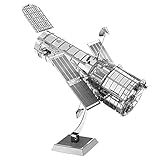
- HOBBY MODEL KIT – Unassembled model packed in an envelope with easy to follow instructions. Ideal for ages 14 and up.
- NO GLUE OR SOLDER NEEDED – Parts can be easily clipped from the metal sheets. Tweezers are the recommended tool for bending and twisting the connection tabs.
- HUBBLE TELESCOPE – 1 Sheet Model with a moderate difficulty level. Assembled Size: 3.00 x 2.00 x 2.50 inches.
- FROM STEEL SHEETS TO 3D – Pop out the pieces and connect using tabs and holes. Includes illustrated instructions.
- HIGHLY DETAILED ETCHED MODEL – Display your 3D model once completed - collect and build them all.
What can be done about it
Responses to orbital debris fall into three groups. They work on different timescales, so they should be compared on that basis rather than as alternatives.
| Approach | What it addresses | Limits, according to the sources |
|---|---|---|
| Prevention: passivation, responsible end-of-life disposal, limiting new debris | Future fragmentation from satellites and rocket bodies | ESA says too few satellites leave heavily congested orbits at end of life. Prevention does not remove debris already in orbit. |
| Detection and coordination: persistent sensing, better cataloging, data sharing, traffic coordination | Helps operators detect objects and avoid collisions | ESA reports a growing gap between objects detected and objects whose origin can be cataloged. NASA says small debris needs more measurement. |
| Removal and servicing: active debris removal | Objects already left in orbit | ESA says prevention alone is no longer enough. Value and feasibility depend on target selection and mission execution. The reporting does not assess any specific removal mission. |
For a single event like Meteor 2-7, the near-term benefit comes from detection and avoidance, which can protect active satellites. Long-term population reduction depends on prevention and removal. None of these measures is established as a way to retrieve the Meteor 2-7 fragments specifically.
The NASA history also defines the term at the center of this story. It describes a satellite breakup as “the usually destructive disassociation of an orbital payload, rocket body, or structure, often with a wide range of separation velocities.”
What is still unknown
- The physical cause of the October 2026 event has not been established in the reporting reviewed.
- “Tens of fragments” is LeoLabs’ initial estimate as reported by Space.com, not a final catalog count.
- A primary LeoLabs event notice, the orbits of individual fragments, and an official event bulletin were not available in the reporting reviewed.
- The reporting does not establish whether the satellite was still operating or was already inactive before the breakup.
Readers should expect the fragment count and cause to be revised as tracking data and catalog updates are released.
Sources cited in this article: Space.com report on the Meteor 2-7 event (8 October 2026); European Space Agency environment report (2026, data through end of 2025); NASA Orbital Debris Quarterly News, volume 29, issue 3 (2025); NASA Orbital Debris Program Office, History of On-Orbit Satellite Fragmentations, 16th edition (2022).
Quick Recap
Product prices and availability are accurate as of the date/time indicated and are subject to change. Any price and availability information displayed on Amazon at the time of purchase will apply.

