
iTechGuides is reader-supported. When you buy through links on our site, we may earn an affiliate commission. As an Amazon Associate I earn from qualifying purchases. Learn more
Neither option has been shown to beat the other for a racing mind. Guided meditation is the more direct match when thoughts, worry, or bodily tension keep you alert. Sleep sounds are better suited to masking an external noise problem. If insomnia is persistent, treat these as optional sleep aids—not replacements for cognitive behavioral therapy for insomnia (CBT-I), the treatment strongly recommended by the American Academy of Sleep Medicine.
The practical answer: match the audio to what is keeping you awake
A racing mind and a noisy bedroom are different sleep problems. If your internal monologue keeps restarting, you are dealing primarily with cognitive arousal: attention remains fixed on planning, worry, replaying events, or physical tension. A guided meditation gives that attention a structured task, such as following a voice through breathing, body awareness, guided imagery, or progressive relaxation.
If traffic, neighbors, a partner’s breathing, building equipment, or irregular household sounds keep pulling you awake, the problem is environmental. A steady sound may mask some of those changes. White noise, pink noise, a fan recording, or another continuous track is passive: it does not ask you to follow instructions or change your thoughts.
Recommended Free Tools
No study identified for this question directly compares sleep sounds with guided meditation in people whose main complaint is a racing mind. That means there is no evidence-based universal winner. The most defensible first experiment is guided meditation for active thoughts or tension and sound masking for unwanted outside noise. Your comfort, attention, and response after several nights should determine whether you continue.
#1 Best Overall
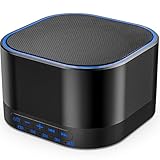
- ❤Notice: This sound machine needs to be plugged in for use.
- ❤20 Non-Looping Sleep Sounds: White noise ,Brown noise, pink noise, blue noise, fan,brook, rain, ocean,bird and Bonfire,suitable for for Baby and Kids and Adults.
- ❤Precise Volume & Timer Settings:With 32 Levels of Volume ,it is perfect for baby sleeping .And you can set 1 hour,2 hours,3 hours,4 hours and continuous play,control the comfort level for your own environment.
- ❤Unique Design: Solid-state design with 3.01inch*3.01inch *1.77inch,it is portable for home, office or travel,can give you a perfect sleep.
- ❤Function & Safety:Memory function automatically restores your previous volume, sound and time,it is powered by AC or USB.The machine is approved by FCC, CE and RoHS,don't need to worry about accidents.
What guided meditation can and cannot do
How the relaxation pathway works
Guided meditation uses spoken prompts to redirect attention. A recording might ask you to notice the breath, scan sensations from head to toe, imagine a calm scene, or release muscle tension. Those instructions are intended to reduce physical tension and cognitive arousal rather than force sleep directly.
The American Academy of Sleep Medicine (AASM) places guided imagery and meditation within relaxation therapy: structured exercises designed to reduce tension and arousal. Its 2021 guideline says, “We suggest that clinicians use relaxation therapy as a single-component therapy for the treatment of chronic insomnia disorder in adults.” The recommendation is conditional, and the guideline characterized the overall evidence for relaxation therapy as low quality.
What the AASM evidence actually measured
The AASM task force identified 12 randomized controlled trials of relaxation therapy. Five supplied data suitable for meta-analysis for at least one critical outcome. That evidence supports relaxation therapy as a reasonable option to discuss or try; it does not establish that one meditation recording, voice, technique, or app will work for every listener.
Windows Errors? Fix Them Before They Spread
Repair common Windows errors and clear accumulated junk for a smoother, more stable PC - no reinstall needed.Free scan · no reinstallCrashes, No Sound, or Screen Glitches?
Random freezes, missing sound and display glitches usually trace back to one bad driver. Find and replace yours safely.Free scan · under a minuteThe same guideline found insufficient evidence to recommend mindfulness therapy by itself as a treatment for chronic insomnia. That distinction matters: a short guided practice may help you settle before bed, while the evidence does not justify claiming that any meditation audio cures chronic insomnia.
Rank #2

- 【Sleep, Finally】- 31 real nature sounds like white noise, fan sounds, rain, thunder and ocean—recorded from real environments to bring true-to-life soundscapes for relaxation and sleep
- 【Sound That Wraps You】- Forward-facing speaker directs sound only to you—so you hear clearly at low volume, shielded from outside noise or snoring. Other machines fill the room. Ours protects your sleep
- 【Sleep on Your Rhythm】- Set your timer, or let it flow till morning. Volume fades softly—no sudden shifts, just seamless rest
- 【Controls That Guide You to Sleep】- A 45° tilt meets your hand where it naturally rests, so you can adjust it without effort, or even opening your eyes. No clicks, No light
- 【Looks Like Nature. Sleeps Like Peace】- Real wood texture and soft curves bring a touch of nature to your space—more aesthetically pleasing than the plain white designs out there. Natural design for a restful night's sleep
When a voice helps—and when it becomes another distraction
A voice can occupy enough attention to interrupt repetitive thinking. For some listeners, that structure is reassuring; for others, following instructions keeps the mind engaged. A narrator with dramatic music, frequent prompts, or a topic that feels emotionally important can be stimulating rather than calming. If you notice yourself concentrating on every word, switch to a shorter, simpler practice or try nonverbal sound instead.
What sleep sounds can and cannot do
Sound masking is an environmental strategy
A constant sound can reduce the contrast between silence and a sudden outside noise. Masking does not remove the source of the disturbance and does not directly address worry, planning, or other thoughts. It is therefore a better fit when you can identify an external sound as the trigger for awakenings.
White noise distributes energy broadly across frequencies; pink noise emphasizes lower frequencies; fans, air purifiers, and nature recordings provide other steady backgrounds. These labels describe sound characteristics, not a guarantee of a sleep effect. Tracks with volume changes, lyrics, alarms, or sudden transitions may create new interruptions.
What’s actually slowing this PC down?
Pick the symptom - the matching free tool is one click away.
What the auditory-stimulation evidence says
A systematic review of auditory stimulation, including white- and pink-noise devices, found no strong evidence that these devices improve sleep. The studies in that review did not report adverse effects during short-term use, but that finding does not prove long-term benefit or establish long-term safety for every device, volume, or listener.
Rank #3

- 💕25 Non-Looping Sleep Sounds:White noise,fans,brook,sea waves,bird, bonfire,train,piano,lullabies,meditation and so on,this special gift with big big love,will give you the most peace of mind,suitable for baby, kids and adults.
- 💕Adjustable Night lights: Four levels of warm lights,it is perfect for sleeping, feeding, even reading.This is a humanized bedside lamp with white noise for your family to take care of their sweet sleep!
- 💕5 Timers & 32 Levels of Volume:You can set it for continuous play or setting a timer 60,120,180,240 min auto-off. And this machine has 32 levels of volume,can easily mask the disruptive environmental noise.
- 💕Compact design& Memory function: With 3.9*3.9*2.3 inch ,it can be easily fitted into a handbag or suitcase,perfect for home, office or travel.And memory function will automatically restore your previous volume, sound and time.
- 💕Quality Assurance & 100% Satisfaction Guarantee:18 Months Warranty for the white noise machine from the date of purchase.This machine is powered by AC or USB,it is approved by ETL, FCC, CE and RoHS,don't need to worry about accidents.Any question just don’t hesitate to contact us.
Music is a related but separate category. A 2022 review of 13 studies involving 1,007 adults was summarized by the National Center for Complementary and Integrative Health (NCCIH) in 2024. It found that listening to music may improve self-reported sleep quality among people with insomnia. Those results concern music and participants’ reported sleep quality; they do not show that white noise is effective, that music beats guided meditation, or that either option treats chronic insomnia.
Side-by-side comparison
| Decision point | Guided meditation | Sleep sounds |
|---|---|---|
| Main problem addressed | Active thoughts, worry, physical tension, or difficulty disengaging attention | Unwanted or irregular environmental noise |
| Listener’s role | Active: follow a voice and return attention to its instructions | Passive: allow a continuous sound to run in the background |
| Likely mismatch | A narrator keeps you alert or the instructions feel frustrating | You are trying to quiet thoughts rather than mask outside noise |
| Evidence relevant to sleep | AASM conditionally suggests relaxation therapy; evidence quality was low, and mindfulness alone had insufficient evidence for a recommendation | Systematic review found no strong evidence for auditory-stimulation devices |
| Direct evidence for a racing mind | No head-to-head test establishes superiority | No head-to-head test establishes superiority |
| Best first test | A short, calm practice before or at bedtime | A steady, low-level track or machine used to mask a specific noise |
How to test guided meditation without turning bedtime into a project
- Name the target. Before pressing play, identify whether thoughts, worry, muscle tension, or repeated planning is the main obstacle. If you cannot name an internal trigger and a neighbor’s bass is clearly waking you, start with sound masking instead.
- Choose a simple format. Start with a short body scan, breathing practice, progressive relaxation, or quiet guided imagery. Select a narrator and pacing that feel neutral rather than emotionally intense. The goal is to reduce arousal, not to learn a complicated technique at midnight.
- Set up before you are frustrated. Dim the screen, queue the recording, and set a timer if the player offers one. Avoid searching through numerous tracks after you are in bed; repeated decisions can become another source of alertness.
- Follow lightly. Let the instructions provide an anchor, but do not try to perform perfectly. When attention wanders, return to the next instruction or to the breath. Straining to empty your mind can increase the very arousal you are trying to reduce.
- Stop judging minute by minute. A practice can be useful even if you remain awake while doing it. Record whether settling felt easier, whether you woke less often, and how you felt the next day instead of checking the clock repeatedly.
- Change one variable at a time. If the voice is distracting, try a shorter recording or a different style before abandoning the entire approach. If every recording keeps you mentally engaged, move to nonverbal sound or address the environmental trigger.
How to test sleep sounds for an actual noise problem
- Identify the sound you are masking. Notice whether awakenings follow traffic, voices, plumbing, appliances, or another irregular source. A sound machine is less likely to solve a problem that is actually worry or physical discomfort.
- Use a continuous track. Choose white noise, pink noise, a fan-like sound, or another even recording. Avoid tracks with sudden volume shifts, advertisements, spoken content, or musical changes that can attract attention.
- Position the source sensibly. Place a speaker or machine between you and the disruptive sound when practical, while keeping it stable and away from pathways. Do not place equipment where it could be pulled into bedding or become a trip hazard.
- Keep it comfortable and low. The NCCIH warns that listening to music at excessive volume can contribute to noise-induced hearing loss. No universal numeric safe-volume threshold is established here, so use the lowest level that masks the disturbance without creating pressure, discomfort, ringing, or the need to raise your voice nearby.
- Try a timer only if silence is not a problem. If the outside noise continues all night, continuous masking may be more logical. If the disruption is limited to a predictable period, a timer can reduce unnecessary exposure. Neither choice has been proven superior in long-term studies.
- Reassess the room. Closing a window, moving the bed, securing a rattling object, or reducing the source itself may help more than increasing playback volume. A machine should supplement, not replace, practical noise control.
A seven-night comparison you can interpret
Because there is no direct head-to-head evidence for racing thoughts, a small personal trial is more useful than switching randomly each night. Keep the schedule and bedtime routine as consistent as reasonably possible, and change only the audio condition.
- Nights 1–2: baseline. Use your usual routine without adding a new recording. Note roughly how long settling feels, how often you remember waking, and your next-day alertness. Avoid repeatedly checking the clock.
- Nights 3–4: guided practice. Use the same short meditation each night if thoughts or tension are the suspected trigger. Record whether attention felt less stuck and whether the voice was calming or engaging.
- Nights 5–6: sound masking. Use one steady sound at a comfortable low level if environmental noise is the suspected trigger. Record whether outside sounds were less noticeable and whether the track itself caused interruptions.
- Night 7: choose the better fit. Continue the option that produced a calmer experience and better next-day functioning, not necessarily the one that made you fall asleep fastest on one night. If neither helped, stop escalating volume or adding more complicated audio and reconsider the cause of wakefulness.
This is a preference experiment, not a clinical trial. A single week cannot establish treatment of insomnia, and an improvement may reflect a calmer bedtime routine rather than a special property of one sound.
Common failure modes and fixes
“The meditation makes me think harder”
Some people become more aware of thoughts when asked to observe them. Try a brief body scan with concrete sensory instructions, a progressive muscle-relaxation recording, or a less verbal sound. If monitoring your breathing feels uncomfortable, do not force that technique.
Rank #4

- ORIGINAL SLEEP SOUND MACHINE: Beloved by millions since 1962, the Dohm Classic was the first white noise machine ever created. It features our signature sound: natural, comforting, fan-based white noise—without the annoyance of actual moving air.
- CUSTOMIZED EXPERIENCE: The Dohm Classic effectively blocks out disruptive sounds like traffic, snoring, or noisy neighbors, making it easier to sleep or concentrate. Its dual speed settings let you fine-tune the tone & volume to your heart’s content.
- CRAFTED WITH LOVE: For over 60 years, Yogasleep has consistently set the gold standard in crafting sleep-enhancing products, leading the way in the industry. It’s lovingly assembled by hand in the USA, a testament to our commitment to quality.
- SIMPLE TO USE: Just plug in the Dohm Classic using the included 7-foot 120V AC power cable, flip the switch & find your happy sound. It’s a lifesaver for better sleep, soothing babies, tuning out tinnitus, or escaping the snore-fest next to you.
- CLASSIC DESIGN: The Dohm Classic’s timeless design fits into any space. Available in a palette of colors to match your style—white, black, gray, pink, tan & camo. To care for & clean your sound machine, simply wipe the exterior with a damp cloth.
“The noise machine has to be loud to work”
That usually indicates either a very strong external source or a mismatch between masking and the underlying problem. First reduce the source where possible and reposition the machine. Do not keep increasing volume to overpower a disturbance; excessive listening levels can harm hearing.
“I fall asleep with audio but wake when it stops”
Test a longer timer or continuous playback only if the sound remains comfortable and the room still needs masking. If stopping the track repeatedly wakes you, the timer may be the wrong setting for that environment. This does not demonstrate that continuous audio improves sleep overall.
“Every recording becomes background entertainment”
Spoken stories, changing music, and tracks with suspense can hold attention. Replace them with an even sound or a plainly narrated relaxation exercise. Keep the phone screen dark and avoid browsing for alternatives after lights-out.
Quick wins for a faster PC:
Fix the driver behind crashes, sound loss and screen glitchesFind Drivers →Repair Windows errors before they cause bigger problemsFix Now →“I am still awake despite doing everything correctly”
Audio is not a test of willpower. Persistent wakefulness can have causes that audio cannot address, including an entrenched insomnia pattern or another health issue. Do not respond by adding louder, longer, or more complicated recordings indefinitely.
Best Value

- 𝟑𝟎 𝐒𝐨𝐨𝐭𝐡𝐢𝐧𝐠 𝐒𝐨𝐮𝐧𝐝𝐬 𝐟𝐨𝐫 𝐋𝐢𝐟𝐞 & 𝐅𝐨𝐜𝐮𝐬: Choose from 8 white noises, 8 fan sounds, 10 nature sounds (rain, ocean, birds), and 4 lullabies—all crisp and clear. Skip scrolling with one-tap playback to instantly block snoring, traffic, or office noise. One device creates the perfect backdrop for sleep, work, yoga, travel, or quiet nights.
- 𝟖-𝐂𝐨𝐥𝐨𝐫 𝐍𝐢𝐠𝐡𝐭 𝐋𝐢𝐠𝐡𝐭 𝐰𝐢𝐭𝐡 𝐓𝐚𝐩 𝐂𝐨𝐧𝐭𝐫𝐨𝐥: Customize your ambiance with 8 sleep-friendly light colors. The entire 2.83-inch stainless steel speaker grill is a tap-control switch, letting you turn the light on/off easily in the dark—perfect for safe nighttime checks in any room.
- 𝟔 𝐓𝐢𝐦𝐞𝐫𝐬 & 𝐌𝐞𝐦𝐨𝐫𝐲: 15/30/60/90/120 mins, 8H auto-shutoff (full-night sleep) or nonstop play.Remembers last sound, volume, light settings-power on & go.
- 𝐁𝐚𝐜𝐤𝐥𝐢𝐭 𝐓𝐨𝐮𝐜𝐡 𝐁𝐮𝐭𝐭𝐨𝐧𝐬: Glowing touch buttons for easy use in the dark. The backlight auto-off saves energy and keeps your room dark for sleep.
- 𝐄𝐚𝐫𝐭𝐡-𝐅𝐫𝐢𝐞𝐧𝐝𝐥𝐲: Rest easy with a choice that supports the planet. Featuring hues made from recycled materials and backed by a European eco-certification.
Safety and practical boundaries
- Keep playback at a comfortable, low level. High-volume music or other audio can contribute to noise-induced hearing loss, according to NCCIH.
- Stop and reassess if you develop ringing, muffled hearing, ear pain, headache, or anxiety related to the audio.
- Check that speakers, cables, and devices cannot overheat, fall into bedding, or create a trip hazard.
- Do not use a meditation recording as a substitute for evaluation when sleeplessness is persistent, distressing, or affecting daytime functioning.
- Do not describe a white-noise device as a treatment for insomnia or as a way to quiet thoughts; its proposed role is masking environmental sound.
When CBT-I belongs in the plan
The AASM strongly recommends multicomponent cognitive behavioral therapy for insomnia for adults with chronic insomnia disorder. Its recommendation is: “We recommend that clinicians use multicomponent cognitive behavioral therapy for insomnia for the treatment of chronic insomnia disorder in adults.” CBT-I addresses the behaviors, thoughts, and sleep patterns that maintain chronic insomnia rather than relying on a single audio track.
Guided relaxation can be one component of self-management or a single relaxation approach, but it is not equivalent to the multicomponent treatment recommended for chronic insomnia. Sound masking may make a noisy room more tolerable, yet the weak evidence for auditory-stimulation devices means it should remain an optional environmental aid.
Seek a clinician’s advice if sleep difficulty continues, repeatedly affects daytime functioning, or leaves you unsure whether the problem is insomnia, environmental disruption, medication-related, or another health concern. Bring notes from your audio trial; they can help distinguish a noise trigger from persistent cognitive arousal.
Free tools Windows power users keep installed
One-click scans. No signup required.
Bottom line
For a racing mind, try guided meditation first when thoughts or tension are the obvious trigger, and use sleep sounds when an outside noise is the obvious trigger. Neither has a proven universal advantage, and neither replaces CBT-I for chronic insomnia. Use the lowest comfortable audio level, evaluate your response over several nights, and stop treating audio as the solution when the sleep problem persists.
Quick Recap
Product prices and availability are accurate as of the date/time indicated and are subject to change. Any price and availability information displayed on Amazon at the time of purchase will apply.

