
The Tool Desk
Outbyte PC Repair FREERepair Windows errors before they cause bigger problemsFix Now →Outbyte Driver Updater FREEScan for outdated or missing drivers - takes under a minuteDriver Scan →iTechGuides is reader-supported. When you buy through links on our site, we may earn an affiliate commission. As an Amazon Associate I earn from qualifying purchases. Learn more
If you want to get flying with the least setup, buy a ready-to-fly drone. Build a multirotor if choosing its frame and propulsion system—and learning to configure, test, repair, and tune it—are part of the goal. Neither route is universally better: the right choice depends on what you want to carry, how much setup you want to own, and whether you value a finished aircraft or a hands-on project.
Should you buy a drone or build one?
A ready-to-fly (RTF) drone minimizes assembly and configuration. A DIY multirotor gives you more control over the design, but you take responsibility for component compatibility, setup, calibration, and tuning. There is no current model comparison or tested parts combination established here, so treat the following as a decision framework rather than a product ranking.
| Priority | RTF drone | DIY multirotor |
|---|---|---|
| Get flying with minimal assembly | Better fit: the aircraft arrives assembled or substantially prepared. | More work: assembly and setup come before flight. |
| Choose the aircraft’s components | Less control over the underlying frame and propulsion system. | Better fit: you select the frame, motors, ESCs, propellers, autopilot, and battery as a system. |
| Learn configuration and tuning | Usually less responsibility for tuning the flight-control system yourself. | Requires you to configure and validate the aircraft, and may involve staged tuning. |
| Repair or change the aircraft | Depends on the model and parts support; check before buying. | Potentially more direct control over parts and repairs, provided replacements remain compatible. |
| Camera, payload, and portability needs | Compare the specific aircraft’s documented capability and size. | Design around the intended payload, while accounting for how it affects the complete aircraft. |
For a beginner whose priority is using a drone rather than building one, an RTF model is the simpler starting point. If your priority is learning how a multirotor works or specifying its hardware yourself, a DIY build may be more satisfying—but it is not a shortcut to a proven aircraft. For either path, check the intended camera or payload, transport needs, repair options, and the amount of configuration you are prepared to handle.
What parts do you need to build a drone?
A DIY multicopter is a compatible system, not a collection of parts chosen by headline specifications. ArduPilot’s build guidance identifies these major hardware categories; exact size and compatibility depend on the aircraft design and payload.
#1 Best Overall

- 1. Unique DIY Drone:This DIY drone integrates optical flow positioning modules, video modules, and high-power brushless motors.The assembly process takes approximately 1.5 hours and requires patience and hands-on skills. Recommended for users aged 14 and above. Difficulty level: 5/5.
- 2. A Project Worth Showcasing:Packed with extensive foundational knowledge about drones, this kit allows you to deeply understand drone technology during assembly. Master the principles and confidently showcase your expertise, gaining admiration from friends.
- 3. Multifunctional Flight Experience:360° flips,One-click takeoff/landing,Headless mode,Speed adjustment,Optical flow positioning,Real-time video transmission,Perfect for indoor/outdoor flight performances,Operation difficulty : 5/5(practice required for proficiency).
- 4. Worry-Free Flying:Includes spare propellers for quick post-crash replacements.Flight time can be up to 30 minutes.【about LED】Slight flight control algorithm differences across batches. If LEDs won't light up, switch to the other installation mode. No impact on flight.
- 5. Educational Value:The detailed manual explains drone fundamentals and serves as a reference for STEM project plans or curriculum design. Includes editable PowerPoint teaching materials to support educators.
- Frame: The structure that holds the aircraft’s components. Its design and stiffness affect the completed multirotor.
- Motors, ESCs, and propellers: The propulsion system. These parts must work together and suit the aircraft’s design and intended load.
- Autopilot: The flight-control hardware that runs the aircraft’s flight software. Choose hardware supported by the flight software you plan to use.
- Rechargeable LiPo battery: The aircraft’s power source. Its compatibility and suitability depend on the overall design and propulsion system.
Do not assume that a motor, ESC, propeller, or battery is suitable merely because its individual specification looks appealing. The available guidance does not establish one universal parts list or a validated motor–propeller–battery combination. Confirm compatibility across the complete build before buying, including any payload you plan to carry.
In ArduPilot’s documented workflow, Mission Planner is used to load Copter firmware and support first-flight setup and calibration. It is free and open source, according to ArduPilot’s build documentation.
Rank #2

- Screen Controller, No Phone Needed: This drone comes with a 4.5-inch remote controller with a built-in screen, making connection simple and convenient. No smartphone connection or app download is required, allowing you to fly and view real-time footage directly on the controller. Without distractions from incoming calls, messages, or notifications, you can enjoy an immersive flying experience. The all-in-one design also reduces reliance on mobile devices.
- 4K UHD Camera with FPV Transmission: This 4K drone features a 90° adjustable lens, allowing for flexible adjustment of the shooting angle during flight. Combined with FPV real-time video transmission, it delivers a clear and intuitive flight perspective and shooting experience. It also boasts altitude hold and stable hovering capabilities, making flight smoother. Not only is it suitable for aerial photography, but it can also be used for inspecting hard-to-reach areas such as rooftops, exterior walls, and drainage ditches.
- GPS Auto Return Safety Flight: Designed for both indoor and outdoor use, this drone adapts to different flying scenarios. When flying outdoors in GPS positioning mode, it supports three return-to-home modes: one-click return-to-home, low battery return-to-home, and automatic return-to-home upon signal loss, effectively reducing the risk of loss and allowing you to fly with peace of mind. In indoor environments, you can switch to optical flow mode for stable hovering and precise positioning.
- All-in-One Beginner Drone: Equipped with a brushless motor for greater efficiency, lower noise, and longer service life. It includes multiple functions such as one-key takeoff/landing, headless mode, auto return, tap fly, point of interest, waypoint fly, 3 speed modes, and gesture photography. It is great for beginners who want to learn more advanced drone functions step by step, and also makes a great gift for family, friends, and drone lovers.
- 60 Mins Flight Time Dual Batteries: This drone is equipped with two 7.4-volt 1600mAh rechargeable batteries, providing a total of approximately 60 minutes of flight time. This effectively reduces charging time, giving you more time to fly and shoot.Weighing under 249g, this foldable and portable drone saves you from complex FAA registration requirements, and is ideal for travel, camping, hiking, outdoor adventures, and everyday fun.
What should you do before the first flight?
Preparation matters most when the aircraft has not yet demonstrated stable flight. ArduPilot describes the first takeoff of an untuned multirotor as especially dangerous. Follow the relevant setup instructions for your aircraft and flight software; do not use a successful motor spin-up as proof that the aircraft is ready to fly.
- Confirm the build and frame configuration. Check that the flight controller’s selected frame type matches the aircraft you assembled.
- Verify motor numbering and orientation. Check every motor against the flight software’s required numbering and direction before attempting a flight.
- Complete software setup and calibration. If following ArduPilot’s workflow, use Mission Planner for firmware loading and the applicable first-flight setup and calibration.
- Establish a stable hover before progressing. Keep the first flight focused on confirming predictable, stable behavior. Do not move on to aggressive tuning or more demanding maneuvers until the baseline is safe.
If the aircraft does not behave as expected, stop and investigate the configuration or hardware rather than trying to correct an uncertain setup by escalating flight tests.
Rank #3
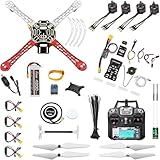
- 𝐘𝐨𝐮𝐫 𝟏𝐬𝐭 𝐃𝐈𝐘 𝐃𝐫𝐨𝐧𝐞 - F450 is the best DIY drone for both beginners to learn the basics and experts to conduct research or secondary development.
- 𝐌𝐨𝐫𝐞 𝐂𝐚𝐩𝐚𝐜𝐢𝐭𝐲 & 𝐌𝐨𝐫𝐞 𝐒𝐩𝐚𝐜𝐞 - Wheelbase: 450mm, Maximum take-off weight: approx. 1.8 kg. It has enough space for flight control, Raspberry Pi, camera, sensors, etc.
- 𝐍𝐞𝐰𝐛𝐢𝐞 𝐅𝐫𝐢𝐞𝐧𝐝𝐥𝐲 - We have prepared a quick start guide for new players that will assist you with the assembly and calibration of a DIY drone. Please contact us if you need it.
- 𝐁𝐫𝐚𝐧𝐝 𝐏𝐚𝐫𝐭𝐬 - We use parts from brands for stable and reliable quality. Free replacement for quality problems within 3 months.
- 𝐅𝐥𝐢𝐠𝐡𝐭 𝐂𝐨𝐧𝐭𝐫𝐨𝐥 𝐍𝐎𝐓 𝐈𝐧𝐜𝐥𝐮𝐝𝐞𝐝 – Assembling a complete drone requires flight controls, which are not included in this kit. You can choose the flight control according to your needs and budget.
How do you tune an ArduPilot quadcopter?
ArduPilot’s approach is staged: establish and evaluate a stable baseline before advancing to more involved tuning. AutoTune is one step in that process, not a replacement for checking the aircraft or obtaining a stable initial tune.
- Prepare the parameters. Configure the aircraft’s parameters for the actual frame and setup before tuning.
- Obtain a stable initial tune. The aircraft needs to fly in a controlled, stable way first; it does not need to be fully optimized at this stage.
- Evaluate the aircraft’s behavior. Use the initial flights to determine whether the baseline is suitable to proceed from.
- Configure noise-notch filtering. Address noise filtering as part of the tuning sequence rather than applying later tuning steps to an unevaluated aircraft.
- Tune roll and pitch manually, and/or use QuikTune. Follow the applicable ArduPilot instructions for the aircraft and selected method.
- Use AutoTune only after the earlier work. Assess the result and adjust input shaping as the tuning guide directs.
ArduPilot says the aircraft should be in its most agile configuration for initial tuning, generally at minimum takeoff weight with a fully charged battery. That describes the tuning configuration in its guide; it is not a reason to fly an unstable aircraft or disregard the flight software’s setup instructions.
Rank #4

- Lightweight & Portable Design - Weighing just 151g [9] and C0 certified, this compact drone features full-coverage propeller guards for safer, worry-free transport and flight.
- Palm Takeoff & Landing [1], Gesture Control [2] - Enjoy easy palm takeoff and landing, plus intuitive gesture controls for hands-free operation and seamless flying experiences.
- Smooth & Reliable Tracking - ActiveTrack [3] keeps your subject in focus, while Apple Watch lets you view live feed, check flight status, or use voice control to adjust tracking [17].
- Easy Moment Capture With SelfieShot - Snap memorable moments easily with SelfieShot, allowing quick and convenient selfies anytime with just a simple tap.
- All-Around Safety & Flexible Flight - Fly confidently with omnidirectional obstacle sensing [8] and enjoy versatile flight [13] for safer, more dynamic aerial adventures.
Why AutoTune can fail
AutoTune can produce gains that make an aircraft unflyable and may lead to a crash. ArduPilot identifies several conditions that can spoil the result:
- Strong wind during tuning
- High gyro noise or vibration-isolation problems
- Nonlinear ESC response
- A flexible frame or payload mount
- A very low motor spin minimum
- Overloaded propellers or motors
If the aircraft has any of these issues, address the underlying setup, noise, or propulsion problem and return to the earlier tuning steps. Do not treat an AutoTune result as automatically safe to fly.
Best Value

- No Registration Needed - Under 249 g, this drone with camera for adults 4K does not require FAA registration or Remote ID for recreational use. Visit the FAA's official website for requirements related to drone registration and Remote ID. [1]
- 4K Ultra HD & 3-Axis Gimbal for Cinematic Quality Shooting - Capture stunning moments in any light—sunrises, sunsets, and night scenes with crystal-clear 4K resolution. Thanks to the 3-axis gimbal, you can achieve cinematic-quality footage with this advanced drone with camera.
- 38kph (Level 5) Wind Resistant - This drone for adults has a stable flight even in Level 5 winds. Brushless motors enhance power and allow takeoff at altitudes up to 4,000 meters.
- Due to platform compatibility issue, the DJI Fly app has been removed from Google Play. To ensure a better product usage experience, please log in to the DJI official website to download the latest version of DJI Fly.
- Uninterrupted Creation with Extended Battery Life - There are three sets available for you to choose from: 1-battery set (31-min), 2-battery set (62-min), or 3-battery set (93-min). [3] Say goodbye to battery anxiety and let nothing hold you back.
What U.S. rules apply to drone flying?
The following points are specific to the United States. They are not worldwide rules; check the aviation authority and local restrictions for the place where you intend to fly. FAA requirements and administrative details can change, so verify current guidance before operating.
Recreational flying and TRUST
In the United States, recreational flyers operating under the Exception for Limited Recreational Operations must pass TRUST before flying and carry proof of passage. FAA-approved test administrators provide the online test free. Passing TRUST is a requirement for this recreational exception; it is not, by itself, permission to fly anywhere or in any manner.
Registration and Remote ID
Under the FAA’s stated rules, drones weighing more than 0.55 pounds generally must be registered. An aircraft weighing 0.55 pounds or less is exempt only when it is flown exclusively under the recreational exception. The FAA says aircraft that are required to be registered or are registered—including recreational, business, and public-safety aircraft—must comply with Remote ID.
Quick wins for a faster PC:
Fix the driver behind crashes, sound loss and screen glitchesFind Drivers →Repair Windows errors before they cause bigger problemsFix Now →Scan for outdated or missing drivers - takes under a minuteDriver Scan →The FAA describes three Remote ID routes:
- Standard Remote ID drone: The aircraft has built-in Remote ID broadcasting.
- Remote ID broadcast module: An eligible module is attached to the drone. The FAA says an aircraft using this route must remain within visual line of sight.
- FAA-Recognized Identification Area (FRIA): Fly without Remote ID equipment within a recognized area, subject to the applicable requirements.
Remote ID modules are not a universal accessory. Before buying one, verify that the specific equipment and aircraft meet current FAA requirements and that this route applies to your operation.
Non-recreational operations
For non-recreational work, the FAA directs pilots to Part 107. The FAA’s summary says a remote pilot certificate is required unless the operation is under the direct supervision of a certificate holder. It also describes requirements including visual line of sight and restrictions on flight over people. Some operations may need additional authorizations or waivers, so check current FAA guidance for the planned flight.
Quick Recap
What to settle before choosing a build or aircraft
- Decide whether your primary goal is to fly a finished aircraft or learn through assembly and configuration.
- Write down the camera or payload, portability, and repair needs that matter for your use.
- For a DIY build, verify the frame, propulsion system, autopilot, battery, and intended payload as one compatible design.
- Before flying in the United States, determine whether your operation is recreational or non-recreational and check the applicable TRUST, registration, Remote ID, and Part 107 requirements.
- For an ArduPilot build, follow its staged setup and tuning process; do not start with AutoTune or assume the first flight is routine.
Product prices and availability are accurate as of the date/time indicated and are subject to change. Any price and availability information displayed on Amazon at the time of purchase will apply.

