
Quick wins for a faster PC:
Repair Windows errors before they cause bigger problemsFix Now →Fix the driver behind crashes, sound loss and screen glitchesFind Drivers →Clear out junk files and repair common Windows errorsFree Scan →iTechGuides is reader-supported. When you buy through links on our site, we may earn an affiliate commission. As an Amazon Associate I earn from qualifying purchases. Learn more
To send appointment reminder calls to many customers, submit one Sinch Voice API v2 batch request. It contains a single shared call flow and one parameter object per appointment. You control the pace with batchOptions.maxCps and the useful life of the queue with ttlSeconds. Then you read the outcome of each call from its session details, not from the batch summary. The batch feature is labeled public preview, so confirm its current status before you rely on it in production.
How a batch reminder run is structured
A batch reuses one call flow for every recipient. The flow contains placeholders such as the recipient’s name, the appointment time, the phone number, and an appointment identifier. Each call gets its own values through the parameters array, which holds one object per call. This is why the design scales: you write the conversation once, and the per-recipient data travels with the request rather than being duplicated into separate flows.
Two settings govern how the run behaves. The official call-pacing guide documents the following bounds for the example’s batch configuration.
Do these 3 things before closing this tab:
1Fix the driver behind crashes, sound loss and screen glitches2Repair Windows errors before they cause bigger problems3Scan for outdated or missing drivers - takes under a minute| Setting | Documented bounds | What it controls | How to choose a value |
|---|---|---|---|
batchOptions.maxCps |
1 to 1000 calls per second | How fast queued calls start | Match your available trunk capacity and the capacity of any downstream agents who will take transferred calls |
ttlSeconds |
1 to 10,800 seconds (three hours) | How long queued calls remain eligible to start | Match the period in which the reminder is still useful, such as the hours before the appointment. Calls that have not started when the TTL expires are marked expired. |
These are bounds stated in the Sinch tutorial, not performance guarantees. The tutorial dated September 30, 2026 is the source for the example values, and the API’s current limits should be checked against the live documentation before you build around them.
#1 Best Overall

- Supports 4 (GRP2613) or 6 (GRP2613W) SIP accounts and 6 multipurpose line keys
- Power supply : Integrated Power over Ethernet (PoE) IEEE 802.3af Class 2 or Universal power adapter Input: 100-240V; Output: +5VDC, 0.5A. It does not use batteries.
- Swappable face plates to allow for easy logo customization. Equipped with noise shield technology to minimize background noise
- HD audio with support for all major codecs, including wideband codecs G.722 and Opus. Up to 24 digital BLF keys
- Integrated dual-band (2.4GHz and 5GHz) Wi-Fi 6 (802.11a/b/g/n/ac/ax) and Bluetooth (GRP2613W only)
Prerequisites
The official reminder tutorial lists the following requirements:
- A Sinch account and a project, with project access-key credentials.
- A voice-capable phone number in that project.
- A Voice API v2 service.
- Node.js 24 or newer.
- The Sinch CLI.
If you do not supply a service ID, batch calls use the project’s default Voice service. Set the service explicitly if your project has more than one, so that the reminder traffic is attributable and configured the way you expect.
Rank #2

- Yealink Optima HD voice technology
- Opus codec support, Dual USB ports, Dual-port Gigabit Ethernet & Dual firmware images
- The full keyboard and intelligent search support simplifies user input
- Support for multi-touch operations, offering unbelievable ease of use
Build the confirmation endpoint before you send anything
The call flow needs a public HTTPS URL to post the caller’s keypad choices to. Create it first, so the flow can be tested end to end before any customer receives a call. The documented pattern works as follows.
- Expose a public HTTPS endpoint that accepts the menu’s action posts. The endpoint must be reachable from Sinch’s side, not only from your internal network.
- Protect the actions against forgery. The tutorial’s example signs the appointment and action values, so the handler can reject a post that was not generated by your own call flow.
- Return a response within five seconds. The confirmation flow waits up to five seconds for the webhook. A failed or late response can end the call while the caller is still listening.
- Queue slower system updates after you respond. Writing to a calendar, a practice-management system, or a CRM should happen asynchronously once the response has been returned.
- Map every response to an appointment using the identifier carried in that call’s parameters. A confirmation that cannot be tied to one appointment is hard to act on.
Design the call flow for people, voicemail, and silence
The example flow handles three situations differently. Keep the same structure in your own flow.
Rank #3
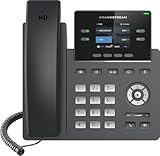
- Supports 4 SIP accounts and 4 multi-purpose line keys
- Swappable faceplate to allow for easy logo customization
- GRP2612W includes built-in dual-band Wi-Fi support. Ethernet cord must be disconnected to enable Wi-Fi capability
- HD audio supporting all major codecs, including wideband codecs G.722 and Opus Up to 16 digital BLF Keys
- Enterprise-level protection including secure boot, dual firmware images, and encrypted data storage
- Answering-machine detection. Use it to separate a human or an unknown outcome from a detected voicemail beep. The flow should not play the full reminder into a voicemail greeting.
- Voicemail message. Use a shorter message for detected voicemail, with the essential appointment time and a callback number.
- Keypad menu for a person. Offer a concise menu, such as confirming, requesting a new time, or reaching a staff member. Keep the number of options low, because callers rarely remember a long list.
- Timeout and failure fallback. If the caller does not press a key or the input fails, say so clearly and give the next step, rather than ending the call silently.
Set pacing and expiry to match capacity and timing
Choose maxCps from two constraints: how many trunks you can use at once and how many people can take calls on the other end. A high rate that sends more calls than your trunks or agents can handle will produce failed or unanswered calls that look like patient problems in your reports. Start conservatively, observe the outcomes, and raise the rate only when the results are clean.
Choose ttlSeconds from the reminder’s usefulness. A reminder for an appointment at 9 a.m. has little value if it starts at 8:55 a.m. The TTL is the cutoff: queued calls that have not started by then are marked expired, and they will not be placed later.
Rank #4

- Quick and easy installation: Connect the main console to analog lines via RJ11; cordless handsets/desksets pair wirelessly with one-touch DECT 6.0 technology—no professional wiring or assistance needed for fast small office setup.
- Expandable to 10 stations: Grow your 4-line small business phone system seamlessly by adding up to 9 cordless handsets or desksets—ideal for scaling operations without replacing equipment.
- Professional auto attendant per line: Automatically answers calls on each of the 4 lines, offers company directory access, routes to extensions, and records voicemail for efficient, polished call management.
- Reliable digital answering system: Captures up to 180 shared minutes of incoming messages, announcements, and memos—ensuring no important calls are missed during busy hours.
- Enhanced productivity features: Full-duplex speakerphone for natural conversations, extra-large display, caller ID/call waiting, 100-name phonebook, 32 speed dials, cordless headset support, intercom, and customizable music-on-hold via 2.5mm jack.
Submit the batch with an idempotency key
Always send an Idempotency-Key header with the whole batch submission. If a network error leaves you unsure whether the request succeeded, retrying with the same key prevents the entire list from being queued a second time. Use one key per submission, and generate a new key only when you intend to send a new run.
Recommended Free Tools
Read outcomes at the session level
The batch summary is useful for progress, but it does not tell you what each person did. The table below shows what each level of detail can and cannot establish.
Best Value

- Make more natural and life-like calls with Polycom HD Voice
- 2. 8” color display: an engaging experience offering visual information at a glance
- Two Gigabit Ethernet ports offer cost savings and performance benefits
- USB port enables users to move data around more quickly
- Integrates with more than 60 industry leading call control platforms
| Level | What it shows | What it does not show |
|---|---|---|
| Batch summary | Counts by queue and session state, which tracks progress through the run | Whether any person answered |
| Session marked completed | That the session ended | That the recipient answered or confirmed |
| Session or call details | The per-call result, such as no answer, busy, or failure | Confirmation or rescheduling choices, which should be recorded by your webhook |
In practice, treat the webhook as the system of record for keypad responses, and treat the session details as the system of record for whether the call connected. Reconcile the two so that every appointment ends in a known state, including the calls that never reached anyone.
Stop a run safely
Deleting a batch stops calls that are still queued. Calls that have already started continue to completion. If you need to halt a run, delete the batch, then check the session details to see which recipients were reached before the stop, so that your follow-up list is accurate.
What the evidence does and does not establish
The Sinch tutorial is a working example of the flow, and it reports a hands-on run of the core flow. It does not publish measured outcomes, cohorts, or causal estimates. The official material therefore does not establish that reminder calls reduce no-shows, by any percentage. Judge the value of the approach by your own results, measured against a baseline.
Free tools Windows power users keep installed
One-click scans. No signup required.
The feature’s status also matters for planning. The tutorial states that Voice API v2 is in public preview. Public preview terms, as described in the tutorial, include no service-level agreement and the possibility of breaking changes before general availability. For a live reminder program, keep a fallback process for appointments whose reminders fail, and check the current status in the Voice API v2 overview before you go live.
For the batch request structure, pacing, idempotency, monitoring, and stopping behavior, use the Sinch call-pacing guide for batch calls. The Sinch blog tutorial on batch calling for appointment reminders covers the complete reminder flow, prerequisites, and webhook handling.
Quick Recap
”
The Bottom Line
“”
Product prices and availability are accurate as of the date/time indicated and are subject to change. Any price and availability information displayed on Amazon at the time of purchase will apply.

