
iTechGuides is reader-supported. When you buy through links on our site, we may earn an affiliate commission. As an Amazon Associate I earn from qualifying purchases. Learn more
Seagate announced globally available 30TB HAMR hard drives on July 15, 2025: the Exos M for enterprise and data-center deployments, and the IronWolf Pro for NAS systems. Both use the company’s Mozaic 3+ platform. Seagate positioned the added capacity for AI and other data-intensive storage needs, but 30TB capacity is not a promise of low-latency performance—and compatibility depends on the host system.
What Seagate announced
Seagate’s July 15, 2025 announcement covered two distinct 30TB drives, alongside 28TB versions: Exos M, aimed at enterprise and data-center use, and IronWolf Pro, aimed at NAS deployments. The company said the 30TB models were available globally through its online store and authorized resellers at launch. That dated announcement does not establish current stock or pricing.
Seagate listed a launch price of $599.99 for each 30TB model and $569.99 for each 28TB version. Those are historical July 2025 launch prices, not verified prices for October 2026. Seagate’s launch announcement also said more than one million Mozaic drives had shipped by that time.
Exos M and IronWolf Pro are built for different systems
| Drive | Intended deployment | What to check before buying |
|---|---|---|
| Exos M 30TB (ST30000NM004K) | Enterprise and data-center storage | Whether the server, enclosure, controller, and workload support this drive and 30TB capacities. |
| IronWolf Pro 30TB (ST30000NT011) | NAS storage | Whether the exact NAS model supports 30TB disks and whether the drive suits the system’s workload and vibration environment. |
Both are high-capacity hard drives, but their product families target different deployment contexts. Do not assume that a drive will be suitable for any system simply because it has a familiar connector. Check the NAS or server maker’s compatibility list and the operating system and controller capacity limits for the exact setup.
#1 Best Overall
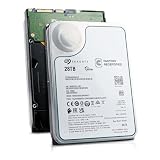
- MASSIVE 28TB CAPACITY – Store and manage enormous datasets with ease. Ideal for data centers, servers, NAS systems, cloud storage, and large-scale backup solutions.
- ENTERPRISE-CLASS PERFORMANCE – 7,200 RPM spindle speed, SATA III 6Gb/s interface, and large cache deliver fast, consistent throughput for demanding 24/7 workloads
- CMR TECHNOLOGY (CONVENTIONAL MAGNETIC RECORDING) – Designed for predictable performance, reliability, and compatibility in RAID and enterprise storage environments.
- BUILT FOR 24/7 OPERATION – Engineered for continuous use with enterprise-grade durability, making it suitable for mission-critical applications and high-density storage arrays.
- STANDARD 3.5” SATA FORM FACTOR – Seamlessly integrates into most enterprise servers, workstations, and NAS enclosures that support 3.5-inch SATA hard drives.
What HAMR and Mozaic 3+ do
HAMR stands for heat-assisted magnetic recording. It is Seagate’s recording approach for increasing areal density—the amount of data that can be stored on a given disk area. Seagate’s Mozaic 3+ platform uses HAMR to make higher-capacity hard drives possible. The capacity increase is useful when a deployment needs to store large datasets in fewer drives; it does not, by itself, make a hard drive a low-latency device for compute or model training.
Seagate’s January 2024 description of Mozaic 3+ cited areal density above 3TB per platter and outlined a roadmap toward greater per-platter capacity. Roadmap targets should not be confused with shipped products. Seagate’s Mozaic 3+ explanation provides the company’s platform framing.
Rank #2

- Breakthrough areal density: The first hard drive to feature up to 3TB per platter, enabling massive storage capacity in the same footprint for maximized data center efficiency.
- Enormous capacity: Up to 28TB of storage in an industry-standard 3.5-inch form factor.
- Time-tested excellence. Next-gen innovation: Blends 90% of trusted, proven components from previous generations with cutting-edge Mozaic 3+ technology for enhanced performance and reliability.
- Reduces power consumption: Up to 60% compared to 10TB drives for lower operational costs and energy consumption.
- Enterprise-class reliability: Designed for the stringent demands of hyperscale cloud service providers and enterprise data centers, providing durable, always-on performance essential for critical enterprise applications.
Reported specifications and performance context
Tom’s Hardware reported that the 30TB drives are 3.5-inch, 7,200 RPM CMR drives with a 512MB cache and SATA 6Gbps interface. These are reported product specifications, not independent testing. SATA compatibility at the connector level does not guarantee a storage system can address a 30TB disk; confirm the host’s capacity support separately.
Free tools Windows power users keep installed
One-click scans. No signup required.
The launch coverage also relayed Seagate performance claims. Treat those as vendor-reported results rather than a general guarantee for every workload or an independent benchmark. Capacity is the clearest point of this announcement; the sources do not establish that the 30TB models deliver a general low-latency or total-cost advantage. Tom’s Hardware’s launch report gives the reported specifications and context.
Rank #3

- 28TB Massive Enterprise Capacity
- 7200 RPM Performance
- SATA 6Gb/s Interface
- 512e Sector Format 3.5-Inch Enterprise Form Factor
- 2.5M-hours MTBF enterprise rating
Why Seagate connected the drives to AI data centers
Seagate framed the products as a response to growing data-storage needs, including AI workloads, edge analytics, data sovereignty, and denser data-center deployments. The practical argument is that more capacity per drive can help store large volumes of foundational data using fewer drives. Whether that translates into lower power use, smaller facilities, or lower total cost depends on the complete system and workload; the announcement does not independently prove those outcomes.
High-capacity HDDs can be a strategic part of AI infrastructure without being the storage used for every latency-sensitive operation. Data retention, archives, and large datasets have different requirements from fast access during computation. The 30TB announcement concerns storage capacity, not a claim that HDDs replace faster storage for every AI task.
Rank #4

- 26TB ultra-high capacity for large-scale storage
- 7,200 RPM for sustained enterprise workloads
- SATA 6Gb/s interface for wide system compatibility
- Enterprise-class reliability for continuous operation
- High workload rating for data-intensive applications
How the 30TB launch fits Seagate’s later roadmap
| Announcement | Capacity or platform | Status described |
|---|---|---|
| January 21, 2025 | Exos M samples up to 36TB on Mozaic 3+ | Samples announced, not the July 2025 30TB channel-availability announcement. Seagate announcement |
| July 15, 2025 | 30TB Exos M and IronWolf Pro on Mozaic 3+ | Seagate announced global channel availability. Seagate announcement |
| March 3, 2026 | Mozaic 4+ | Seagate said the platform was qualified and in production with two hyperscale cloud providers; this is a later platform milestone, not a revision of the 30TB launch. Seagate announcement |
These milestones describe different capacities, platform generations, and statuses. The 36TB figure was a sample announcement; the 30TB models were announced as available through channels; and the later Mozaic 4+ statement concerned qualification and production with two hyperscale cloud providers. They should not be treated as interchangeable evidence of retail availability.
The Tool Desk
Outbyte PC Repair FREEClear out junk files and repair common Windows errorsFree Scan →Outbyte Driver Updater FREEFix the driver behind crashes, sound loss and screen glitchesFind Drivers →Quick Recap
What to verify before choosing a drive
- System capacity limit: Confirm the NAS, server, controller, and operating system support individual 30TB drives.
- Drive-family fit: Match Exos M to an enterprise/data-center deployment or IronWolf Pro to a NAS use case, then check the exact system compatibility list.
- Workload needs: Consider required capacity, workload, and vibration environment; capacity alone does not establish performance suitability.
- Current price and stock: The July 2025 launch price and availability statement do not verify current listings, sellers, or inventory.
Product prices and availability are accurate as of the date/time indicated and are subject to change. Any price and availability information displayed on Amazon at the time of purchase will apply.

