
Quick wins for a faster PC:
Repair Windows errors before they cause bigger problemsFix Now →Scan for outdated or missing drivers - takes under a minuteDriver Scan →Clear out junk files and repair common Windows errorsFree Scan →iTechGuides is reader-supported. When you buy through links on our site, we may earn an affiliate commission. As an Amazon Associate I earn from qualifying purchases. Learn more
A 2026 Science paper reports experimental evidence for a long-proposed liquid–liquid critical point in supercooled water. Researchers rapidly heated two forms of amorphous ice with infrared laser pulses, then used X-ray scattering to probe the brief period before the water crystallized. The “two types” are proposed low-density and high-density liquid states—not different kinds of water you can find at room temperature.
What the researchers found
In “Experimental evidence of a liquid-liquid critical point in supercooled water,” Seonju You and colleagues report evidence supporting a liquid–liquid critical point, where the proposed low-density liquid (LDL) and high-density liquid (HDL) states meet. The paper appeared in Science on March 26, 2026. Read the paper’s indexed record.
The result addresses a difficult question: whether water can exist as two distinct liquid states under deeply supercooled conditions. It does not establish two stable liquids at everyday temperatures, nor does it mean water is made of two chemically different kinds of H₂O.
How the experiment worked
Liquid water in the relevant supercooled region tends to crystallize quickly, making it hard to observe before it turns to ice. The team used amorphous ice—ice without the regular crystal structure of ordinary ice—as a starting material. Ultrafast infrared laser pulses rapidly heated samples of high- and low-density amorphous ice. X-ray scattering then provided structural information about the short-lived liquid before ice crystals nucleated and grew. The paper’s abstract and publication record are available from Science.
#1 Best Overall

- HANDS-ON WATER FILTRATION: Kids can build their own water filtration and distillation plant, providing a practical understanding of how clean water is produced and the science behind water purification.
- SOLAR POWER DISINFECTION: The kit teaches children how to disinfect water using solar power, promoting renewable energy concepts and demonstrating sustainable practices in water resource management.
- COMPREHENSIVE EXPERIMENTATION: Includes a detailed booklet with suggested experiments and activities, allowing for a variety of hands-on learning experiences that reinforce the principles of clean water science.
- ENVIRONMENTAL AWARENESS: Features alarming water facts that educate children about environmental issues and the importance of protecting clean water resources, fostering a sense of responsibility toward the planet.
- PERFECT FOR ALL SETTINGS: The kit includes clear instructions and all necessary materials, making it simple for children to conduct experiments safely and effectively. STEM powered learning.
Chemistry World describes the measurement window as a few microseconds and reports the result as the team’s claim of evidence for the transition. That short interval matters: the experiment probes a metastable liquid that exists only briefly before crystallization, not a sample that can be kept as two separate liquids under ordinary conditions. Chemistry World’s report quotes Pacific Northwest National Laboratory physicist Greg Kimmel calling the results “the most persuasive evidence to date” for a liquid–liquid critical point. That is an expert assessment of the evidence, not a claim that every question about water’s behavior is settled.
What “two types of water” means
LDL and HDL refer to proposed liquid states with different densities and molecular arrangements. They are both water: the distinction is how neighboring molecules are organized under particular conditions, not a change in chemical composition.
Rank #2
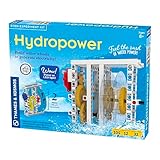
- 12 experiments and building projects
- Harness mechanical energy from water to do physical work
- Generate electricity to light an LED
- Learn the physics of water turnies
- Discover why hydropower is a promising source of energy
Low-density liquid
The low-density picture is associated with a more open, tetrahedral arrangement. In a simplified description, a water molecule is surrounded by four hydrogen-bonded neighbors.
High-density liquid
The high-density picture involves more distorted arrangements, often described as having three or five hydrogen-bonded neighbors. These arrangements can pack more closely than the tetrahedral structure.
Rank #3
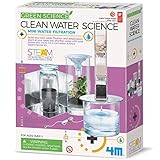
- This personal desalination kit demonstrates the scientific way to extract salt from sea water.
- The kit contains a plastic filter system, active carbon, sand, rock and filter paper.
- Perfect for young science enthusiasts, especially those with an interest in chemistry and the environment.
- Detailed instructions for use and care are included.
- Recommended for ages 8 years and up.
The distinction is a useful simplification of molecular structure and density, not a consumer-facing classification. The hypothesis proposes that the balance and fluctuations between such local arrangements matter under extreme conditions; it does not identify two varieties in a glass of tap water.
Why the finding may help explain water’s odd properties
Water behaves unusually in several familiar ways, and researchers have proposed that changes in its local molecular structure help account for those anomalies. In the critical-point model, competition between LDL-like and HDL-like arrangements—and fluctuations in their balance—offers one possible explanation. Anders Nilsson is quoted by Chemistry World as saying, “The LLCP is important because it is the source of the water anomalies.” This is the model’s explanatory interpretation, not proof that the 2026 experiment directly explains every unusual property of ordinary water.
Rank #4
- This Science Experiment Kit serves as an excellent tool for early science enlightenment, guiding learners to explore foundational engineering and physics concepts.
- Electric Motor Kit features a streamlined, ingenious structure that a clear view of mechanical transmission and energy conversion processes.
- Science Experiment Kit includes full-color printed tutorials and video PPT materials, catering to both independent learning and interactive classroom demonstrations.
- DIY Hydroelectric Generator Kit promotes hands-on assembly practice, fostering the development of manual dexterity and scientific inquiry abilities.
- Water Wheel Generator Kit clearly showcases the transformation of water potential energy into electrical energy, simplifying the comprehension of core physics principles.
How this fits the earlier hypothesis
The idea of two liquid states in water predates the 2026 paper. A 2020 review discussed the two-state model, and earlier experimental work had reported observations of a liquid–liquid transition in bulk supercooled water under pressure. The newer paper adds experimental evidence using amorphous ice, rapid laser heating and X-ray scattering; it is not the first proposal that water might have two liquid states.
A 2020 account from Sapienza University of Rome describes modeling in which water is metastable relative to ice below about 180 kelvin (about −90°C), and the modeled liquid density begins to fluctuate between low- and high-density values. That temperature belongs to the 2020 modeling summary; it should not be mistaken for a temperature measured in the 2026 experiment. Sapienza’s account of the modeling study explains the earlier theoretical context.
Quick Recap
Best Value
- DIY Hydroelectric Generator Kit promotes hands-on assembly practice, fostering the development of manual dexterity and scientific inquiry abilities.
- This Science Experiment Kit serves as an excellent tool for early science enlightenment, guiding learners to explore foundational engineering and physics concepts.
- Science Experiment Kit includes full-color printed tutorials and video PPT materials, catering to both independent learning and interactive classroom demonstrations.
- Electric Motor Kit features a streamlined, ingenious structure that a clear view of mechanical transmission and energy conversion processes.
- Water Wheel Generator Kit clearly showcases the transformation of water potential energy into electrical energy, simplifying the comprehension of core physics principles.
Product prices and availability are accurate as of the date/time indicated and are subject to change. Any price and availability information displayed on Amazon at the time of purchase will apply.

