
Do these 3 things before closing this tab:
1Repair Windows errors before they cause bigger problems2Fix the driver behind crashes, sound loss and screen glitches3Clear out junk files and repair common Windows errorsiTechGuides is reader-supported. When you buy through links on our site, we may earn an affiliate commission. As an Amazon Associate I earn from qualifying purchases. Learn more
Rigol’s DS80000 is the series behind the 13 GHz claim: its top model, the four-channel DS81304, is specified for up to 13 GHz analog bandwidth and 40 GSa/s real-time sampling. The family also includes 6 GHz, 8 GHz and 10 GHz models. Those figures make it a platform for high-speed design and debugging, but the probe, memory configuration and analysis options determine what the complete measurement setup can do.
Which Rigol oscilloscope reaches 13 GHz?
The claim applies to the Rigol DS80000 series, not every Rigol real-time oscilloscope. Its four models each have four analog channels and are specified for a maximum real-time sampling rate of 40 GSa/s:
| Model | Maximum analog bandwidth | Analog channels | Maximum real-time sample rate |
|---|---|---|---|
| DS80604 | 6 GHz | 4 | 40 GSa/s |
| DS80804 | 8 GHz | 4 | 40 GSa/s |
| DS81004 | 10 GHz | 4 | 40 GSa/s |
| DS81304 | 13 GHz | 4 | 40 GSa/s |
The DS70000 is a separate family, specified by Rigol at up to 5 GHz bandwidth and 20 GSa/s. Calling it the 13 GHz model confuses the product lines. See Rigol’s DS70000 specifications.
What 13 GHz bandwidth means in practice
Thirteen gigahertz is the maximum analog input bandwidth of the DS81304, not a specification shared by all DS80000 models. Oscilloscope bandwidth is commonly defined at the frequency where the input response has fallen by 3 dB. Consequently, a signal at the stated limit is already attenuated; the number does not promise full amplitude or phase accuracy at 13 GHz.
#1 Best Overall

- 【Superior Performance】 The MHO934 digital oscilloscope features 350MHz bandwidth and a 4GSa/s sample rate to effortlessly tackle high-speed signal challenges. With 100Mpts of memory depth standard and optional upgrades up to 500Mpts, it enables long-duration capture to ensure you never miss a single detail in complex events
- 【All-in-One Integrated Test Station】 This oscilloscope integrates multiple measurement functions. It includes a 4-channel oscilloscope, a 16-channel logic analyzer (requires optional PLA2216 logic probe), a dual-channel 100MHz arbitrary waveform generator (optional), protocol decoding (optional), and a digital voltmeter function
- 【12-Bit High Resolution】 This oscilloscope is equipped with a true 12-bit ADC, delivering 4096 vertical quantization levels—16 times the resolution of traditional 8-bit oscilloscopes. This allows you to observe the most subtle signal details with exceptional clarity
- 【HD Touch & Remote Control】 The 7-inch HD (1024*600) touchscreen, powered by an Android system, provides a smooth, smartphone-like operating experience. Built-in Wi-Fi and Bluetooth enable comprehensive remote network access and control. It also supports secondary development, is compatible with SCPI commands, and is suitable for programming with LabVIEW, Visual Basic, and Visual C++
- 【Rich Interfaces】 This oscilloscope is equipped with a full suite of interfaces, including USB Host/Device, LAN, and HDMI, to meet all your connectivity needs
More bandwidth can preserve faster edges and higher-frequency signal content, but the whole measurement path matters: scope input, probe, adapter, cable, fixture, connection geometry and the device under test. Probe loading and long ground paths can distort a fast waveform. Choose bandwidth for the accuracy required by the measurement, not simply the highest frequency printed on the instrument.
What “real-time” sampling adds
Rigol specifies up to 40 GSa/s real-time sampling for the DS80000. Real-time acquisition samples a waveform during an acquisition, which is useful for single-shot or nonrepetitive events such as intermittent faults, bursts and changing behavior. Equivalent-time sampling instead builds a waveform from repeated acquisitions, making it less appropriate when the event cannot be repeated consistently.
Sample rate and analog bandwidth describe different limits. A 40 GSa/s rating is not a guarantee of perfect reconstruction, nor does the family headline establish that the maximum rate is available on all four channels simultaneously in every configuration. Confirm the channel-interleaving and operating-condition details in the DS80000 datasheet for the model and channel arrangement you intend to use.
What’s actually slowing this PC down?
Pick the symptom - the matching free tool is one click away.
Rank #2
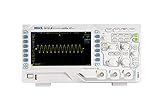
- 【Core Specs】100 MHz digital oscilloscope with 2 analog channels and external trigger input, up to 1 GSa/s real-time sample rate and standard deep memory up to 24 Mpts (12 Mpts dual-channel) for longer captures at higher sample rate.
- 【Waveform Capture & Display】Up to 30,000 wfms/s waveform capture rate helps reveal intermittent glitches; 7" WVGA (800×480) TFT with intensity graded color display provides a digital-phosphor style view for jitter and noise visibility.
- 【Record/Playback & Decode】Hardware real-time waveform recording and playback up to 60,000 frames supports event review. Serial bus trigger and decoding functions support RS232/UART, I2C and SPI for embedded troubleshooting.
- 【Connectivity & Remote】Standard interfaces include USB Host, USB Device and LAN (LXI), plus AUX output (TrigOut/PassFail) for bench integration and documentation workflows.
- 【Applications】Digital oscilloscope for electronics debugging, education labs, power and embedded bring-up; deep memory and capture rate help you keep both the big picture and fine details in long time captures.
Other DS80000 specifications and options
Rigol describes the family as using its StationMAX II hardware technology and UltraVision III acquisition and storage platform. Published family specifications include the following; maximum values and optional functions should not be treated as standard on every configuration.
| Capability | Published specification or qualification |
|---|---|
| Analog inputs | 4 analog channels; datasheet also lists 1 external trigger/input channel |
| Memory depth | Up to 2 Gpts or 4 Gpts, depending on option and configuration |
| Waveform capture rate | Up to 250,000 waveforms per second |
| Vertical resolution | Adjustable 8–16 bits; this is not evidence of a native 16-bit ADC |
| Display | 15.6-inch high-definition capacitive touchscreen |
| Waveform recording | Hardware recording and playback for up to 2,000,000 frames |
| Connections and control | Ethernet/LXI, USB host/device, HDMI and web control |
| Analysis functions | Protocol analysis, real-time eye diagrams and jitter analysis are listed as optional or software-dependent |
The maximum 4 Gpts depth can support longer captures at high sample rates, but it is an option-dependent figure. Memory allocation can also depend on channel count and acquisition mode; long records may take longer to process and search. Verify the depth available per channel in the intended multichannel setup.
The 250,000 wfms/s maximum is a waveform capture-rate figure, not the 40 GSa/s sample rate and not a promise of continuous recording at that rate. It indicates how frequently the scope can acquire and update waveforms under supported conditions; trigger setup, acquisition mode and enabled processing affect what is captured or displayed.
Rank #3
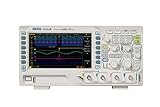
- 【Core Specs】50 MHz digital oscilloscope with 4 analog channels, up to 1 GSa/s (single-channel) sample rate and standard memory depth up to 24 Mpts (12 Mpts dual-channel, 6 Mpts 3/4-ch) for long captures.
- 【UltraVision Capture】Up to 30,000 wfms/s capture rate and intensity graded display help reveal intermittent events; waveform recording/playback up to 60,000 frames supports fast review of trigger-related anomalies.
- 【Trigger & Decode Tools】Rich trigger set plus serial bus trigger/decoding for RS232/UART, I2C and SPI; FFT and filters support basic frequency-domain checks during troubleshooting.
- 【Connectivity & Remote】Standard interfaces include USB Host, USB Device, LAN (LXI) and AUX output (TrigOut/PassFail) for bench integration and documentation workflows.
- 【Applications】Digital oscilloscope for electronics debugging, teaching labs, and power/embedded bring-up where deep memory and capture rate help keep both global timing context and waveform detail.
Applications Rigol targets
Rigol positions the DS80000 for high-speed device and system verification, high-speed bus compliance analysis, DDR debugging and high-speed design verification. Its datasheet lists protocol analysis and decoding for interfaces including RS-232/UART, I²C, SPI, CAN and CAN-FD, FlexRay, LIN, I²S, MIL-STD-1553 and USB 2.0. Decoding and advanced analysis may depend on software options.
The Tool Desk
Outbyte PC Repair FREERepair Windows errors before they cause bigger problemsFix Now →Outbyte Driver Updater FREEFix the driver behind crashes, sound loss and screen glitchesFind Drivers →General waveform observation is distinct from a complete compliance test. A standards-based workflow can require specific fixtures, probes, reference clocks, de-embedding, calibration, test automation and software with the relevant masks and limits. The instrument’s bandwidth alone does not establish turnkey compliance for a given standard.
Probes and connections can set the real limit
Rigol lists the PVA9130 as a 13 GHz active differential voltage probe, along with 10 GHz and 7 GHz active differential probes. The product page lists these as accessories; do not assume a probe is included in the instrument package. A lower-bandwidth probe or unsuitable fixture can become the bottleneck even when the scope is the DS81304.
Rank #4
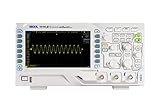
- 【Core Specs】200 MHz digital oscilloscope with 2 analog channels and external trigger input, up to 1 GSa/s real-time sample rate and standard deep memory up to 24 Mpts (12 Mpts dual-channel) for longer captures at higher sample rate.
- 【Waveform Capture & Display】Up to 30,000 wfms/s waveform capture rate helps reveal intermittent glitches; 7" WVGA (800×480) TFT with intensity graded color display provides a digital-phosphor style view for jitter and noise visibility.
- 【Record/Playback & Decode】Hardware real-time waveform recording and playback up to 60,000 frames supports event review. Serial bus trigger and decoding functions support RS232/UART, I2C and SPI for embedded troubleshooting.
- 【Connectivity & Remote】Standard interfaces include USB Host, USB Device and LAN (LXI), plus AUX output (TrigOut/PassFail) for bench integration and documentation workflows.
- 【Applications】Digital oscilloscope for electronics debugging, education labs, power and embedded bring-up; deep memory and capture rate help you keep both the big picture and fine details in long time captures.
The DS80000 introduces Rigol’s SmartProbe 2.0 interface, including direct 3.5 mm connections with a probe adapter. Rigol says the interface supports backward compatibility with previous-generation probes, but mechanical or interface compatibility does not mean an older probe delivers 13 GHz performance. Confirm the exact probe, adapter, bandwidth, loading, calibration support and regional bundle with Rigol or the seller.
- For differential serial links, memory buses or floating signals, choose a probe with suitable differential and common-mode range.
- Check input capacitance, maximum differential voltage, tip geometry and accessories; these can affect both the waveform and the circuit being measured.
- Use short, low-inductance connections where possible. Long ground leads can introduce ringing, overshoot and timing errors.
- Include probe and fixture calibration in the measurement plan, especially when working near the top of the bandwidth range.
How DS80000 compares with DS70000 and DS9000
Rigol’s North American comparison page lists these family-level figures. The DS9000 price range below is the US listing observed on August 18, 2026; it is not a quote for a particular model or configuration.
Recommended Free Tools
| Series | Maximum bandwidth | Maximum sample rate | Listed waveform capture rate | Digital channels | US price information |
|---|---|---|---|---|---|
| DS80000 | 13 GHz | 40 GSa/s | 250,000 wfms/s | None listed | Get a Quote |
| DS70000 | 5 GHz | 20 GSa/s | 1 Mwfms/s | None listed | Get a Quote |
| DS9000 | 6 GHz | 20 GSa/s | 1 Mwfms/s | 16 | $9,999–$27,999 family range shown in the US listing on August 18, 2026 |
These are different trade-offs, not a universal ranking. The DS80000 suits work where analog bandwidth and real-time sample rate are priorities. The DS70000 may suit a buyer whose bandwidth ceiling is 5 GHz and who values its higher listed waveform capture rate. The DS9000 may be a better fit for mixed-signal debugging when 6 GHz is enough and 16 digital channels matter more than a 13 GHz analog ceiling. Compare the intended model, options and measurement workflow using Rigol’s North American family comparison.
Best Value

- 【Core Specs】250 MHz digital oscilloscope with 4 analog channels, 1.25 GSa/s sampling, 12-bit resolution and up to 50 Mpts memory depth—captures faster edges and long records for advanced debug and validation.
- 【UltraAcquire & Search】UltraAcquire up to 1,000,000 wfms/s with 256-level intensity grading; waveform search/navigation and event table accelerate locating rare glitches and reviewing long acquisitions.
- 【AFG + Bode Plot (S Model)】S model includes single-channel AFG output and Bode plot analysis (10 Hz to 25 MHz) for loop and frequency-response testing; plus 16 digital channels (PLA2216 probe required, sold separately; no Slow sweep/Roll).
- 【Remote & Automation】Standard USB Host/Device, LAN (LXI‑C) and HDMI; Web Control in a browser and standard SCPI commands support remote operation, automation and documentation workflows.
- 【Applications】For power ripple/noise and loop response checks, high-speed embedded timing, and CAN/LIN/UART/I2C/SPI debug; 7" 1024×600 touch display and Flex Knob improve daily productivity. [3][4]
Availability, price and total system cost
Rigol’s US family page shows “Get a Quote” for DS80000 rather than a public US price. Its international product page offers buying and quote routes, but availability and delivered price depend on region and should be confirmed with a local seller. The cost of a usable setup may also include active probes, adapters, memory upgrades, protocol or eye/jitter software, compliance packages, calibration and support.
Rigol’s international product page lists a DS80000 datasheet and user guide dated May 8, 2025, a quick guide dated May 16, 2025, and a firmware listing of 00.01.01.00.01 dated November 10, 2025. These are documentation and firmware details shown on the product page, not a verified launch date.
Quick Recap
How to decide whether you need a DS80000
- Choose the bandwidth tier: identify the fastest edge or highest-frequency content that must be measured, then allow appropriate margin for the required amplitude and timing accuracy. Pick among 6, 8, 10 and 13 GHz rather than assuming the top model is necessary.
- Check the channel requirement: the DS80000 provides four analog channels. Rigol’s US comparison lists no digital channels for it; if many logic signals must be observed alongside analog waveforms, assess a separate logic analyzer or a mixed-signal alternative.
- Validate acquisition conditions: confirm the sample rate available with the number of channels in use, the memory depth per channel, and the behavior of the acquisition mode you need.
- Specify the measurement chain: identify probes, adapters, fixtures and calibration required for the signals, including the probe’s bandwidth and loading.
- Price the required functions: list any protocol decoding, eye diagram, jitter or compliance software, plus memory, service and support options.
- Request a region-specific quote: ask what probes and accessories are included, what options are licensed, and what calibration and warranty arrangements apply.
Product prices and availability are accurate as of the date/time indicated and are subject to change. Any price and availability information displayed on Amazon at the time of purchase will apply.

