
Recommended Free Tools
iTechGuides is reader-supported. When you buy through links on our site, we may earn an affiliate commission. As an Amazon Associate I earn from qualifying purchases. Learn more
The Ricoh GR III is a compact fixed-lens camera built around an APS-C sensor and a wide 28mm-equivalent F2.8 lens. Its appeal is the combination of a large sensor, a small body and direct, wide-angle framing—not zoom range or high-resolution video. Ricoh’s published specifications support that proposition, but they do not establish independent image-quality, autofocus or handling results.
Is the Ricoh GR III worth it?
It may suit you if you want an everyday camera with a wide, fixed perspective and the flexibility of RAW capture. The trade-off is fundamental: the lens does not zoom, and video tops out at Full HD. Before buying, consider whether you naturally compose with a wide view and whether those limits fit the way you shoot.
Ricoh specifies a 23.5 × 15.6 mm APS-C CMOS sensor with approximately 24.24 effective megapixels. The fixed GR lens is 18.3 mm, equivalent to about 28 mm in 35mm format, with an F2.8–F16 aperture range. The lens has six elements in four groups, including two aspherical elements. Ricoh’s GR III specifications list these details.
Ricoh describes the sensor as AA-filter-free, with an AA-filter simulator that uses sensor movement. The camera records 14-bit DNG RAW and JPEG, and supports sRGB and Adobe RGB color spaces. Its listed maximum sensitivity is ISO 102400; that ceiling is a specification, not evidence of image quality at that setting.
#1 Best Overall
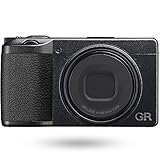
- GR with a 40mm angle of view: A focal length of 40mm provides a highly versatile angle of view that is close to the effective field of view of humans. You can enjoy snap expression with a new angle of view that has never been seen before.
- The ultimate snapshot camera-GR unchanging concept: High image quality, Quick response, Portability, and Evolving
- High image quality: Equipped with a GR lens that realizes sharp images, a 24.2M APS-C sensor, and a GR engine 6 that achieves both advanced image processing and response.
- Quick response: High-speed startup of about 0.8 seconds after the power is turned on. Equipped with high-speed hybrid AF that delivers both high-speed autofocus and greater precision.
- Portability: Controls are improved while maintaining the pursuit of portability.
How good is the Ricoh GR III for street photography?
The 28mm-equivalent lens gives a wide view that includes surroundings as well as a subject. That can be useful when the setting is part of the picture, but it is less suited to filling the frame with distant subjects. Since the lens is fixed, changing the framing means moving yourself, accepting more or less context, or cropping later.
Ricoh specifies hybrid autofocus combining image-plane phase matching and contrast detection. Its launch announcement describes the design rationale as pairing contrast AF’s focusing precision with phase detection’s high-speed operation. That is the manufacturer’s description, not an independently measured focus hit rate. Ricoh also gives an approximate 0.8-second startup time; this, too, is a manufacturer figure rather than a separate test result. Ricoh Imaging’s launch announcement provides the context.
Rank #2

- Built-in Highlight Diffusion Filter for Enhanced Expression: The built-in HDF (Highlight Diffusion Filter) diffuses highlights for softer light, creating more expressive images with a sense of depth and emotion
- Quick Function Button Access: The HDF ON/OFF function can be quickly changed with the Fn button, and "HDF" is printed on the back near the Fn button for easy identification
- Distinctive Dark Silver Shutter-Release Button: The dark silver shutter-release button subtly differentiates it from the regular model, adding a unique aesthetic touch
- High-Performance GR Lens with 40mm Equivalent Focal Length: A newly developed optical system consisting of 7 elements 5 groups with a new focal length of 26.1mm (approx. 40mm in 35 mm equivalent focal length) achieves sharp imaging with high resolution and high contrast
- Large Format Image Sensor for Superior Detail: 24.2MP large APS-C format image sensor with high resolution that utilizes the characteristics of the high-resolution lens for high-definition detail reproduction
What do stabilization and the body specifications mean in practice?
Ricoh specifies three-axis, sensor-shift Shake Reduction that compensates for yaw, pitch and roll, rated for up to four shutter-speed steps under the CIPA-based description. Treat that as a manufacturer rating, not a guarantee for a particular exposure. Stabilization can help reduce camera shake, but it does not freeze a moving subject.
The camera has a 3.0-inch capacitive touchscreen with approximately 1.037 million dots. Ricoh’s launch announcement identifies a magnesium-alloy exterior frame. Body weight is approximately 227 g without battery and card, or 257 g with them, according to the product specifications. These numbers help describe the portability goal; whether it fits comfortably in a particular pocket depends on the pocket and the owner.
Rank #3

- Monochrome-dedicated image sensor: Exclusively designed for black and white photography, the 25.74MP monochrome-dedicated APS-C CMOS image sensor achieves nuanced detail, high resolution, and exceptional reproduction of tones for outstanding monochrome rendering
- Dedicated monochrome image processing: GR ENGINE 7 maximizes the performance of the monochrome-dedicated image sensor, making full use of the brightness information captured by each pixel
- GR Lens: 28mm F2.8 GR Lens (in the 35mm format) delivers exceptional imaging performance with edge-to-edge sharpness
- Expressive high-ISO imaging to maximum ISO 409600: Even at high sensitivities, image detail remains abundant
- Image Control Options for Monochrome: New Image Control options Solid and Grainy have been developed to bring out the unique appeal of black and white photography
How long does the Ricoh GR III battery last?
Ricoh rates the DB-110 battery for approximately 200 recordable still images when fully charged, at 23°C and under CIPA test conditions. The company cautions that actual results vary with shooting conditions. Ricoh also lists approximately 180 minutes of playback time measured by its own method. Neither figure should be treated as a guaranteed real-world duration.
The camera can recharge or receive power through USB Type-C; Ricoh says an optional AC adapter is required for power supply. The supplied-items list includes a DB-110 battery, USB power adapter, plug, USB cable and hand strap. Ricoh separately lists its BJ-11 charger for the DB-110 and gives an approximate 2.5-hour charge time for an empty battery. That estimate is from Ricoh’s GR IIIx accessory information.
Rank #4
- Monochrome-dedicated image sensor: Exclusively designed for black and white photography, the 25.74MP monochrome-dedicated APS-C CMOS image sensor achieves nuanced detail, high resolution, and exceptional reproduction of tones for outstanding monochrome rendering
- Dedicated monochrome image processing: GR ENGINE 7 maximizes the performance of the monochrome-dedicated image sensor, making full use of the brightness information captured by each pixel
- GR Lens: 28mm F2.8 GR Lens (in the 35mm format) delivers exceptional imaging performance with edge-to-edge sharpness
- Expressive high-ISO imaging to maximum ISO 409600: Even at high sensitivities, image detail remains abundant
- Image Control Options for Monochrome: New Image Control options “Solid” and “Grainy” have been developed to bring out the unique appeal of black and white photography
What video and storage does the GR III support?
The GR III records Full HD video, not 4K. Its listed modes are 1920 × 1080 at 60p, 30p and 24p, in MPEG-4 AVC/H.264 MOV format, with a built-in stereo microphone. Each recording is limited to 25 minutes or 4 GB, and recording can stop automatically if the camera’s internal temperature becomes high.
Free tools Windows power users keep installed
One-click scans. No signup required.
Internal memory is approximately 2 GB. The camera accepts SD, SDHC and SDXC cards conforming to UHS-I. Ricoh lists USB Type-C for data transfer and DisplayPort video output in addition to charging and power functions.
Best Value

- Built-in HDF (Highlight Diffusion Filter): Diffuses highlights for softer light, creating more expressive images with a sense of depth and emotion
- Ultra Compact Design: Smallest GR to date, easily fits in your pocket for convenient portability
- New Image Sensor: 25.74MP Back-illuminated APS-C size equivalent CMOS sensor delivers exceptional image quality
- New GR Lens: Exceptional imaging performance with edge-to-edge sharpness
- High-Sensitivity Image Quality: Maximum of ISO 204800
Ricoh GR III vs GR IIIx: which should you buy?
The key difference is framing. Both cameras use an APS-C sensor with approximately 24.24 effective megapixels and an F2.8 lens, but the GR III’s view is wider. Ricoh’s comparison lists these focal lengths:
| Camera | Lens | 35mm-equivalent view | Best fit by framing |
|---|---|---|---|
| GR III | 18.3 mm, F2.8 | Approximately 28 mm | Wider scenes and more environmental context |
| GR IIIx | 26.1 mm, F2.8 | Approximately 40 mm | A tighter, more normal perspective |
Choose the GR III if you prefer a wider composition; choose the GR IIIx if you more often want a tighter view. This is a recommendation based on focal length and framing, not a claim that one camera produces better images. The comparison is documented on Ricoh’s GR III comparison page.
Firmware, price and availability
Ricoh’s U.S. product page showed a price of $1,049.95 and an out-of-stock notice when checked on October 7, 2026. That was a regional manufacturer listing at that time, not a universal street price or a guarantee of present availability. Check the current listing and confirm the exact model before purchasing: Ricoh’s U.S. GR III page.
Do these 3 things before closing this tab:
1Clear out junk files and repair common Windows errors2Fix the driver behind crashes, sound loss and screen glitches3Repair Windows errors before they cause bigger problemsRicoh’s U.S. firmware 2.10 notice says the update adds a GF-2 Flash Mode exposure setting that automatically adjusts exposure when the external GF-2 flash is attached and used for flash photography. It also reports a general stability improvement. Check Ricoh’s support page for any later release before updating: GR III firmware notice.
Quick Recap
Who should consider the GR III?
- Consider it if you want an APS-C compact with a wide fixed lens, RAW capture and sensor-shift stabilization, and you are comfortable composing without zoom.
- Look elsewhere or compare carefully if you need 4K video, a zoom lens, or a tested performance benchmark before deciding. The manufacturer specifications alone do not establish independent image-quality or autofocus performance.
- Compare it with the GR IIIx if you are unsure about the focal length: the choice is principally between a 28mm-equivalent wide view and a 40mm-equivalent tighter one.
Product prices and availability are accurate as of the date/time indicated and are subject to change. Any price and availability information displayed on Amazon at the time of purchase will apply.

