
Free tools Windows power users keep installed
One-click scans. No signup required.
iTechGuides is reader-supported. When you buy through links on our site, we may earn an affiliate commission. As an Amazon Associate I earn from qualifying purchases. Learn more
The PwrTool 500 is an inline DC shunt monitor that can send battery-path measurements to Home Assistant through its ESP32-C3 and ESPHome firmware. Voidbox Industries lists ratings of 6–60 VDC, 500 A peak and 300 A continuous. Its key limitation is what a single shunt measures: current and power in the battery path are net readings, not separate totals for charging and loads.
What the PwrTool 500 measures and how it connects to Home Assistant
Voidbox Industries describes the PwrTool 500 as a DC battery and power monitor built around a FLIP-C3/ESP32-C3 wireless controller and an INA238 measurement IC. ESPHome is its default firmware path for connecting the device to Home Assistant. The published specifications also list an onboard SHTC3 temperature/humidity sensor and a MOSFET output rated at 45 W. These are manufacturer specifications, not independently verified measurements.
Home Assistant’s battery-monitoring documentation frames the goal as tracking energy flowing to and from batteries. In this setup, the PwrTool 500 supplies DC-path measurements; Home Assistant can then present the resulting sensors for monitoring or automation.
Quick wins for a faster PC:
Repair Windows errors before they cause bigger problemsFix Now →Scan for outdated or missing drivers - takes under a minuteDriver Scan →Clear out junk files and repair common Windows errorsFree Scan →Published ratings and what they mean for your system
Voidbox Industries’ undated product specifications list the following ratings:
#1 Best Overall

- 1% Accuracy Measurement: Shunt-type battery monitor design provides much more accurate real-time voltage and current draw measurement.
- Protect the batteries: With High and low capacity alarm functions, our battery tester with shunt will alarm, and backlight and voltage value will flash simultaneously to protect the batteries from getting over-discharged.
- Fit for all battery: The energy monitor is compatible with various battery types, including Lead Acid (AGM, GEL), Lithium Iron Phosphate, Lithium-ion, Nickel-metal hybrid. 12V battery monitor compatible with batteries operating at 12 volts, 24 volts, and 48 volts.
- Easy To read: Renogy battery monitor displays multiple electronic parameters, including Voltage, Current, Consumed Power, Battery Capacity, and battery degradation rate with a customized brightness high-definition Backlight Display.
- Easy to Install: Transparent shunt holder makes the renogy lithium battery monitor easier to mount the shunt. And the 20ft Shielded cable allows you to monitor the battery status from a distance.
| Specification | Published value | Practical reading |
|---|---|---|
| Operating voltage | 6–60 VDC | Check that the battery system’s operating voltage falls within this range. |
| Current | 500 A peak; 300 A continuous | Peak and continuous ratings are not interchangeable. Size the installation for the continuous current expected in normal operation, and confirm transient conditions against the product documentation. |
| Measurement IC | INA238, 16-bit | Manufacturer-stated component and resolution; this does not by itself establish system-level accuracy. |
| Temperature and humidity sensor | SHTC3 | Onboard environmental readings are separate from battery-path measurements. |
| MOSFET output | 45 W | Intended for controlling suitable external loads; check the output’s electrical limits and wiring requirements before connecting anything. |
These figures do not alone determine whether the unit suits a particular installation. Battery voltage, expected continuous current, cable and lug sizing, sensing-side configuration, and the physical wiring arrangement all matter. The installation guide calls for appropriately sized cables but does not establish a universal cable gauge; select conductors and connections for the actual system and applicable electrical requirements.
How the inline shunt reading represents battery flow
The basic configuration described in the installation guide places the monitor inline in the battery negative path, between the battery and the connected loads and chargers. In that position, the monitor observes the net current through the battery connection. It does not independently measure every charger output and every load branch.
For example, the guide says that charging at 100 W while a 50 W load is active produces a 50 W charging reading. That is the net result at the battery path. To see separate charger and load figures, combine the battery reading with other relevant system data, such as a solar charge controller, or use additional PwrTool 500 units to monitor separate paths.
Rank #2

- More Accurate,No Data Lost:Upgraded shunt battery monitor equipped with high precision current detector which provides more accurate real-time voltage and current measurement. Moreover, LNEX battery monitor can automatically store the latest testing data when its system shuts down for protecting no data becomes lost when a power failure occurs.
- More Clear,No Blurry:For improving the visual experience, LNEX developed a battery monitor with 2.4" color screen which has a clearly backlit LCD display and a user-friendly interface.everything is displayed on the large color screen, you can easily check the readings at a glance or at the press of a button.
- More Safe, No Over-Discharged:With high low capacity alarm function,our rv battery monitor will alarm and backlight and voltage value will flash simultaneously to draw your attention, when your battery capacity is low or high to protect the batteries from getting over-discharged.
- More Simple,NoComplicated:Transparent shunt holder with clearly marked positive and negative makes it easier to mount the shunt while the 16ft long shielded wire allows you to monitor the status of your battery from a distance.
- All Compatible,Less Consumption:LNEX smart battery monitor 500A can monitor 8V-100V battery, compatible with various battery types, including Lead Acid, LiFePO4, Lithium-ion, Nickel-metal hybrid,widely used in the battery monitoring of RV, Car, Electric Motorcycle, Golf Cart, Boat and etc. In addition, Our battery monitor brightness is adjustable which keeps you comfortable at night and saves your battery power.
The device offers selectable hot-side or cold-side sensing. The guide says it is factory configured for cold-side sensing and directs users to choose the intended position before wiring. Do not assume that the factory setting matches a different installation topology; follow the official guide for the selected sensing position and wiring arrangement.
Install and adopt the device
Voidbox’s installation guide describes three main stages: wiring, connecting to Wi-Fi, and adopting the device in Home Assistant. Adopting it into ESPHome is optional.
- Choose the sensing side and plan the wiring. Decide whether the installation uses hot-side or cold-side sensing before making connections. Review the official PwrTool 500 installation guide for the relevant wiring layout.
- Install it in the battery path. For the guide’s basic arrangement, place the shunt inline in the battery negative path with the loads and chargers connected on the system side. Use appropriately sized cable and connections for the system; the guide does not prescribe one gauge for every installation.
- Connect the monitor to Wi-Fi. Follow the guide’s setup steps so the ESPHome-based device can join the local network.
- Adopt it in Home Assistant. Add the discovered device to Home Assistant using the documented adoption process. ESPHome adoption is available if you want to manage the device through ESPHome, but the guide describes it as optional.
Wiring a high-current battery path is not equivalent to installing a low-voltage sensor. Confirm the system is safe to work on, use suitable protective measures, and seek a qualified installer where the system, local rules, or your experience warrant it.
Rank #3
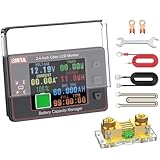
- Real-Time Battery Monitoring: The battery monitor shunt provides precise (±1%) readings of battery capacity, charge/discharge status, voltage, and current — with no limitation on battery bank size. It automatically saves the latest data during power loss to maximize efficiency, extend battery life, and prevent unexpected failures
- Wide Compatibility: This battery monitor works with 8-100V lead-acid, LiFePO4, and lithium-ion batteries. Supports currents from 0-500A. Perfect for monitoring batteries in RVs, boats, golf carts, motorcycles, cars, solar setups, trailers, and more
- Crisp Backlit Screen: This battery monitor with shunt comes with a 2.4-inch color LCD screen. Different data is shown in different colors, and everything’s labeled clearly. The backlight makes sure the display stays easy to read, whether it’s dark or sunny out. You can set a time for the screen to turn off to save battery, and just a quick tap on the button wakes it right up
- Easy to Install: The battery meter includes a 3m/10ft shielded cable that simplifies wiring and makes the process more convenient. It comes with a ground loop wire to facilitate installation, and a wrench is included to further ease the wiring work for users
- High and Low Capacitance Alarm: The battery shunt has high and low capacity alarm functions When battery capacity is too low or too high the backlight and voltage value flash to draw attention and alert It also has high and low voltage protection When voltage is above or below the protection value it automatically fully charges or empties power to avoid cumulative errors
Use power and energy sensors correctly in dashboards
Power and energy answer different questions. Home Assistant’s Power integration documentation describes power as a rate at a moment, typically measured in watts (W) or kilowatts (kW), and accumulated energy as a quantity over time, typically measured in kilowatt-hours (kWh). A current or power reading from the battery path is not itself an accumulated energy total.
Do these 3 things before closing this tab:
1Scan for outdated or missing drivers - takes under a minute2Repair Windows errors before they cause bigger problems3Fix the driver behind crashes, sound loss and screen glitches- Use an instantaneous power sensor when you want to see whether the battery is charging or supplying a load right now, or to create a power-based trigger or condition.
- Use an energy value accumulated over time when you want to track energy delivered or used across a period. Confirm that the sensor and its units represent energy rather than instantaneous power.
- Interpret the PwrTool 500’s battery-path value as net flow when both chargers and loads pass through the monitored path. Separate flow totals require separate measurements or data sources.
Home Assistant also documents other battery-monitoring approaches, including battery-vendor APIs, suitable AC-circuit CT clamps, and DIY sensors or energy-meter components. An AC CT clamp is a different measurement approach from this product’s inline DC shunt; CT installation can require opening an electrical cabinet and may require a qualified professional depending on the region.
Independent reader supportYour contribution helps us test, update, and keep practical guides available for everyone.Price and current availability
Availability details differ by page and can change. Voidbox Industries’ product page lists a price of $149.95, while Crowd Supply’s campaign page shows a $149 pledge amount and describes the item as available for preorder. The campaign is marked funded and includes a June 18, 2026 update titled “We’re in Production!” A production update is not confirmation that every order has shipped. Check the current product and campaign pages for live purchase terms and fulfillment status.
Rank #4

- 【Real‑Time Data Display】Our smart battery monitor tracks real‑time voltage, current, power, remaining capacity, runtime, and ambient temperature at a glance. Equipped with 4 display modes: simple display full data display curve display and historical data display for comprehensive battery oversight
- 【High Precision Monitoring】This shunt battery monitor delivers professional‑grade current accuracy of ±0.5% and voltage accuracy of ±1% across a wide 0‑500A, 8‑100V range. It automatically stores the latest test data during power loss, ensuring critical monitoring records are never lost
- 【Crisp Backlit Screen】View every detail on a bright 3.5‑inch color LCD with adjustable backlight brightness controlled by the up/down keys. Housed in strong PVC flame‑retardant material, this battery shunt monitor remains stable even in demanding conditions
- 【Wide Compatibility】 Compatible with LiFePO4 batteries, lithium‑ion, gel, sealed, and flooded types, this battery voltage meter operates with minimal power consumption. Perfect for monitoring batteries in RVs, boats, golf carts, motorcycles, cars, solar setups, trailers, and more
- 【Easy Installation】The battery meter includes a 10ft shielded cable, ground loop wire, an installation wrench, and a complete user manual. This all‑in‑one kit enables quick setup with flexible placement while minimizing signal interference
CNX Software’s September 1, 2025 launch coverage reported a $149 pledge and an expected shipment by the end of April 2026. That was a forecast published at launch, not proof of shipment; the later campaign page’s June 2026 production update is a separate status snapshot.
What to compare before choosing a battery monitor
Voidbox’s product page compares the PwrTool 500 with Victron SmartShunt, Thornwave PowerMon, REDARC, and LNEX devices. Treat those comparisons as manufacturer-published material. For an independent fit check, compare products using the same criteria and verify each model’s own documentation:
- Voltage range and continuous current rating, kept distinct from any peak rating.
- Hot-side or cold-side sensing options and compatibility with the intended wiring layout.
- Local Home Assistant connectivity, firmware path, and degree of configuration openness.
- Available measurement sensors and any control outputs, including their electrical limits.
- Price, current availability, support, and the clarity of installation documentation.
Those criteria are especially important when a monitor will carry battery current rather than observe a non-invasive AC circuit. The stated peak rating should not be used as a substitute for checking continuous-current suitability and the complete installation requirements.
Quick Recap
Product prices and availability are accurate as of the date/time indicated and are subject to change. Any price and availability information displayed on Amazon at the time of purchase will apply.

