Open-Unmix
Open-Unmix: An open-source toolkit for local four-stem separation through CLI and Python workflows. Ranked #17 of 21 in Stem Separation Software by our editors (7.8/10); pricing: Open source; best for developers wanting open-source four-stem separation.
At a glance
- Editor score7.8 / 10
- PricingOpen source
- Best forDevelopers wanting open-source four-stem separation
- Paid fromFree
- Stem typesvocals, drums, bass, other instruments
- Facts checked19 Sep 2026
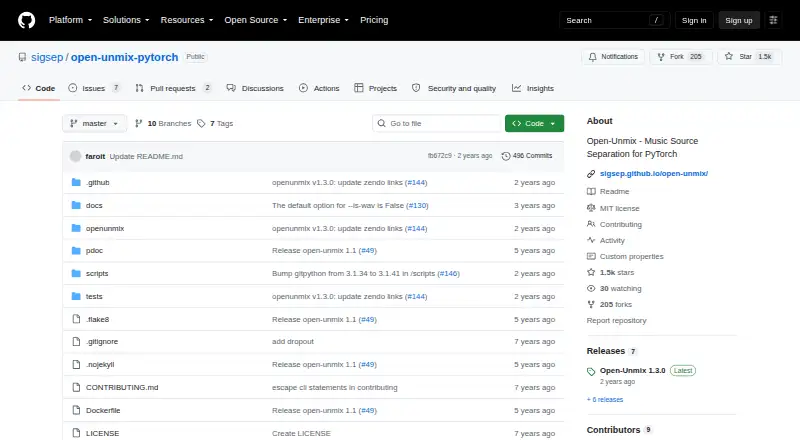
Where it wins
- Separates vocals, drums, bass, and other instruments with pretrained models
- Offers command-line, Python API, Torch Hub, and Docker workflows
- Supports batch processing, target selection, and residual-source generation
Where it doesn't
- Exports separated audio in WAV format
- Does not provide a dedicated desktop application
- Focuses primarily on four-stem music separation
Our verdict on Open-Unmix
Open-Unmix is an open-source PyTorch toolkit for separating music into vocals, drums, bass, and other instruments. It is aimed at researchers, audio engineers, artists, and developers who want to incorporate source separation into local audio workflows. Pretrained models include umx, umxhq, and umxl, and the toolkit also includes a speech-enhancement model. Rather than presenting a dedicated desktop interface, Open-Unmix offers command-line and Python workflows, with model loading through Torch Hub and Docker-based execution as additional options.
Its workflow flexibility is a central strength for technical users. Python APIs support loading models and separating audio, while batch processing handles multiple input files. Users can select targets and aggregate them, and optional residual-source generation and Wiener filtering provide additional processing choices. The surrounding ecosystem includes PyTorch and torchaudio, as well as Google Colab for notebook-based work. These options suit developers and research-oriented users fitting separation into existing code or audio-processing workflows; they are less suited to someone seeking a ready-made desktop editor.
The scope is comparatively focused: the verified music-separation output centers on four stems, with WAV as the export format. That makes Open-Unmix a reasonable fit when those stems and local processing align with the task, but a poor match for buyers who need broader stem choices, other export formats, or a dedicated desktop application. Its open-source model and technical entry points favor users comfortable working with software tools rather than a turnkey consumer interface. Choose it for programmable, open-source separation; look elsewhere if an app-led workflow or wider output-format support is essential.
Your product? Our editors can test Open-Unmix in depth and publish a review, labelled as paid · from $149/mo →
Open-Unmix pricing
Open-Unmix fact sheet
| Free plan | Not verified |
|---|---|
| Paid from | Free |
| Stem types | vocals, drums, bass, other instruments |
| Max upload size | Not verified |
| Max track length | Not verified |
| Batch processing | Yes |
| Export formats | WAV |
| Desktop app | No |
| API access | Yes |
| Deployment | Desktop, Self-hosted |
| Platforms | Windows, macOS, Linux |
| Integrations | 5 integrations: PyTorch, torchaudio, Torch Hub, Docker, Google Colab |
| Pricing | Open source |
| Website | github.com |
| Facts checked | 19 Sep 2026 |
Open-Unmix integrations
Open-Unmix lists 5 integrations on its own site.
- PyTorch
- torchaudio
- Torch Hub
- Docker
- Google Colab
Alternatives to Open-Unmix
- FadrA free starting point for stem separation, remix tools, MIDI detection and API workflows.9.4
- LALAL.AIFlexible stem separation with web, app, plugin, and API access.9.3
- MoisesA broad stem-separation toolkit for musicians, with bulk processing and apps across platforms.9.2



See all Open-Unmix alternatives →
Used Open-Unmix? Be the first to review it
The editor score above is our own research. What this page doesn't have yet is a reader's view — what you used Open-Unmix for, what worked and what didn't. No stars are seeded and no review is paid for; an editor reads every one before it appears.
Write a reviewTwo minutes · verified accounts only · read by an editor before it appears
Featured on iTechGuides

Open-Unmix is listed in our Stem Separation Software directory. Add the badge to your site — it links back to this page.
<a href="https://www.itechguides.com/products/open-unmix/"><img src="https://www.itechguides.com/best/badge/open-unmix.svg" alt="Featured on iTechGuides" width="230" height="46"></a>
Reviewed by iTechGuides Editors · Editorial team · Updated Oct 2026
Advertiser disclosure: iTechGuides is reader-supported. Vendors can pay for top positions in our rankings and for a place on other products' pages, and we may earn a commission when you click some links. Bought places stand at the number bought; this page and our disclosure say so. Paying vendors may get a fuller, more detailed review from our editors, and that review can change their score. How we rank.
Last updated · How we research and update