Open Music Theory
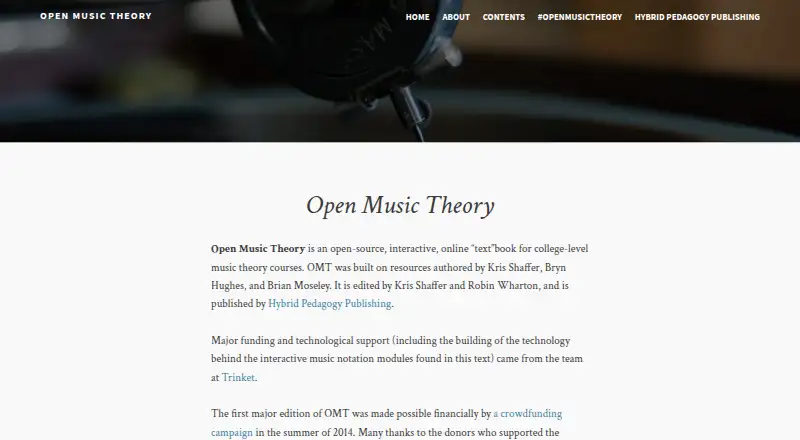
Open Music Theory: A broad, free web resource for teaching and studying music theory. Ranked #17 of 27 in Music Theory Software by our editors (7.4/10); pricing: Free plan; best for open educational music theory resources.
At a glance
- Editor score7.4 / 10
- PricingFree plan
- Best forOpen educational music theory resources
- Free planYes
- Paid fromFree
- Interactive exercisesYes
- Founded2014
- Facts checked20 Sep 2026
Where it wins
- Covers fundamentals, harmony, counterpoint, form, post-tonal, and pop/rock theory
- Interactive browser notation supports pitches, rhythms, chords, lyrics, and analysis
- Open licensing allows modification, distribution, and forking
Where it doesn't
- Web-only access limits platform coverage
- Notation is basic rather than a full notation environment
- No verified progress tracking or MIDI support
Our verdict on Open Music Theory
Open Music Theory is an open-source, interactive online textbook for college-level music theory courses. It suits instructors building active or flipped classroom lessons, as well as learners who need a broad reference covering notation, meter, pitches, scales, intervals, chords, harmony, voice-leading, form, post-tonal theory, and pop/rock analysis. Its browser-based notation modules add interactive exercises, including error detection and notation entry for pitches, rhythms, chords, lyrics, and analytical notation. It is designed to support guided instruction rather than serve as a standalone course platform.
The resource’s main strength is breadth within music theory education. Materials address species counterpoint, thoroughbass, figured bass, Roman-numeral and functional harmonic analysis, classical form, sonata, rondo, galant schemata, pitch-class sets, twelve-tone theory, and pop/rock rhythm, harmony, and form. That range makes it suitable for a college theory sequence or a reference library that spans multiple analytical traditions. Integrations with Trinket, Vimeo, and Spotify extend the textbook with embedded interactive, video, and listening content. The open license is also significant for educators or institutions that want to modify, distribute, or fork the material.
Open Music Theory is a strong choice when free, adaptable instructional content matters more than course-management features. It works particularly well alongside instructor-led teaching, where educators can assign readings and interactive activities within a broader curriculum. Buyers seeking a dedicated learning platform should look elsewhere: it does not provide verified progress tracking, MIDI support, or broader platform coverage, and its notation mode is basic. The web-only format keeps access straightforward but limits use beyond the browser. Its value is concentrated in openly licensed theory content and interactive explanation, not in managing a complete, self-paced learning experience.
Your product? Our editors can test Open Music Theory in depth and publish a review, labelled as paid · from $149/mo →
Open Music Theory pricing
Open Music Theory fact sheet
| Free plan | Yes |
|---|---|
| Paid from | Free |
| Interactive exercises | Yes |
| Notation tools | Basic |
| Harmony tools | Yes |
| Rhythm practice | Not verified |
| MIDI support | Not verified |
| Supported platforms | web |
| Progress tracking | Not verified |
| Deployment | Cloud, Self-hosted |
| Platforms | Web |
| Compliance & security | GDPR |
| Support | Docs |
| Built for | Small business, Mid-market, Enterprise (editorial estimate) |
| Integrations | 3 integrations: Trinket, Vimeo, Spotify |
| Pricing | Free plan |
| Website | openmusictheory.github.io |
| Facts checked | 20 Sep 2026 |
Open Music Theory integrations
Open Music Theory lists 3 integrations on its own site.
- Trinket
- Vimeo
- Spotify
Alternatives to Open Music Theory
- MusitionA comprehensive theory classroom tool with deep exercises, assessment, and LMS support.9.4
- HarmoniaA feature-rich free option for structured harmony study and classroom assessment.9.2
- note-noodleA broad, low-cost practice app covering theory, ear training, notation, rhythm, and play-alongs.9.0


See all Open Music Theory alternatives →
Used Open Music Theory? Be the first to review it
The editor score above is our own research. What this page doesn't have yet is a reader's view — what you used Open Music Theory for, what worked and what didn't. No stars are seeded and no review is paid for; an editor reads every one before it appears.
Write a reviewTwo minutes · verified accounts only · read by an editor before it appears
Featured on iTechGuides

Open Music Theory is listed in our Music Theory Software directory. Add the badge to your site — it links back to this page.
<a href="https://www.itechguides.com/products/open-music-theory/"><img src="https://www.itechguides.com/best/badge/open-music-theory.svg" alt="Featured on iTechGuides" width="230" height="46"></a>
Reviewed by iTechGuides Editors · Editorial team · Updated Oct 2026
Advertiser disclosure: iTechGuides is reader-supported. Vendors can pay for top positions in our rankings and for a place on other products' pages, and we may earn a commission when you click some links. Bought places stand at the number bought; this page and our disclosure say so. Paying vendors may get a fuller, more detailed review from our editors, and that review can change their score. How we rank.
Last updated · How we research and update