
Open Learning Analytics Platform (OpenLAP)
Open Learning Analytics Platform (OpenLAP): A research-oriented platform for co-designing indicators and analyzing xAPI learning data. Ranked #23 of 25 in Learning Analytics Software by our editors (6.7/10); pricing: Open source; best for open-source indicator design and xAPI analytics.
At a glance
- Editor score6.7 / 10
- PricingOpen source
- Best forOpen-source indicator design and xAPI analytics
- Paid fromFree
- Founded2003 · Duisburg and Essen, Germany
- Facts checked20 Sep 2026
Where it wins
- Aggregates learning data and collects it through xAPI
- Supports co-designed indicators with specification cards and an editor
- Includes modular analytics methods and visualization techniques
Where it doesn't
- Does not provide verified predictive, risk, or intervention features
- Built as a research and open-source platform, not commercial SaaS
- Its listed integrations focus on xAPI, Learning Locker, and MongoDB
Our verdict on Open Learning Analytics Platform (OpenLAP)
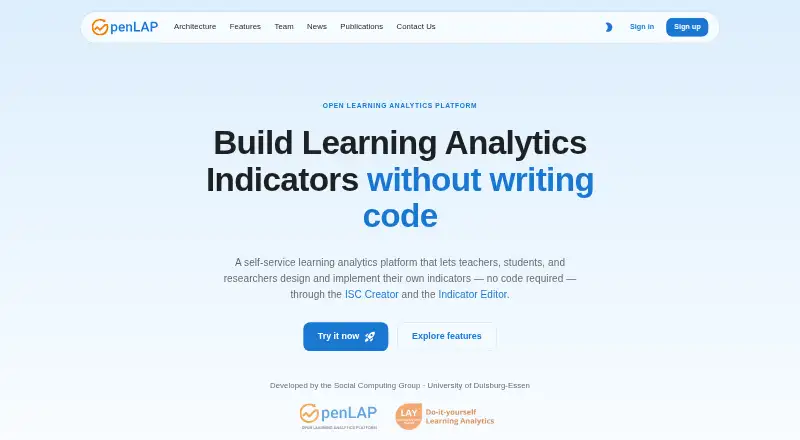
Open Learning Analytics Platform (OpenLAP) is an open-source learning analytics platform from the University of Duisburg-Essen's Social Computing group. It is designed for learning analytics researchers, educators, designers, and other stakeholders who need to collect learning data, define indicators, run analysis methods, and generate visualizations. The web and self-hosted platform supports learning data aggregation and integration, xAPI-based collection, privacy policy management, and personalized learning indicator design.
OpenLAP's standout capability is its indicator workflow. Indicator Specification Cards support co-design between stakeholders, while the interactive indicator editor supports basic, composite, and multi-level indicators. The platform also includes xAPI-to-CSV and CSV-to-xAPI conversion, allowing teams to work between xAPI data and CSV-based processes. This combination suits projects where the main challenge is translating learning goals into defined, reusable analytics indicators rather than selecting a packaged reporting application.
Its ecosystem fit centers on xAPI, Learning Locker, and MongoDB, with API access listed in the category specifications. The modular architecture covers analytics methods and visualization techniques, but OpenLAP does not provide verified predictive, risk, or intervention features. Choose it when open-source control, research flexibility, privacy management, and indicator co-design are priorities. Consider an alternative when the primary requirement is a commercial SaaS experience or verified predictive and intervention-oriented analytics.
Open Learning Analytics Platform (OpenLAP) pricing
Open Learning Analytics Platform (OpenLAP) fact sheet
| Free plan | Not verified |
|---|---|
| Paid from | Free |
| Custom dashboards | Not verified |
| Predictive analytics | Not verified |
| Learner risk scoring | Not verified |
| Intervention alerts | Not verified |
| API access | Yes |
| LTI support | Not verified |
| Deployment | Cloud, Self-hosted |
| Platforms | Web |
| Support | Email, Docs |
| Built for | Mid-market, Enterprise (editorial estimate) |
| Integrations | 3 integrations: xAPI, Learning Locker, MongoDB |
| Pricing | Open source |
| Website | openlap.de |
| Facts checked | 20 Sep 2026 |
Open Learning Analytics Platform (OpenLAP) integrations
Open Learning Analytics Platform (OpenLAP) lists 3 integrations on its own site.
- xAPI
- Learning Locker
- MongoDB
Alternatives to Open Learning Analytics Platform (OpenLAP)
- AnalyticVueA broad analytics platform for districts combining reporting, prediction, alerts, and integrations.9.4
- Civitas Learning Student Impact PlatformA higher-ed analytics platform for prioritizing risk, coordinating interventions, and measuring impact.9.3
- IntelliBoard Learning Analytics PlatformA multi-source analytics platform for identifying learner risk and coordinating interventions.9.1



See all Open Learning Analytics Platform (OpenLAP) alternatives →
Used Open Learning Analytics Platform (OpenLAP)? Be the first to review it
The editor score above is our own research. What this page doesn't have yet is a reader's view — what you used Open Learning Analytics Platform (OpenLAP) for, what worked and what didn't. No stars are seeded and no review is paid for; an editor reads every one before it appears.
Write a reviewTwo minutes · verified accounts only · read by an editor before it appears
Featured on iTechGuides

Open Learning Analytics Platform (OpenLAP) is listed in our Learning Analytics Software directory. Add the badge to your site — it links back to this page.
<a href="https://www.itechguides.com/products/open-learning-analytics-platform-openlap/"><img src="https://www.itechguides.com/best/badge/open-learning-analytics-platform-openlap.svg" alt="Featured on iTechGuides" width="230" height="46"></a>
Reviewed by iTechGuides Editors · Editorial team · Updated Oct 2026
Advertiser disclosure: iTechGuides is reader-supported. Vendors can pay for top positions in our rankings and for a place on other products' pages, and we may earn a commission when you click some links. Bought places stand at the number bought; this page and our disclosure say so. Paying vendors may get a fuller, more detailed review from our editors, and that review can change their score. How we rank.
Last updated · How we research and update