
Free tools Windows power users keep installed
One-click scans. No signup required.
iTechGuides is reader-supported. When you buy through links on our site, we may earn an affiliate commission. As an Amazon Associate I earn from qualifying purchases. Learn more
Poplar biofuel has potential to offer substantial environmental savings, but it is not automatically low-carbon or environmentally harmless. Results depend on the conversion route, farm inputs, land-use and soil-carbon assumptions, and which fossil fuel the biofuel replaces. A 2026 U.S. analysis, for example, modeled markedly different direct life-cycle emissions for two poplar-to-jet-fuel pathways.
Does poplar biofuel reduce greenhouse-gas emissions?
It can, when the full fuel pathway emits less than the fossil energy it displaces. The relevant comparison is not simply a poplar tree’s carbon uptake against the emissions from burning a fuel. A life-cycle assessment must account for growing and harvesting the crop, converting it into fuel, using that fuel, and the carbon changes that would have occurred under the alternative land-use scenario.

That is why there is no single emissions factor or percentage saving that applies to all poplar biofuel. Crop yields and fertilizer use affect production emissions; conversion technology affects processing emissions; and the baseline land and soil-carbon assumptions affect the overall comparison. The fossil fuel displaced also matters.
How the conversion route changes the result
A 2026 U.S. study modeled dedicated energy crops using national-average crop yields and farming inputs. Its direct well-to-wake estimates for poplar jet fuel include direct emissions from biomass production, fuel production, and fuel combustion:
#1 Best Overall
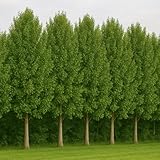
- Very fast growing, Hybrid Poplar Trees are great for fast privacy, shade, and landscaping.
- Great for windbreaks, privacy hedge, landscaping and more.
- Very fast growing, instructions are included.
- Satisfaction Guaranteed. We guarantee our natural products.
| Poplar-to-jet pathway | Direct well-to-wake emissions | What the figure represents |
|---|---|---|
| Fischer–Tropsch-to-jet | 11.9 g CO2e/MJ | Modeled direct pathway estimate in the 2026 U.S. study; not a universal value for poplar fuel. |
| Ethanol-to-jet | 36.2 g CO2e/MJ | Modeled direct pathway estimate in the same study and under the same broad study context. |
The estimates show why “poplar biofuel” is too broad a category for a precise climate claim: the modeled conversion route matters. These values are not standalone percentage reductions against petroleum jet fuel, because they do not themselves specify a petroleum comparator. The study also analyzed market-mediated emissions separately; including those effects changed the comparative rankings among crop pathways.
What other poplar life-cycle studies show
Results from other studies illustrate how much the outcome depends on the system being assessed. Their figures use different boundaries, places, fuels, and assumptions, so they should not be treated as directly comparable estimates of one typical poplar project.
Rank #2
- Very fast growing, Hybrid Poplar Trees are great for fast privacy, shade, and landscaping.
- Great for windbreaks, privacy hedge, landscaping and more.
- Very fast growing, instructions are included.
- Satisfaction Guaranteed. We guarantee our natural products.
| Study context | Reported finding | Important qualification |
|---|---|---|
| Pacific Northwest hybrid-poplar bioethanol case study | Net global-warming impact of −1.05 × 10⁻³ kg CO2-eq per MJ; bioconversion contributed an average of 77% across the environmental categories assessed. | The negative climate result was modeled under the case study’s accounting, including credits for carbon stored during crop growth and avoided fossil emissions from renewable electricity. It is not a general property of poplar ethanol. |
| Poplar wood chips replacing oil heat on marginal agricultural land in southern Germany (2017 study) | Up to 123 Mg CO2-eq/ha in modeled savings for a seven-year, unfertilized rotation. | This is a scenario-specific maximum for the study’s land, rotation, and oil-heating substitution—not a generic biofuel saving. |
| Hybrid-poplar bioenergy cropping systems modeled for Pennsylvania (2007 study) | About 145% near-term and 115% long-term life-cycle greenhouse-gas reductions relative to gasoline and diesel. | These are older model outputs that depend on assumed fossil-fuel displacement and soil-carbon changes, not measured results or a claim about current commercial performance. |
Why climate savings do not settle every environmental question
Greenhouse-gas emissions are only one part of environmental performance. In the Pacific Northwest bioethanol case study, bioconversion was the largest average contributor across the environmental categories assessed, while the second-largest contributor varied by category between poplar feedstock and harvesting, and fuel use. A favorable climate result therefore does not establish that every impact category is favorable.
What’s actually slowing this PC down?
Pick the symptom - the matching free tool is one click away.
Crop management can also shift impacts in different directions. In the 2017 southern Germany marginal-land study, longer rotations increased yields and reduced some impacts. Higher fertilizer use increased biomass, but also increased nitrate leaching and soil nitrous-oxide emissions. The study’s greatest modeled oil-heating substitution savings came from its seven-year unfertilized rotation.
How to interpret claims about carbon neutrality
Burning biomass releases carbon dioxide; it should not be described as having zero combustion emissions. A carbon assessment instead distinguishes fossil-derived emissions from biogenic carbon and considers how much carbon the crop absorbs, whether and when regrowth compensates for harvested biomass, and how the result differs from the reference land-use case.
A 2021 framework applied to poplar biomass separates those elements, including changes in carbon sequestration relative to the reference scenario. The accounting method and baseline matter: a claim that poplar is “carbon neutral” without defining them leaves out information needed to judge the claim.
Rank #4

- 🌳 Includes 10 Healthy Live Seedlings Receive 10 live Hybrid Poplar tree seedlings, each measuring approximately 14–18 inches tall. Shipped dormant during the appropriate season to ensure safe transit and successful planting.
- ⚡ Fast-Growing Shade Trees Hybrid Poplars are among the fastest-growing shade trees, capable of adding several feet of growth per year under ideal conditions. Quickly establish natural privacy screens, windbreaks, and cooling shade.
- 🏡 Ideal for Privacy & Landscaping Perfect for creating living fences, property borders, erosion control, wildlife habitat, and large landscape projects where rapid growth is desired.
- 🌱 Easy to Establish Thrives in full sun and adapts to a wide range of soil types, including loam, clay, and sandy soils, provided they are well-drained. Water regularly during the first growing season to encourage strong root development.
- ❄️ Hardy & Low Maintenance Suitable for USDA Hardiness Zones 3–9. Once established, Hybrid Poplars require minimal maintenance while providing years of beauty, shade, and privacy.
What to check when evaluating a poplar-fuel claim
- Fuel pathway: Identify whether the claim concerns heat, ethanol, jet fuel, or another product, and the conversion process used.
- Life-cycle boundary: Check whether the estimate covers crop production, conversion, fuel use, and market-mediated effects, or only some of them.
- Land and soil baseline: Find out what land use the poplar system replaces and how soil-carbon changes are handled.
- Farm management: Look for the assumed yields, rotation length, fertilizer use, and other crop inputs.
- Comparator and unit: Check which fossil energy source is displaced and whether the result is reported per unit of energy, area, or another basis.
- Impact category: Separate climate results from effects such as nitrate leaching and nitrous-oxide emissions.
Without those details, two apparently conflicting claims may be describing different fuels, boundaries, baselines, or environmental outcomes rather than contradicting each other.
Recommended Free Tools
Quick Recap
Best Value

- Get 55 cuttings of the fast growing hybrid poplar tree. Easy to grow and maintain, these trees dont produce cotton or suckers.
- Great for windbreaks, privacy hedge, landscaping and more.
- Grown in Iowa
- Satisfaction Guaranteed. We guarantee our natural products.
Product prices and availability are accurate as of the date/time indicated and are subject to change. Any price and availability information displayed on Amazon at the time of purchase will apply.

