
iTechGuides is reader-supported. When you buy through links on our site, we may earn an affiliate commission. As an Amazon Associate I earn from qualifying purchases. Learn more
The “step-up” in polyurethane precursor production was a 2006 industrial expansion in Shanghai—not a current production announcement. Huntsman, BASF and three Chinese partners launched an integrated isocyanates complex at Shanghai Chemical Industry Park, with announced annual capacity of 240,000 metric tons of crude MDI. A contemporaneous American Chemical Society report put the complex’s TDI capacity at 160,000 metric tons per year.
What the 2006 expansion involved
On 18 August 2006, Huntsman, BASF, Shanghai Hua Yi, Sinopec Shanghai Gao Qiao Petrochemical and Shanghai Chlor-Alkali marked startup of an integrated isocyanates complex at Shanghai Chemical Industry Park. Huntsman reported that the project represented $1 billion in capital expenditure and included capacity to produce 240,000 metric tons of crude MDI annually. Huntsman’s 18 August 2006 announcement also reported 28 million working hours since groundbreaking in spring 2004.
The complex was made up of separate joint ventures covering MDI finishing and prepolymers, crude MDI production, and an MDI finishing/TDI plant. Huntsman’s announcement identifies the TDI plant and its nitric acid and dinitrotoluene precursors but does not state a TDI capacity. The American Chemical Society’s Chemical & Engineering News report, published 23 August 2006, gives the complex’s TDI capacity as 160,000 metric tons per year. That figure is reported by C&EN, rather than in Huntsman’s release.
What MDI and TDI do
MDI and TDI are isocyanates used as precursors in polyurethane manufacturing. The 2006 Huntsman announcement named automotive, construction, refrigerators and other appliances, upholstery, and footwear among the markets served by polyurethane products made with these materials. A 2023 joint announcement also cited automotive, construction, refrigerators, and footwear.
#1 Best Overall

- BUILT FOR MARINE FLOTATION - This 2 lb density expanding pour foam is designed for flotation cavities in boats, kayaks, canoes, and marine refits. Once cured, it forms lightweight, rigid flotation foam for boats and helps provide buoyancy in enclosed voids. Under recommended conditions, each 2 Quart kit expands to approximately 2 cubic feet, filling more space with less liquid.
- CLOSED CELL & WATER RESISTANT - This polyurethane pour foam cures into a 94% closed-cell structure that traps air for buoyancy while resisting water absorption. The rigid marine foam is suited to hull, deck, and compartment cavities exposed to damp or saltwater environments. Water resistant refers to the cured foam; it is not a waterproof surface sealant or a substitute for vessel safety equipment.
- HIGH EXPANSION FOR IRREGULAR VOIDS - The liquid, two part expanding foam flows into curved cavities and hard-to-reach openings before expanding to fill the available space. Use as boat pour foam for flotation voids, large gap filling, fish boxes, bait wells, and insulation cavities. Leave extra room for expansion, avoid overfilling confined spaces, and apply larger volumes in controlled layers.
- EASY TO MIX, POUR & SHAPE – Mix Part A and Part B in a 1:1 ratio and stir evenly; the liquid foam pours easily and conforms to any shape or space. Working time before foaming is about 45 seconds. For best adhesion on smooth surfaces like PE plastic, sand and clean the area first. Apply in layers for thicker fills, letting each layer set before adding the next.
- FAST EXPANSION, RIGID & TRIMMABLE - At about 65-85 F, full expansion takes approximately 5 minutes; the cured rigid foam is generally ready to cut, sand, and shape after about 15 minutes. This closed cell foam also supports thermal insulation, sound dampening, and vibration reduction. Cured surfaces can be coated with compatible polyester, epoxy, or vinyl ester resin. Use for nonstructural filling applications.
The announced capacities describe the scale of the Shanghai complex, not verified production in any later year. Capacity is not the same as actual output: the sources describe the project and its initial ramp-up, not sustained utilization or current production.
Startup and commercial operation
Huntsman said the complex’s MDI plants entered commercial operation on 18 October 2006. The company reported that operating rates were building rapidly according to plan and that product was being processed and supplied to the Chinese market. Its CEO, Peter R. Huntsman, said the company expected the plants to reach full design capacity throughout 2007 and beyond. That was a management expectation at the time; the reviewed announcements do not establish that the target was achieved.
Rank #2

- Flotation Foam is a polyurethane 2-part foam that, when mixed in equal parts and poured in place this foam will soundproof, insulate, or provide extra buoyancy.
- 6LB. Density polyurethane flotation Foam 1 Gallon Kit; Consists of 1/2 gallon of Part A and 1/2 gallon of Part B and produces 1.5 cubic feet. If you want a high expanding foam look at our 2lb foam. 6lb foam does not expand much from its liqued state.
- Once fully cured this foam can be laminated over with any type of polyester, epoxy or vinyl ester resin without melting.
- The 6LB density also works well in floating decoy or taxidermy applications as well as many other sculpting, casting, carving and other filling applications
- All expansion rates and times given are temperature critical. Temperatures below 75° F will lower the expansion rate therefore requiring more foam. Ideal working temperature is 75° to 80° F or above. Accurate measuring of these products is extremely critical. Working time before foaming: approx. 45 seconds Time before full expansion: approx. 5 minutes
How the arrangement was later set to change
In a joint release dated 31 July 2023, BASF and Huntsman described a planned separation of the Caojing MDI production arrangement. Under the plan, Huntsman and Shanghai Chlor-Alkali would take over the original MDI plant, which began commercial production in 2006; BASF, Shanghai Hua Yi and Sinopec would take over the plant added in 2018. The announcement said the new arrangement was subject to approvals and other closing conditions. The 2023 joint release does not, by itself, establish the exact ownership or operating status in 2026.
What’s actually slowing this PC down?
Pick the symptom - the matching free tool is one click away.
What the headline means today
“Polyurethane precursor production stepped up” refers to the Shanghai complex’s 2006 startup and capacity announcement. The Chemistry World listing dated 22 August 2006 paired the headline with the subtitle “China on track for world-beating polyurethane market.” Its listing repeated an expectation that China’s polyurethane market would grow about 10% annually through 2015; that was a forecast made at the time, not a current growth statistic or confirmation of what later occurred. The listing is the basis for the headline and date, while project details and figures above come from the dated company announcements and contemporaneous C&EN report.
Quick Recap
Best Value

- Flotation Foam is a polyurethane 2-part foam that, when mixed in equal parts and poured in place this foam will soundproof, insulate, or provide extra buoyancy.
- 4LB. Density polyurethane flotation Foam 1 Gallon Kit; Consists of 1/2 gallon of Part A and 1/2 gallon of Part B and produces 2 cubic feet.
- Once fully cured this foam can be laminated over with any type of polyester, epoxy or vinyl ester resin without melting.
- The 4LB density also works well in floating decoy or taxidermy applications as well as many other sculpting, casting, carving and other filling applications
- All expansion rates and times given are temperature critical. Temperatures below 75° F will lower the expansion rate therefore requiring more foam. Ideal working temperature is 75° to 80° F or above. Accurate measuring of these products is extremely critical. Working time before foaming: approx. 45 seconds Time before full expansion: approx. 5 minutes
Rank #4

- CLASS A SURFACE-BURNING PERFORMANCE + HIGH R-VALUE: BEEST FullStop was tested to ASTM E84 and achieved a Flame Spread Index of 0 and Smoke Developed Index of 120, meeting Class A surface-burning criteria. Delivers strong thermal insulation performance with an R-Value of 8.24 at 2" thickness.
- ALL-IN-ONE SPRAY FOAM INSULATION KIT — UP TO 240 BOARD FT: Get everything needed to start insulating in one box, including 12 spray foam cans, heavy-duty applicator gun, solvent-based cleaner, gloves, goggles and coverall for a complete DIY insulation setup.
- ADVANCED HYBRID FOAM WITH LOW WATER ABSORPTION: FullStop combines strength and controlled expansion for dependable gap filling, insulation and coverage. Its cured foam structure helps resist water absorption, with short-term water absorption tested under EN 1609.
- HELPS REDUCE AIR LEAKS & IMPROVE THERMAL COMFORT: FullStop expands consistently within the recommended 68–77°F application range to fill gaps, cracks and hard-to-reach spaces. Its insulating foam helps reduce unwanted air movement and heat transfer for improved year-round comfort.
- STRONG ADHESION TO COMMON BUILDING MATERIALS: The moisture-cured polyurethane formula bonds securely to wood, metal, drywall, concrete, brick and other common building surfaces. Once cured, the foam creates a durable insulating seal that helps reduce drafts while resisting water absorption.
Rank #3
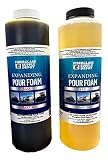
- Flotation Foam is a polyurethane 2-part foam that, when mixed in equal parts and poured in place this foam will soundproof, insulate, or provide extra buoyancy.
- 4LB. Density polyurethane flotation Foam Quart Kit; Consists of 1 pint of Part A and 1 pint of Part B and produces 1/2 cubic foot.
- Once fully cured this foam can be laminated over with any type of polyester, epoxy or vinyl ester resin without melting.
- The 4LB density also works well in floating decoy or taxidermy applications as well as many other sculpting, casting, carving and other filling applications
- All expansion rates and times given are temperature critical. Temperatures below 75° F will lower the expansion rate therefore requiring more foam. Ideal working temperature is 75° to 80° F or above. Accurate measuring of these products is extremely critical. Working time before foaming: approx. 45 seconds Time before full expansion: approx. 5 minutes
Product prices and availability are accurate as of the date/time indicated and are subject to change. Any price and availability information displayed on Amazon at the time of purchase will apply.

