
PC Slower Than It Used to Be?
A free scan shows the junk files, broken settings and background clutter dragging Windows down - then fixes them in one click.Free scan · Windows 10 & 11Crashes, No Sound, or Screen Glitches?
Random freezes, missing sound and display glitches usually trace back to one bad driver. Find and replace yours safely.Free scan · under a minuteiTechGuides is reader-supported. When you buy through links on our site, we may earn an affiliate commission. As an Amazon Associate I earn from qualifying purchases. Learn more
PCIe 7.0 doubles PCIe 6.0’s raw data rate to 128 GT/s and targets up to 512 GB/s of bidirectional bandwidth over a 16-lane (x16) link. That is a major step for systems moving data among accelerators, storage and networks—but it does not mean a consumer SSD will deliver 512 GB/s, or that PCIe 7.0 drives are about to appear in ordinary PCs. The specification was published in June 2025; PCI-SIG’s FAQ anticipated preliminary testing in 2026, with an official compliance program to follow.
What PCIe 7.0 is—and what its speed figures mean
PCI Express (PCIe) is the high-speed connection standard that lets a computer’s components exchange data. Graphics cards, SSDs, network adapters and other devices connect through PCIe links, which can use different numbers of lanes. More lanes provide a wider link; a higher generation raises the data rate each lane can carry.
PCI-SIG, the organization that develops the standard, lists PCIe 7.0 Base Specification Revision 7.0 as dated June 11, 2025. Its headline figures are 128 gigatransfers per second (GT/s) raw bit rate and up to 512 gigabytes per second (GB/s) bidirectional bandwidth on an x16 link. That aggregate figure counts traffic in both directions; it is not a promise of 512 GB/s of application data in one direction. Actual payload throughput depends on protocol overhead and the components and configuration in the system.
Recommended Free Tools
PCIe 7.0 uses PAM4 signaling, which encodes more information per signal event than traditional two-level signaling. That helps increase the data rate, but also makes signal quality and error management more demanding. PCI-SIG’s feature goals include reach and channel parameters, low latency and high reliability, improved power efficiency, and backward compatibility.
#1 Best Overall

- PCIe 4.0 Performance: Delivers up to 7,100 MB/s read and 6,000 MB/s write speeds for quicker game load times, bootups, and smooth multitasking
- Spacious 1TB SSD: Provides space for AAA games, apps, and media with standard Gen4 NVMe performance for casual gamers and home users
- Broad Compatibility: Works seamlessly with laptops, desktops, and select gaming consoles including ROG Ally X, Lenovo Legion Go, and AYANEO Kun. Also backward compatible with PCIe Gen3 systems for flexible upgrades
- Better Productivity: Up to 2x faster than previous Gen3 generation. Improve performance for real world tasks like booting Windows, starting applications like Adobe Photoshop and Illustrator, and working in applications like Microsoft Excel and PowerPoint
- Trusted Micron Quality: Built with advanced G8 NAND and thermal control for reliable Gen4 performance trusted by gamers and home users
How PCIe 7.0 compares with PCIe 6.0
| Generation | Raw data rate | Bandwidth figure established here |
|---|---|---|
| PCIe 6.0 | 64.0 GT/s | Not stated in the cited PCI-SIG figures |
| PCIe 7.0 | 128.0 GT/s | Up to 512 GB/s bidirectional over x16 |
PCI-SIG describes PCIe 7.0 as doubling PCIe 6.0’s 64.0 GT/s raw rate. GT/s measures transfers, not bytes of application data. The 512 GB/s figure applies to the specified x16 configuration and sums both directions, so comparing it directly with a drive’s one-way sequential-read result would be misleading.
Why engineers are accelerating the interconnect roadmap
PCI-SIG identifies 800G Ethernet, artificial intelligence and machine learning, high-performance computing (HPC), quantum computing, hyperscale data centers and cloud computing as target markets for PCIe 7.0. These systems can move large datasets among accelerators, memory, storage and network connections. Raising link capacity can help prevent the connection between components from becoming a bottleneck, while keeping latency, reliability and power use in view.
Higher signaling rates also make the physical path harder to engineer. Channel reach, signal integrity, error handling, power and cooling all matter alongside peak bandwidth. Depending on the platform and topology, designers may need to account for retimers or switches, as well as validation and compliance work. The standard’s backward-compatibility goal does not make every older device or motherboard capable of running at PCIe 7.0 speeds; the host, link and endpoint must support the relevant generation and configuration.
Rank #2

- HUGE SPEED BOOST: Get random read/write speeds that are 40%/55% faster than 980 PRO; Experience up to 1400K/1550K IOPS, while sequential read/write speeds up to 7,450/6,900 MB/s reach near the max performance of PCIe 4.0*
- BREAKTHROUGH POWER EFFICIENCY: Use less power and get more performance; Enjoy up to 50% improved performance per watt over 980 PRO, plus optimal power efficiency with max PCIe 4.0 performance**
- SMART THERMAL CONTROL: Samsung's own nickel-coated controller delivers effective thermal control; With its slim size, 990 PRO is a perfect fit for desktops and laptops that meet the PCI-SIG D8 standard***
- THE CHAMPION MAKER: Up to 65% improvement in random performance enables faster loads for an ultimate gaming experience on PS5 and DirectStorage PC games****
- SAMSUNG MAGICIAN SOFTWARE: Get the most out of your SSD with Samsung Magician's advanced yet intuitive optimization tools; Monitor drive health, protect valuable data, and receive important updates for your 990 PRO
What PCIe 7.0 could mean for SSDs
NVMe SSDs are a visible example of storage benefiting from wider, faster links: a drive capable of producing more data can use the added bandwidth when the rest of the system can accept it. But an interconnect standard sets a ceiling for the connection, not the speed of every device attached to it. NAND, the SSD controller, firmware, workload, cooling and host platform all affect real performance.
Micron describes its 9650 as the first PCIe Gen6 SSD designed for data centers. Its product materials list up to 28 GB/s sequential read and 5.5 million random-read IOPS. Micron reports those figures for an enterprise/data-center drive available in E1.S and E3.S form factors—not a consumer M.2 PCIe 7.0 SSD.
Micron’s Gen6 and Gen5 product figures
| Measure | Micron 9650, PCIe Gen6 | PCIe Gen5 SSD comparison |
|---|---|---|
| Sequential read | 28,000 MB/s | 14,000 MB/s |
| Sequential write | 14,000 MB/s | 10,000 MB/s |
| Random read | 5.5 million IOPS | 3.3 million IOPS |
| Random write | 900,000 IOPS | Not stated in Micron’s cited comparison |
These are figures in Micron’s 2025/2026 product reporting, not a controlled comparison of otherwise identical drives. Sequential results describe sustained transfers of data; random IOPS describe operations on smaller, scattered requests. Neither number alone predicts how quickly a particular application will feel. Drive form factor, host support, cooling and workload matter, especially when comparing a data-center device with a consumer M.2 product.
Rank #3
- PCIe 4.0 Performance: Delivers up to 7,100 MB/s read and 6,000 MB/s write speeds for quicker game load times, bootups, and smooth multitasking
- Spacious 2TB SSD: Provides space for AAA games, apps, and media with standard Gen4 NVMe performance for casual gamers and home users
- Broad Compatibility: Works seamlessly with laptops, desktops, and select gaming consoles including ROG Ally X, Lenovo Legion Go, and AYANEO Kun. Also backward compatible with PCIe Gen3 systems for flexible upgrades
- Better Productivity: Up to 2x faster than previous Gen3 generation. Improve performance for real world tasks like booting Windows, starting applications like Adobe Photoshop and Illustrator, and working in applications like Microsoft Excel and PowerPoint
- Trusted Micron Quality: Built with advanced G8 NAND and thermal control for reliable Gen4 performance trusted by gamers and home users
Why fast storage is becoming a system-design problem
A faster SSD is only one part of a storage path. The host processor or switch, link topology, firmware, cooling and available power must all support the intended configuration. E1.S and E3.S enterprise drives are not interchangeable with consumer M.2 drives simply because all use PCIe. Their form factors and platform requirements differ.
A Microchip announcement dated August 4, 2026, describes a Switchtec PCIe Gen6 switch connecting multiple Micron 9650 SSDs in an end-to-end architecture for AI, HPC and cloud workloads. The example illustrates how system designers can build capacity and throughput by combining drives and a switch, rather than relying on a single SSD alone. It is a Gen6 data-center system example, not evidence of a consumer PCIe 7.0 launch.
Independent reader supportYour contribution helps us test, update, and keep practical guides available for everyone.Should you wait for PCIe 7.0 storage?
For a typical PC or gaming build
There is no established consumer PCIe 7.0 SSD launch date or retail price in the published information cited here. A PCIe 7.0 specification is not the same thing as an available drive, compatible motherboard or complete consumer platform. Choose storage based on your existing system’s supported generation, drive form factor, workload, capacity and cooling rather than a future link-speed ceiling.
Rank #4
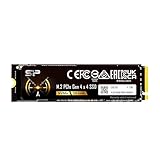
- PCIe Gen 4x4 interface with read speeds up to 7,000MB/s and write speeds up to 6,000MB/s
- NVMe 1.4 support allows for higher performance, lower latency, and lower power consumption
- Available in massive storage capacity options ranging from 1TB to 4TB
- TBW: 300
- Backed by a 5-year limited warranty or up to 300 TBW, whichever comes first. Please note that the warranty covers standard consumer/business use and is voided if the drive’s total written data exceeds its rated TBW limit.
For workstation and data-center buyers
PCIe 6.0 storage already shows how higher-bandwidth SSDs can serve data-center workloads, but Micron’s 9650 is enterprise hardware. Buyers planning a storage fabric should consider the full path: the CPU or switch, number of lanes, drive form factors, retimers where required, power and thermal capacity, firmware and workload. Peak sequential bandwidth is only one part of that decision.
For platform and interconnect engineers
PCIe 7.0’s 128 GT/s target is relevant where systems must move growing volumes of data without treating bandwidth as the sole design goal. The work includes maintaining signal quality and reach, managing errors and latency, meeting power constraints, validating interoperability and designing for compliance. PCI-SIG’s FAQ anticipated preliminary FYI testing in 2026, followed by an official compliance program; that stated expectation is not confirmation that either milestone has already occurred.
Quick wins for a faster PC:
Repair Windows errors before they cause bigger problemsFix Now →Fix the driver behind crashes, sound loss and screen glitchesFind Drivers →Clear out junk files and repair common Windows errorsFree Scan →Quick Recap
Product prices and availability are accurate as of the date/time indicated and are subject to change. Any price and availability information displayed on Amazon at the time of purchase will apply.

