
iTechGuides is reader-supported. When you buy through links on our site, we may earn an affiliate commission. As an Amazon Associate I earn from qualifying purchases. Learn more
Paleblue’s Voyager AA is an AA-sized lithium-ion rechargeable battery with a USB-C charging port built into each cell and a nominal 1.5 V output. Its cell-by-cell charging convenience may appeal if you regularly replace batteries in compatible devices, but the published capacity, cycle life, and runtime claims have not been independently verified in the available evidence. Most importantly, Paleblue advises against using its rechargeables in life-safety devices such as smoke and carbon-monoxide alarms.
What the Paleblue Voyager AA is
Voyager AA is a rechargeable lithium-ion battery made in the size of a standard AA cell. Each battery has its own USB-C port, so charging does not depend on a separate multi-cell charger. Paleblue lists its chemistry as NMC613 + LFP and its nominal voltage as 1.5 V, with a stated range of 1.0–1.6 V. The current product page labels this specification set “Version 1.0.”
That nominal voltage is intended to make the cell usable in devices designed for single-use alkaline AA batteries, but it is not a guarantee of compatibility with every device. Paleblue says to check the device manual when its battery requirements are uncertain. Its product page also describes a discharge curve that softens and drops near depletion to help devices display a low-battery warning; that is the manufacturer’s design claim, not an independently verified behavior.
The Tool Desk
Outbyte Driver Updater FREEScan for outdated or missing drivers - takes under a minuteDriver Scan →Outbyte PC Repair FREEClear out junk files and repair common Windows errorsFree Scan →Voyager AA specifications
The figures below are specifications published by Paleblue for Voyager AA, not independent measurements.
#1 Best Overall

- Charges via USB-C for convenient charging at home or on the go. True 1.5V output with a new voltage profile that outperforms alkaline batteries and improves compatibility. 1,000+ recharge cycles per battery, replacing over 50lbs of single-use batteries LED ring indicator shows charge status at a glance Pays for themselves. One set replaces drawers full of disposables, for a fraction of the cost long-term
| Specification | Paleblue’s listed value |
|---|---|
| Capacity | 3,300 mWh |
| Nominal voltage | 1.5 V (1.0–1.6 V) |
| Chemistry | Lithium-ion (NMC613 + LFP) |
| Cycle life | 1,000+ recharges |
| Maximum continuous output | 3.3 A |
| Maximum peak output | 4.5 A for up to 3 seconds |
| Charge time | 80% in 94 minutes; full charge in 126 minutes (2.1 hours) |
| Charging input | USB-C; 5 V at 100–530 mA per battery |
| Dimensions | 14.2 mm diameter × 50.2 mm |
| Weight | 17.5 g ± 0.5 g |
| Operating temperature | 10–45 °C |
| Charging temperature | 0–55 °C |
Paleblue’s stated 3,300 mWh capacity is an energy figure; it does not, by itself, tell you how many hours a particular device will run. Runtime depends on the device’s load and operating pattern. The available evidence does not establish a controlled runtime comparison against alkaline or NiMH cells. Likewise, “1,000+ recharges” is Paleblue’s rating, not a verified cycle-life result.
Charging: convenient, with limits
The port on each cell makes charging straightforward: connect a USB-C cable to the battery. Paleblue lists 94 minutes to reach 80% and 126 minutes to reach a full charge, with a 5 V charging input of 100–530 mA per cell. Actual charging time can vary with the power source and conditions.
Rank #2
- Charges via USB-C for convenient charging at home or on the go. True 1.5V output with a new voltage profile that outperforms alkaline batteries and improves compatibility. 1,000+ recharge cycles per battery, replacing over 50lbs of single-use batteries LED ring indicator shows charge status at a glance Pays for themselves. One set replaces drawers full of disposables, for a fraction of the cost long-term
The package includes a four-ended charging cable, according to Paleblue’s help page. The company says charging four cells at once is optimized with a 2 A power supply; a lower-output USB source will charge them more slowly. Paleblue also says not to charge cells while they are powering a device, even if that setup is physically possible.
Crashes, No Sound, or Screen Glitches?
Random freezes, missing sound and display glitches usually trace back to one bad driver. Find and replace yours safely.Free scan · under a minuteWindows Errors? Fix Them Before They Spread
Repair common Windows errors and clear accumulated junk for a smoother, more stable PC - no reinstall needed.Free scan · no reinstallPaleblue lists over-temperature, under-temperature, under-voltage, over-voltage, short-circuit, and overcurrent protections. Its support page also reports IEC 62133 safety certification/testing claims. These are manufacturer statements; certification records were not independently reviewed here.
Rank #3
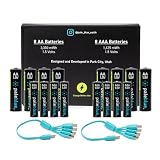
- Charges via USB-C for convenient charging at home or on the go. True 1.5V output with a new voltage profile that outperforms alkaline batteries and improves compatibility. 1,000+ recharge cycles per battery, replacing over 50lbs of single-use batteries LED ring indicator shows charge status at a glance Pays for themselves. One set replaces drawers full of disposables, for a fraction of the cost long-term
Is it suitable for your device?
For ordinary devices that use standard alkaline AA batteries, Voyager’s size and nominal voltage make it a possible rechargeable option, subject to the device maker’s instructions. Do not assume compatibility solely from the AA form factor. Check the manual for voltage requirements, restrictions on rechargeable batteries, and any warning against lithium-ion cells.
Door locks and other devices with battery warnings
A door lock may be a plausible use only if its manual permits this battery type and its low-battery warning works as expected with a rechargeable 1.5 V cell. Paleblue says Voyager’s discharge curve is designed to fall near depletion and help trigger low-battery warnings, but that claim does not establish how a particular lock will behave. If the manual specifies a battery chemistry or warns against rechargeable cells, follow that guidance.
Rank #4
- Charges via USB-C for convenient charging at home or on the go. True 1.5V output with a new voltage profile that outperforms alkaline batteries and improves compatibility. 1,000+ recharge cycles per battery, replacing over 50lbs of single-use batteries LED ring indicator shows charge status at a glance Pays for themselves. One set replaces drawers full of disposables, for a fraction of the cost long-term
Smoke alarms, carbon-monoxide alarms, and other life-safety devices
Paleblue explicitly says its rechargeable batteries are not a good fit for life-safety devices that may sit untouched for months or years. It names smoke detectors, carbon-monoxide detectors, and avalanche transceivers, citing self-discharge and the need for reserve charge. The company recommends a fresh non-rechargeable battery with a regular replacement schedule for these cases. Follow the alarm manufacturer’s instructions and local safety guidance; do not choose Voyager for an alarm unless its manual specifically permits it.
What the available evidence does—and does not—show
The published specifications describe what Paleblue says the current Voyager model should deliver. No independent controlled capacity, runtime, or durability test is established in the available evidence, so claims that it lasts longer than a named alkaline battery, achieves 1,000 cycles in practice, or outperforms NiMH should not be treated as proven. The few company-hosted customer reviews are anecdotal rather than a representative performance study.
Use care when comparing older coverage or listings: Paleblue’s older AA product page describes a different product generation, with figures such as 1,700 mAh, 2,550 mWh, and a 90-minute charge time. Those values are not Voyager specifications and should not be combined with its current 3,300 mWh and 126-minute full-charge figures.
Price, returns, and warranty
When the Voyager page was observed in 2026, it offered 4-, 8-, and 12-cell pack choices and displayed $29.99 for the selected four-pack. Price and availability can change. The page also stated 30-day returns and a limited lifetime warranty covering manufacturing defects and failures during normal use; review Paleblue’s current terms before buying.
Verdict
Paleblue Voyager AA’s clearest advantage is practical: every AA-sized cell has its own USB-C port, and its listed 1.5 V nominal output targets devices built for alkaline AAs. That convenience may suit frequently used, manual-approved devices. Its published capacity and cycle-life claims remain manufacturer claims rather than independent test results, and Paleblue itself advises against using rechargeables in alarms and other life-safety devices that sit unused for long periods.
What’s actually slowing this PC down?
Pick the symptom - the matching free tool is one click away.
Quick Recap
Product prices and availability are accurate as of the date/time indicated and are subject to change. Any price and availability information displayed on Amazon at the time of purchase will apply.

