
PC Slower Than It Used to Be?
A free scan shows the junk files, broken settings and background clutter dragging Windows down - then fixes them in one click.Free scan · Windows 10 & 11Outdated Drivers Are Slowing You Down
One free scan finds every outdated or missing driver and matches the right update for your exact hardware.Free scan · exact hardware matchiTechGuides is reader-supported. When you buy through links on our site, we may earn an affiliate commission. As an Amazon Associate I earn from qualifying purchases. Learn more
The 3-channel wide-field-of-view time-of-flight sensor named for the TI-RSLK MAX lab is Pololu #3680, built around Texas Instruments’ OPT3101 sensing analog front end. The distinction that matters: OPT3101 chip specifications, TI’s separate TIDA-010021 reference-design figures, and Pololu #3680’s own product performance are not interchangeable. TI course materials identify the Pololu module for the robot lab, but the cited material does not establish a product-specific range or field of view for #3680.
What is the Pololu #3680 OPT3101 sensor for TI-RSLK MAX?
TI training materials name the “Pololu 3-Channel, Wide FOV Time-of-Flight Distance Sensor using OPT3101 for TI-RSLK MAX” and identify it as Pololu part #3680. TI’s sensor-integration lab lists both the TI-RSLK MAX robot kit and the #3680 sensor among its equipment. TI lecture handout · TI sensor-integration lab materials
The module is intended for use in that educational robotics context. The OPT3101 at its center is a time-of-flight (ToF) proximity and distance-sensing analog front end (AFE), not a complete robot-ready sensor on its own. The cited materials connect #3680 with the TI-RSLK MAX lab, but do not provide a product-specific performance table, exact wiring instructions, or current price and availability.
How does a three-channel ToF sensor provide a wide field of view?
In continuous-wave ToF sensing, the system illuminates a scene with modulated light and uses the returning signal to derive depth information. The OPT3101 supports up to three transmitter channels, enabling a design to use multiple emitters or sensing zones. TI lists I²C for control and data and an integrated illumination driver. The chip itself does not determine a finished module’s actual coverage: that depends on the surrounding optical and electrical design.
#1 Best Overall

- The VL53L0X time-of-flight range sensor is a cutting-edge laser range module. It is a fully integrated device featuring an embedded infrared laser that is safe for human eyes, advanced filters, and ultra-high-speed photon detection arrays, all designed to enhance range, speed and accuracy (Ranging distance within 2M, ranging accuracy: ±5% (high-speed mode), ±3% (high-precision mode))
- The VL53L0X ToF laser ranging module is small, offering precise distance measurement regardless of target reflectance, unlike traditional technologies. It can measure absolute distances up to 2 meters, establishing a new standard in ranging performance and enabling numerous new applications
- The VL53L0X features a state-of-the-art SPAD (Single Photon Avalanche Diodes) array and incorporates patented second-generation flight sensing technology
- The VL53L0X features a 940nm VCSEL (Vertical Cavity Surface Emitting Laser) that is completely invisible to the human eye. Along with internal infrared filters, this design allows for extended range, increased resistance to ambient light, and improved durability against optical cross-talk from cover glass
- The VL53L0X's sensing capability enables a variety of functions, such as gesture and proximity detection for innovative user interfaces, obstacle detection and collision avoidance for floor sweepers and service robots, user presence detection or power control for home appliances and laptops, as well as applications in drones and Internet of Things (IoT) devices
TI’s separate TIDA-010021 reference design illustrates a three-emitter approach: one OPT3101 AFE, three external near-infrared LEDs, and one photodiode. TI specifies a 120° total field of view and detection up to 1.5 meters without a lens for that reference design. Those are TIDA-010021 figures, not confirmed specifications for Pololu #3680. TI TIDA-010021 reference design
What do the OPT3101 specifications mean?
| Figure | What it applies to | How to interpret it |
|---|---|---|
| Up to 4 kHz sample rate | OPT3101 datasheet specification, Rev. A (June 2018) | A chip-level maximum sample rate; not a guarantee of system-level accuracy or usable range. |
| 15-meter unambiguous range with 16-bit distance output | OPT3101 datasheet specification, Rev. A (June 2018) | The datasheet’s unambiguous-range specification, not proof that an assembled sensor can reliably detect targets at 15 meters. |
| Three transmitter channels | OPT3101 datasheet specification, Rev. A (June 2018) | A capability of the AFE for multi-channel designs; it does not by itself establish a finished product’s field of view. |
| 120° total field of view; detection up to 1.5 meters without a lens | TI TIDA-010021 reference design materials (2018) | Values for that specific reference design, not confirmed Pololu #3680 specifications. |
TI describes the OPT3101 as supporting independent emitter channels for flexible ranging applications. That is TI’s characterization of the device, not an independent performance test. TI OPT3101 product information · OPT3101 datasheet · TI OPT3101 development-tools training video
Quick Recap
Best Value

- The VL53L0X from ST Microelectronics is a time-of-flight ranging system integrated into a compact module. This board is a carrier for the VL53L0X, so we recommend careful reading of the VL53L0X datasheet (1MB pdf) before using this product.
- The VL53L0 uses ST's FlightSense technology to precisely measure how long it takes for emitted pulses of infrared laser light to reach the nearest object and be reflected back to a detector, so it can be considered a tiny, self-contained lidar system.
- Ranging measurements are available through the sensor's I⊃2;C (TWI) interface, which is also used to configure sensor settings, and the sensor provides two additional pins: a shutdown input and an interrupt output.
- The VL53L0X is a great IC, but its small, leadless, LGA package makes it difficult for the typical student or hobbyist to use. It also operates at a recommended voltage of 2.8 V, which can make interfacing difficult for microcontrollers operating at 3.3 V or 5 V. Our breakout board addresses these issues, making it easier to get started using the sensor, while keeping the overall size as small as possible.
- A time-of-flight ranging system integrated into a compact module
Rank #4

- The VL53L0X time-of-flight ranging sensor is new--generation laser ranging module, with a fully integrated sensor and built-in embedded infrared, eye-safe laser
- Advantage: A time-of-flight ranging system integrated into a compact module
- Accuracy: Range from ±3% at best to over ±10% in less optimal conditions
- Maximum Sensoring Distance: 2m
- Working Voltage: 2.6V - 5.5V
Rank #3
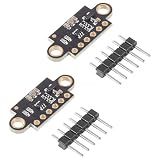
- Note:It is recommended to read the VL53L0X datasheet before using this product
- VL53L0X:A time-of-flight ranging system integrated into a compact module
- Function:VL53L0 is a small self-contained liDAR system,which uses ST's FlightSense technology to measure the time it takes for emitted infrared laser pulses to reach the nearest object and reflect back to the detector
- Working Voltage: 2.8V-5V;Communication method: IIC communication protocol (compatible with 3-5V system)
- Package Includes:2 x VL53L0X Time-of-Flight Ranging Sensors
Rank #2

- TOF400C VL53L1X 4M Laser Ranging Sensor Module TOF Time-of-Flight Distance IIC Output for Arduino Better Than TOF050C TOF200C
- TOF400C VL53L1X 4M Laser Ranging Sensor Module Operating Voltage:3.0V-5V(DC)
- TOF400C VL53L1X 4M Laser Ranging Sensor Module Operating temperature:-20°C-70°C。Operating current:40mA (Max).
- TOF400C VL53L1X 4M Laser Ranging Sensor Module with Provide physical protection for the module, including preventing dust from entering。
- TOF400C VL53L1X 4M Laser Ranging Sensor Module Development routines/software:Arduino Demo / STM32 Demo
How do Pololu #3680, the OPT3101EVM, and TIDA-010021 differ?
| Item | Role | Platform fit and performance evidence |
|---|---|---|
| Pololu #3680 | Named three-channel wide-FOV distance sensor module | TI lab materials identify it for TI-RSLK MAX instruction. The cited sources do not establish its exact range, field of view, or current availability. |
| TI OPT3101EVM | Evaluation module for the OPT3101 AFE | Useful for evaluating the AFE; the cited material does not establish it as a drop-in replacement for Pololu #3680. TI product information |
| TI TIDA-010021 | Reference design with a published three-emitter wide-FOV architecture | TI’s published 120° and up-to-1.5-meter-without-a-lens figures apply to this design, not automatically to either hardware item above. TI reference-design materials |
What should you confirm before choosing or integrating the sensor?
- Check that the intended lab or robot setup specifically calls for Pololu #3680; TI materials identify it as the sensor used in the relevant TI-RSLK MAX instruction.
- Use the OPT3101 datasheet for AFE capabilities, but do not treat its sample rate or unambiguous range as guaranteed performance of an assembled module.
- Use TIDA-010021 only as an example of a reference-design implementation unless product-specific documentation confirms that #3680 shares its optical design and performance.
- Confirm current availability, connections, and integration details with the product documentation or supplier before purchase or wiring; those details are not established by the cited TI materials.
Product prices and availability are accurate as of the date/time indicated and are subject to change. Any price and availability information displayed on Amazon at the time of purchase will apply.
Do these 3 things before closing this tab:
1Fix the driver behind crashes, sound loss and screen glitches2Repair Windows errors before they cause bigger problems3Scan for outdated or missing drivers - takes under a minute
