
Do these 3 things before closing this tab:
1Scan for outdated or missing drivers - takes under a minute2Clear out junk files and repair common Windows errors3Fix the driver behind crashes, sound loss and screen glitchesiTechGuides is reader-supported. When you buy through links on our site, we may earn an affiliate commission. As an Amazon Associate I earn from qualifying purchases. Learn more
Yes—an older graphics card can be useful in a headless home server, even with no monitor attached. It can accelerate a supported compute, rendering, or media task, but “headless” does not make every GPU compatible with every application. The deciding factors are the exact card, its supported driver and APIs, the workload, and the server’s power and cooling constraints.
What headless GPU use actually means
A headless server runs without a display connected for normal operation. That does not mean the GPU is unused: an application can address it for a supported workload without driving a desktop or gaming display. It also does not guarantee that an application will find or use the card. Rendering, compute, and video processing rely on different interfaces and hardware capabilities.
Headless operation is not limited to one method. Some workloads use a GPU directly through an application or compute interface; a graphics-rendering workload may instead use an X session configured without an active display. NVIDIA documents an X configuration using UseDisplayDevice set to none and selecting a GPU by PCI bus ID. That example comes from guidance for server-class Tesla GPUs, so it is a pattern to adapt to the installed driver and workload—not a universal configuration for consumer cards. NVIDIA’s remote visualization guide provides that example.
A monitor or HDMI dummy plug is therefore not a universal requirement. Whether a particular application needs a display or a particular graphics session depends on its implementation.
#1 Best Overall

- Chipset: NVIDIA GeForce GT 1030
- Video Memory: 4GB DDR4
- Boost Clock: 1430 MHz
- Memory Interface: 64-bit
- Output: DisplayPort x 1 (v1.4a) / HDMI 2.0b x 1
Check these five things before putting an old GPU to work
- Identify the exact card. Record its full model and generation, not just the brand or memory size. Support can differ between products that look similar.
- Name the workload. Decide whether the server needs compute, rendering, video decoding, video encoding, or another task. Then check that the application uses an interface and features the card supports.
- Confirm driver support. Check the current vendor and operating-system driver support for the exact model. A GPU may be physically detected while lacking a suitable maintained driver or the functionality an application needs. NVIDIA’s vGPU guide, for example, makes the Linux driver a prerequisite for full GPU operation in that product context; that is not a blanket requirement statement for every GPU application. NVIDIA vGPU Software User Guide.
- Check the host constraints. Verify that the card fits, has the necessary power connectors, and can be cooled in the server. Compare its idle and loaded power draw with the cost and practicalities of keeping it running; figures must come from the specifications or measurements for that specific model.
- Test the real application remotely. Connect over SSH or your normal remote-management method, run the intended workload, and verify that it is using the GPU rather than silently falling back to the CPU. NVIDIA’s vGPU documentation describes remote access and verification workflows in its own vGPU context, but the exact checks depend on your operating system and application.
When an X-based rendering setup is involved
If the rendering application expects an X server, NVIDIA’s documented headless example uses the GPU’s PCI bus ID and disables the display device. The guide gives this command for its server-class Tesla setup:
nvidia-xconfig --busid=PCI:4:0:0 --use-display-device=noneThe PCI address shown is an example, not a value to copy blindly. Find the address for the intended GPU and check the current documentation for the installed driver before adapting the command. This X configuration is distinct from a workload that can use the GPU through an application-native or compute path without an X rendering session.
Rank #2

- Powered by NVIDIA GeForce GT 730, 28nm GK208 chipset process with 902MHz core frequency, integrated with 4096MB DDR3 memory and 64-bit bus width
- More stable performance, compatible with Win11, can automatically install new driver
- Support NVIDIA Surround technology for 4 screens output by dual HDMI and VGA / DP. HDMI Max Resolution-2560x1600, VGA Max Resolution-2048x1536, DP Max Resolution-2560x1600
- Support DirectX 12, OpenGL 4.6, CUDA, OpenCL, DirectCompute and DirectML
- Original half height bracket matches with the low profile brackets make the Glorto GeForce GT 730 graphics card fit well with all PC tower, small form factor and HTPC(except micro form factor)
AMD also documents headless rendering without a windowing system, including EGL surfaceless contexts and Vulkan’s headless path. That guide covers Versal AI Edge Series Gen 2 and Prime Series Gen 2; it does not establish support for older Radeon cards. AMD’s headless rendering guide.
Account for display-related rendering behavior
With no active display, an OpenGL or Vulkan application cannot synchronize to vertical blanking (vblank) in the way it can with an active display. NVIDIA’s driver documentation also describes frame-rate-limiting behavior that depends on how the X server starts. These details matter when evaluating an X-based rendering workload; they do not show that every compute task is affected. Check the options for the driver release in use. NVIDIA X Config Options for driver release 550.67.
Rank #3
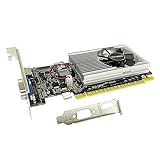
- The Geforce 210 is with a 589MHz core clock,up to 1066Mbps effective,perfect for working,video and photo editing,allows good fluency,which can effectively meet your needs.
- PCI Express 2.0 interface,offers compatibility with a range of systems. Also includes VGA and HDMI outputs for expanded connectivity,supports up to 2 monitors.Good for adding a simple low profile gpu to a small form factor pc.
- The computer graphics cards is small in size and saves more space,easy to install,plug and play,you can build a compact PC system easily for slim/ITX chassis.
- This low profile video card is good value option for entry level, if you just want basic upgrade graphics and daily simple work for your computer, or not be AAA gamer.(include low profile bracket)
- No external power supply and the all-solid-state capacitor keeps low power consumption and high performance,supports Windows 10/8/7/Vista/XP(not compatible with windows 11).
Media support depends on the card and codec path
Do not infer video decoding or encoding support from the fact that a card can render graphics. Media applications use specific APIs and codec features, and support varies by GPU and software. NVIDIA’s VDPAU documentation for Linux driver 430.14 describes the API and its feature limits, but it is historical guidance rather than a current compatibility list for individual cards. NVIDIA VDPAU documentation for driver 430.14.
Independent reader supportYour contribution helps us test, update, and keep practical guides available for everyone.Keep the old card or replace it?
There is no model-independent answer: the available documentation does not establish a general performance, power-saving, or cost advantage for keeping an unspecified old GPU. Compare the actual card with the replacement you would otherwise use:
Rank #4

- Powered by NVIDIA GeForce GT 610, 40nm chipset process with 523MHz core frequency, integrated with 2048MB DDR3 memory and 64-bit bus width
- Compatible with windows 11 system, no need to download driver manually
- HDMI / VGA 2 ports output available. HDMI Max Resolution-2560x1600, VGA Max Resolution-2048x1536
- Support DirectX 11, OpenCL, CUDA, DirectCompute 5.0
- Original half height bracket matches with the low profile brackets make the Glorto GeForce GT 610 graphics card fit well with all PC tower, small form factor and HTPC(except micro form factor)
- Workload fit: Can the card run the exact application, API, and codec feature you need?
- Driver longevity: Is there a supported driver branch for the card and your operating system?
- Power and cooling: What does it draw at idle and under your workload, and can the server cool it without unacceptable noise?
- Installation: Does it physically fit, and does the host have the required power connectors?
- Total cost: Compare the cost of operating and maintaining the old card with the acquisition cost of a more efficient replacement.
Reuse makes sense when the card’s supported features match a real task and the host can accommodate it. If the driver or application no longer supports the required path, or the power, cooling, or installation demands outweigh its usefulness, an alternative is more practical.
Quick Recap
Product prices and availability are accurate as of the date/time indicated and are subject to change. Any price and availability information displayed on Amazon at the time of purchase will apply.

