
iTechGuides is reader-supported. When you buy through links on our site, we may earn an affiliate commission. As an Amazon Associate I earn from qualifying purchases. Learn more
NASA’s lithium-fed magnetoplasmadynamic (MPD) thruster prototype reached a peak of 120 kilowatts in a ground test—an electric-propulsion power milestone, not proof of an engine ready to take astronauts to Mars. NASA’s headline calls it an “ion thruster,” but the prototype is specifically an MPD thruster, a different electric-propulsion architecture from the Hall-effect and gridded-ion systems often meant by that label.
What record did NASA’s thruster break?
NASA reported that the prototype reached 120 kilowatts during a test on February 24, 2026, at the Jet Propulsion Laboratory’s Electric Propulsion Lab. NASA characterized this as the first time an electric-propulsion system in the United States had operated at such a high power level. The 120-kW figure is the test’s peak power; it is not a reported thrust, efficiency, specific impulse, or travel-time result. (NASA, April 28, 2026)
NASA compared the test power with the electric thrusters on its Psyche spacecraft, saying it was more than 25 times greater. That comparison is about power, not a direct measure of propulsion performance: Psyche’s solar-electric thrusters are operating in space, while the lithium-fed MPD prototype was fired on the ground. (NASA, April 28, 2026)
Recommended Free Tools
How does a magnetoplasmadynamic thruster work?
The prototype uses lithium metal vapor as propellant. High electrical currents interact with a magnetic field to accelerate the resulting lithium plasma electromagnetically, producing thrust. Electric propulsion generally generates low, sustained thrust rather than the brief, powerful push of a chemical rocket; over time, that thrust can build spacecraft speed. The detailed architecture and demonstrated performance of this MPD prototype should not be assumed to match solar-powered xenon Hall or gridded-ion thrusters. NASA’s propulsion reference identifies Hall-effect thrusters as one form of ion propulsion, but this prototype is not a Hall thruster. (NASA, April 28, 2026; NASA, Solar Electric Propulsion; NASA Small Spacecraft Systems Virtual Institute, In-Space Propulsion)
#1 Best Overall
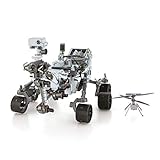
- HOBBY MODEL KIT – Unassembled model packed in an envelope with easy to follow instructions. Ideal for ages 14 and up.
- NO GLUE OR SOLDER NEEDED – Parts can be easily clipped from the metal sheets. Tweezers are the recommended tool for bending and twisting the connection tabs.
- MARS ROVER PERSEVERANCE & INGENUITY HELICOPTER – 4.5 Sheet Model with a challenging difficulty level. Assembled Size: Rover: 4.92 L x 3.54 W x 2.95 H inches. Helicopter: 1.02 L x 1.30 W x 0.79 H inches. 1:30 Scale.
- FROM STEEL SHEETS TO 3D – Pop out the pieces and connect using tabs and holes. Includes illustrated instructions.
- HIGHLY DETAILED ETCHED MODEL – Display your 3D model once completed - collect and build them all.
Power alone does not establish how much thrust a thruster produces or how effectively it uses energy and propellant. NASA’s announcement gives no thrust, efficiency, or specific-impulse value for this prototype, so those performance measures—and a Mars transit time—cannot be inferred from the 120-kW figure.
Could this thruster take humans to Mars?
It is a possible technology for future human Mars missions, not a flight-ready engine. NASA says MPD thrusters have never flown operationally and require further development. The contemplated Mars application would pair them with a nuclear power source; the current test was of a ground-based thruster prototype, not a complete nuclear-electric spacecraft or a selected crewed mission. JPL says substantial development remains before the technology could be used in space. (NASA, April 28, 2026; JPL, April 28, 2026)
Rank #2

- Mars Exploration Made Easy: GalaxyRVR, compatible with Arduino Uno R3, recreates the experience of real Mars rovers. Inspired by NASA’s rocker-bogie suspension system, it easily travels over rocks, sand, and grass—delivering true off-road capability beyond ordinary robot cars. Powered by solar charging and equipped with real-time FPV, smart obstacle avoidance, and remote control, it brings an immersive Martian adventure right to you. Start with easy controls, then advance to Arduino programming or Scratch block coding. Perfect for students, educators, and DIY enthusiasts
- Tough and Terrain-Ready: GalaxyRVR, crafted from sturdy aluminum alloy and featuring a rocker-bogie system like real Mars rovers, is designed for outdoor exploration and effortlessly tackles diverse terrains such as sand, rocks, grass, and mud pits for seamless adventure
- Solar-Powered and FPV: GalaxyRVR comes equipped with a solar panel, enabling solar charging. Its ESP32 CAM, paired with an app, offers remote control and a real-time FPV experience, bringing exploration to your fingertips
- Intelligent Obstacle Avoidance and Enhanced Lighting: GalaxyRVR is fitted with ultrasonic and infrared sensors, ensuring effective obstacle avoidance. Enhanced by RGB light strips and ESP32 LED lighting, it not only brings vibrancy but also confidently illuminates its path, making exploration in the dark possible
- Beginner-Friendly with Comprehensive Support: The GalaxyRVR kit is designed for easy assembly, allowing users to get started quickly without frustration. It comes with detailed online tutorials and step-by-step video lessons, ensuring a smooth learning curve. Coupled with an active community forum and responsive technical support, even novices can confidently bring this project to life
NASA’s planning figures show the scale of the work ahead, rather than what the prototype has achieved:
| Figure | What it describes |
|---|---|
| 500 kW to 1 MW per thruster | The team’s future target for individual thrusters, according to NASA. |
| 2 to 4 MW | NASA’s estimated power need for a possible human Mars mission. |
| More than 23,000 hours | NASA’s estimate of thruster operating time in that mission scenario, with multiple thrusters required. |
These are NASA’s stated targets and mission-planning estimates, not results from the 120-kW test. A nuclear power source and multiple thrusters would be needed for the Mars scenario NASA describes; the announcement does not establish a mission selection or operational schedule. (NASA, April 28, 2026)
Rank #3

- IGNITE SPACE EXPLORATION PASSION: Dive into the world of Martian engineering with the Perseverance Mars Rover, an immersive NASA-inspired STEM toy. Assemble and operate a real working Mars rover powered by a powerful motor, equipped with a movable robotic arm, strong grip, and powerful torque, offering the excitement of Martian exploration up close.
- UNVEIL STEM WONDERS: Unbox the future of learning with the Perseverance Mars Rover kit, containing 71 pieces and a 60-page educational and instructions booklet. Aimed at kids aged 8 and above, this kit is more than just a toy—it's a gateway to hands-on STEM education, fostering curiosity and understanding in robotics, mobility systems, electrical connections, and transmission systems, among other disciplines.
- MASTER SPACE MISSION CONTROL: Embark on a journey of discovery as you assemble and control the Perseverance Mars Rover model. With its DC motor capable of driving uphill and crossing uneven surfaces, children simulate Martian exploration missions, learning about the intricacies of mobility systems and experiencing the excitement of space missions on the Red Planet.
- EMPOWER FUTURE INNOVATORS WITH STEM EDUCATION: Inspire the next generation of scientists and engineers with the Perseverance Mars Rover. Through interactive play, children not only gain valuable insights into robotics, engineering, and space exploration but also develop essential skills like hand-eye coordination and concentration, laying the foundation for future STEM careers and innovations.
- BOND THROUGH COSMIC ADVENTURES: Bring families and friends together with the Perseverance Mars Rover kit, fostering teamwork and collaboration as they tackle assembly challenges and simulate Martian exploration missions. Spark lively discussions about space exploration and science, creating lasting memories filled with learning and fun.
What are the main engineering hurdles?
Surviving heat for long operating periods
NASA reported five ignitions during the test and a tungsten central-electrode temperature above 5,000°F (2,800°C). Those conditions show a prototype firing, not endurance over a Mars mission’s operating lifetime. NASA identifies proving that components can withstand the heat over many hours as a key challenge—especially in light of the more-than-23,000-hour operating estimate for the human-mission scenario. (NASA, April 28, 2026)
Scaling power and integrating a nuclear source
The team’s stated next power target is 500 kW to 1 MW per thruster, compared with the 120-kW peak in the test. Reaching a higher power level is only part of the challenge: the proposed Mars system also depends on developing and integrating a suitable nuclear power source. The reported thruster test does not demonstrate that complete system. (NASA, April 28, 2026)
Rank #4

- Gift Envelope Includes - Unassembled Model Easy to Follow Instructions
- From Steel Sheets to Museum Quality 3D Model
- Assembled Size 3.65x3.35x2.35 inches
- No Glue or Solder Needed
- Ages 14+
Who is developing the prototype?
JPL leads the work with Princeton University and NASA’s Glenn Research Center. NASA’s Space Nuclear Propulsion project funds it; that project is based at Marshall Space Flight Center within NASA’s Space Technology Mission Directorate. JPL research scientist James Polk described the test as both a demonstration that the thruster works and a useful testbed for tackling the challenges of scaling it up. (NASA, April 28, 2026; JPL, April 28, 2026)
Quick Recap
Best Value

- Feed a passion for science and technology – Kids can learn more about the challenges of space exploration with this LEGO Technic NASA Mars Rover Perseverance (42158) building toy set
- Conduct a test flight – This advanced building kit for kids ages 10 and up includes a buildable toy version of NASA’s Ingenuity helicopter, which accompanied the Perseverance Rover and was used to test powered flight on Mars
- AR brings the mission to life – The accompanying augmented reality app experience lets kids dive into the details of the rover and its mission
- Explore the functions – Features 360° steering, movable arms and fully articulated suspension that lets the vehicle travel across uneven surfaces, plus buildable scientific instruments
- A gift for kids who love engineering – This Mars Perseverance Rover NASA toy makes a great gift idea for kids with a passion for space exploration, technology or science projects
Product prices and availability are accurate as of the date/time indicated and are subject to change. Any price and availability information displayed on Amazon at the time of purchase will apply.

