
iTechGuides is reader-supported. When you buy through links on our site, we may earn an affiliate commission. As an Amazon Associate I earn from qualifying purchases. Learn more
Nanoscale tRNA architecture can mean two different things: the folded three-dimensional shape of a transfer RNA molecule, or a larger nanoscale structure engineered from tRNAs. Researchers have demonstrated both how tRNA molecules can assemble into a defined polyhedral particle and how engineered scaffolds can help determine the structures of compact RNA guests. The first is construction; the second is structural analysis.
What does nanoscale tRNA architecture mean?
Transfer RNA (tRNA) is an RNA molecule that participates in translation. Its secondary structure is often drawn as a cloverleaf, but that diagram represents base-pairing relationships rather than the molecule’s complete three-dimensional architecture. At molecular scale, tRNA folds into a compact 3D form.
The phrase can also refer to engineered assemblies that use tRNA molecules as structural components. In that usage, the subject is not the shape of one tRNA but the architecture created when multiple RNA units assemble into a larger particle.
Recommended Free Tools
How have researchers built a structure from tRNA?
In a 2010 study, Severcan and colleagues reported stable, modular three-dimensional RNA particles assembled with tRNA as a structural building block. The particles adopted a non-uniform square antiprism geometry. The authors describe the design, synthesis and structural characterization in their paper in Nature Chemistry.
#1 Best Overall

- Core Educational Tool: This DNA Model Double Helix Model offers a hands-on molecular model kit designed specifically for biology classroom supplies and science education toys, enabling students to visually and physically explore the structure of DNA and gain a deeper understanding of genetics and molecular biology
- Interactive Assembly Design: Featuring an easy-to-assemble molecular model kit with detachable components, this DNA model kit for students promotes active learning and allows detailed examination of each DNA segment, enhancing engagement and comprehension in biology science kits
- Safe and Quality Materials: Constructed with safe, non-toxic materials to ensure reliable use in classrooms and homes, this biology teaching aids model supports repeated handling and disassembly without compromising the integrity of the DNA model decor
- Versatile Usage Scenarios: Perfect for high school biology classrooms, homeschool science education, and individual study, this DNA model double helix component serves as an effective teaching aid to demonstrate gene structure and molecular biology concepts clearly
- Compact and Portable Size: Measuring approximately 4x1x6 inches, this compact DNA science kit is easy to transport and store, making it a convenient addition for science educators and students needing a practical and portable model for biology science class
The study reports spatial control that enabled protein positioning and encapsulation. Its authors raised nanomedicine and synthetic biology as potential application areas; these are proposed directions, not evidence of approved treatments or established commercial products.
The paper’s figure descriptions identify tRNA octamer self-assembly and thermal-stability work, along with characterization by atomic force microscopy (AFM) and cryo-electron microscopy (cryo-EM). They also describe coupling streptavidin to spatially addressable particles. Those descriptions do not establish numerical stability or imaging results, so no such measurements should be inferred from them.
Rank #2
![[239 PCS] Organic Chemistry Model Kit | Molecular Model Kit for Students](https://m.media-amazon.com/images/I/511A7UN+wEL._SL160_.jpg)
- 𝐇𝐀𝐍𝐃𝐒-𝐎𝐍 𝐂𝐇𝐄𝐌𝐈𝐒𝐓𝐑𝐘 𝐋𝐄𝐀𝐑𝐍𝐈𝐍𝐆: Take chemistry beyond memorizing formulas with an interactive learning experience students can physically handle. Manipulating the pieces of this molecule kit gives learners a more engaging way to practice identifying atoms, connecting bonds, and studying molecular structures.
- 𝐓𝐔𝐑𝐍 𝟐𝐃 𝐃𝐈𝐀𝐆𝐑𝐀𝐌𝐒 𝐈𝐍𝐓𝐎 𝟑𝐃 𝐌𝐎𝐃𝐄𝐋𝐒: Make textbook structures easier to interpret by transforming flat molecular diagrams into physical 3D models. With the help of this chemistry modeling kit students can see the position of atoms and bonds from different angles, helping them better understand molecular shape and arrangement.
- 𝐁𝐔𝐈𝐋𝐃, 𝐄𝐗𝐏𝐋𝐎𝐑𝐄 & 𝐑𝐄𝐁𝐔𝐈𝐋𝐃: Encourage active discovery by letting students construct a structure, adjust its arrangement, and build it again for continued practice. The reusable pieces make it easy to explore different molecular configurations without needing a new model for every lesson.
- 𝐄𝐅𝐅𝐎𝐑𝐓𝐋𝐄𝐒𝐒 𝐀𝐒𝐒𝐄𝐌𝐁𝐋𝐘: Designed for smooth, straightforward model building, the pieces connect easily so students can spend less time figuring out how to assemble the kit and more time exploring chemistry. Simple construction also makes it convenient for repeated classroom or study use.
- 𝐆𝐈𝐕𝐄 𝐓𝐇𝐄 𝐆𝐈𝐅𝐓 𝐎𝐅 𝐃𝐈𝐒𝐂𝐎𝐕𝐄𝐑𝐘: Bring a creative twist to science gifting with this organic chemistry molecular model kit made for curious students, chemistry fans, and STEM enthusiasts. Whether for a birthday, classroom reward, holiday, or special occasion, it gives recipients something interesting to build, examine, and enjoy.
How is determining tRNA structure different from building a particle?
A 2026 Nature Methods study by Christopher P. Jones and Adrian R. Ferré-D’Amaré tackles a measurement problem rather than an assembly-design problem. The authors engineered twofold- and fourfold-symmetric scaffolds to support cryo-EM analysis of covalently attached RNA guests, including post-transcriptionally unmodified Escherichia coli tRNA-Asp. The paper reports better than 3 Å overall resolution for its best-resolved guests—not for every guest or every tRNA. See the 2026 study.
Small RNAs can be difficult to resolve by cryo-EM because they provide less particle mass, and structural heterogeneity can make reconstruction harder. A 2022 review characterized RNA cryo-EM structures at that time as commonly falling in the 4–10 Å range, where de novo modeling can be challenging. That is a review’s snapshot of the field when published, not a permanent resolution limit. The newer scaffold study shows a route to improved results for particular small-RNA guests.
Rank #3
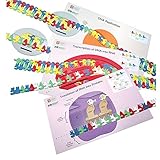
- 95+ YEARS OF EXPERIENCE - Carolina Biological has over 95 years of experience in providing high-quality science education materials, trusted by educators worldwide. As a leader in the field, they are committed to advancing hands-on learning, offering a vast range of biological specimens, lab equipment, and instructional materials. Carolina’s dedication to innovation, quality, and ethical sourcing has made them a go-to resource for schools, colleges, and independent learners.
- CREATE STOP MOTION ANIMATIONS – Challenge students to produce short videos demonstrating each step of the flow of genetic information—ideal for classroom projects.
- ENGAGE STUDENTS WITH INTERACTIVE LEARNING – Includes placemats, polymerase ovals, sticky-back foam parts, and nucleotides to help students model and sequence key genetic processes.
- BUILD DEEPER UNDERSTANDING – Demonstrate DNA directionality, anti-parallel strands, and the differences between DNA and RNA structures.
- PROTEIN DETECTION VIA COLOR CHANGE – Changes from blue to violet in the presence of proteins, making it a reliable and engaging reagent for teaching basic biochemical testing.
AFM and cryo-EM answer different questions in these studies. AFM can characterize particle surface topography; cryo-EM produces density maps and structural models. The evidence here does not support a general ranking of the methods: the appropriate approach depends on whether the goal is to examine an assembled particle or determine an RNA structure, as well as on sample properties and structural heterogeneity. The 2022 review discusses combining cryo-EM with RNA modeling, NMR and X-ray crystallography where complementary evidence is useful: Cryo-EM advances in RNA structure determination.
Independent reader supportYour contribution helps us test, update, and keep practical guides available for everyone.Why RNA structure matters beyond tRNA particles
RNA structure is not always static. A 2024 review describes profiling approaches that examine RNA structures across cell populations, single cells and single molecules, and connects RNA structure with functions such as transcription, processing, translation, degradation and localization. This broader work on RNA structure and function is distinct from directly imaging a tRNA-built polyhedron. See the review in Nature Reviews Molecular Cell Biology.
Quick Recap
Best Value
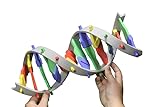
- Pair nitrogenous bases using the base pairing rule to create a sequence
- Transform the familiar ladder shape of DNA with a simple twist
- Explore the semi-conservative replication of DNA
- Synthesize mRNA using sugar-phosphate pieces to show transcription
Rank #4

- Visualize Molecular: The molecular model kit simplifies complex chemistry concepts into tangible 3D structures improve learning efficiency, suitable for students from Grade 7 to Graduate level.
- 444 Pcs Complete Set: The atom model kit includes with 136 atoms,158 bonds, and 150 fullerene model parts, explore most the molecules structures from simple compounds to complex polymers.
- Effortless Assembly: Embedded component design ensures easy to construct Ball-and-stick and Space-filling models that maximizes focus on exploration without complex assembly.
- Durable & Portable: Built to last, the chemistry set is crafted from high-quality materials. Plus, its portable Snap-Lock design allows you to take your experiments learning anywhere, between the home, classroom and lab.
- Essential Study Tool: Whether you're studying organic chemistry, biochemistry, or molecular biology, molecule building kit is an perfect learning tool for you deeper comprehension of molecular science.
What to take away
- A cloverleaf diagram is a representation of tRNA’s secondary structure, not its full 3D shape.
- Researchers reported modular particles with a non-uniform square antiprism geometry assembled from tRNA building blocks.
- Positioning and encapsulating proteins were reported structural capabilities; nanomedicine and synthetic biology remain proposed application areas in that study.
- Symmetric scaffolds are a separate tool for cryo-EM analysis of compact RNA guests, including unmodified E. coli tRNA-Asp.
- The reported better-than-3 Å result applies to the best-resolved guests in the 2026 study, not all tRNAs.
Product prices and availability are accurate as of the date/time indicated and are subject to change. Any price and availability information displayed on Amazon at the time of purchase will apply.
Free tools Windows power users keep installed
One-click scans. No signup required.

