
Quick wins for a faster PC:
Scan for outdated or missing drivers - takes under a minuteDriver Scan →Clear out junk files and repair common Windows errorsFree Scan →Fix the driver behind crashes, sound loss and screen glitchesFind Drivers →iTechGuides is reader-supported. When you buy through links on our site, we may earn an affiliate commission. As an Amazon Associate I earn from qualifying purchases. Learn more
Yes: a difference in salt concentration can generate electricity. In a 2016 laboratory experiment, researchers used a nanopore in an atomically thin molybdenum disulfide (MoS₂) membrane to turn a salt gradient into ionic current, then used two generators to power a transistor. The result was a nanoscale demonstration—not a working power plant—and its striking power-density figure needs to be understood at that scale.
What “blue energy” means
Blue energy, also called osmotic power, is energy available from the chemical-potential difference between solutions with different salinities. Seawater meeting freshwater is a familiar example: dissolved salt is more concentrated on one side than the other, creating a gradient that can drive ion movement.
The 2016 study by Feng and colleagues explored whether that movement could be converted directly into electrical current at a single nanopore. It was a materials-science experiment, not a demonstration of electricity generation at a river mouth or utility scale.
How the MoS₂ nanogenerator produced current
A salt gradient across an atomically thin sheet
The researchers placed a single-layer MoS₂ membrane, about 0.65 nanometres thick, between potassium chloride solutions of different concentrations. The concentration difference created a chemical-potential gradient across a pore in the membrane.
#1 Best Overall
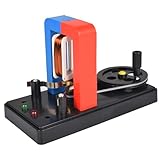
- Educational model - This is an assembled hand-cranked generator model that can be disassembled with tools to give student a better understanding of the model's construction.Through this package, They can exercise their own hands, thinking, exploring, creating ability,Build a project model that light up the LED by hand and the drive motor to learn the principle of conversion between energies.
- Learn through playing - Student will learn from the mechanics of the hand-crank generator and how the kinetic energy is used to generate electricity. The Dynamo Lantern is a safe and interactive experience that keeps student engaged, which makes it one of the most unique electricity learning available.
- Safe to Learn- A great and practical teaching equipment for student to enjoy and learn. Popular among schools and teachers for an interactive, hands-on learning experience as well as being one of the safest electricity learning model in the classroom.
- Hands on fun -The hand crank generator is already assembled and comes with an English manual. After you receive the items, you only need to install the pulley and adjust the brush to use.Student can learn to solve and think about issue while reading the manuals.
- This is an assembled hand-cranked generator model, primarily intended for teachers or middle school students (Recommended Age 14+). It is mainly used for educational demonstrations, showcasing how kinetic energy is converted into electrical energy through our model, and then transformed into light energy via an LED. This process enhances our understanding of textbook knowledge.
Selective ion transport makes electricity
The pore’s negative charge favored positively charged potassium ions over negatively charged chloride ions. Because more positive charge moved through the pore in one direction, the selective transport produced a diffusion current. This is a reverse-electrodialysis or electrokinetic approach: it converts ion movement across a charged membrane into electrical output.
That mechanism differs from pressure-retarded osmosis (PRO), which uses a membrane to exploit an osmotic pressure difference and drive a turbine. Both approaches draw on salinity differences, but they convert the gradient in different ways.
Rank #2

- Negative Ion Generator – This 12 Volt Generator features 15kV DC output, ideal for crafting realistic static grass landscapes. Also known as an ion generator or static field generator, it's perfect for DIY hobbyists and professional model makers.
- Ion Generator for Air Purifier Applications – Although designed for modeling, this versatile ion generator can also be used in custom air purifier or ionization systems requiring a static field of 12kV.
- 12 Volt Generator for Hobby Projects – Create vertical-standing artificial grass flock, miniature trees, or detailed scenery for architecture models and dioramas. Delivers pro-level results for both beginners and experts
- Plasma Ionization for Static Grass Applicators – Build your own static grass applicator easily and affordably, using this compact negative ion generator. A budget-friendly tool that doesn’t compromise performance.
- Dimensions: 2.4 x 1.6 x 1.2 inches. Weight: 3.84 oz. Small but powerful, this negative ion generator integrates effortlessly into DIY kits or small-scale HVAC and air filtration systems.
What the experiment demonstrated—and what its power figure means
Feng et al. reported an estimated power density of up to 10⁶ watts per square metre for the single-nanopore laboratory experiment. The figure is an estimate from the 2016 study, not a measured output from a large membrane installation. It should not be read as evidence that a square metre of practical equipment—or a power plant—could deliver that output under real-world conditions.
PC Slower Than It Used to Be?
A free scan shows the junk files, broken settings and background clutter dragging Windows down - then fixes them in one click.Free scan · Windows 10 & 11Outdated Drivers Are Slowing You Down
One free scan finds every outdated or missing driver and matches the right update for your exact hardware.Free scan · exact hardware matchThe team also connected two MoS₂ generator sheets to power a MoS₂ transistor. The paper described this as a “self-powered nanosystem”: a concrete laboratory demonstration that the generated current could operate a small electronic component. It did not establish a commercial generator or a deployed nanosensor product. Nature’s 2016 paper reports the experiment and its estimated power density.
Rank #3

- Positive Orgone Generator
- Inside your Tower Buster: Aventurine, Carnelian, Bionized(B.) Citrine, Crazy Lace Agate, B. Emerald, Fluorite, B. Black Jade, Jasper Picture, Kyanite, Lepidolite, Onyx, Obsidian, Pyrite, Selenite, Tiger's Eye, Black Tourmaline, Turquoise, B. Rose Quartz, B. Smoky Quartz, Az/Zeo, TM, Copper BB's, Aluminum Shavings/Spirals, and Steel Shavings/Spirals
- purifies atmosphere, transmutes negative energy into positive energy, benefits sleep and overall health, boosts plant growth, enhances psychic and intuitive abilities, balances chakras
- Bionized Crystals: Crystals that has been energetically "woken up". Wilhelm Reich was working with the theory of Bions as well as Orgone. Many people in the orgonite community agree that it's very effective to bionize sand and added to orgone yields some great energetic effects.
- Intentions Love, Strength, Power, Healing, Calm, Clarity, Creativity, Abundance, Prosperity
Why scaling up is difficult
Making large, uniform membranes
A single atomically thin membrane is not the same engineering challenge as manufacturing durable sheets over large areas. In Chemistry World’s 2016 account, researcher Lydéric Bocquet identified the difficulty of making metre-square MoS₂ sheets as a potential bottleneck. A high figure from a nanoscale pore does not by itself show that a large membrane can be fabricated with comparable performance.
Keeping nanopores clear in natural water
River water and seawater contain material that can foul or clog pores. As Ngai Yin Yip noted in the same report, fouling is a practical concern for a system that depends on unobstructed ion transport. A working installation would also need to manage separate water sources and do so without spending too much energy on the supporting system. These issues affect the net usefulness of any generated power.
Rank #4

- [DUAL PURPOSE FUNCTIONALITY] This generator efficiently harnesses both wind and water energy, making it suitable for diverse environments and applications.
- [for EASY INSTALLATION] Designed with user-friendly output terminals, it allows for quick setup without the need for special tools or extensive technical knowledge.
- [ENGAGING LEARNING TOOL] for students and children, this generator promotes hands-on experiments related to wind and hydroelectric power generation, enhancing their understanding of energy concepts.
- [ROBUST DESIGN] Built to endure outdoor conditions, this small wind for turbine and hydroelectric generator ensures long-term performance for across various weather scenarios.
- [SKILL DEVELOPMENT OPPORTUNITY] Working with this generator fosters practical skills and creativity, making it an excellent resource for educational institutions and home learning environments.
Chemistry World’s report discussed remote, low-power nanosensors as a possible niche for the technology, not as an available or proven product. The report’s expert comments describe challenges and possibilities; they do not establish current commercial deployment.
How this approach compares with other osmotic-power methods
| Approach | How it converts the salinity difference | What the cited work establishes |
|---|---|---|
| Pressure-retarded osmosis (PRO) | A membrane uses the osmotic pressure difference; the resulting pressure can drive a turbine. | The 2016 accounts identify PRO as a conventional osmotic-power route. They do not provide a comparable performance figure or current commercial-product assessment. |
| Reverse electrodialysis (RED) | Ion exchange across charged membranes converts selective ion movement into electrical output. | The MoS₂ nanopore experiment is a RED/electrokinetic approach. Its estimated peak power density applies to the single-nanopore laboratory experiment, not a commercial installation. |
The comparison is about conversion mechanisms, not a contest between commercially available products. The cited sources do not establish a current product comparison or show that the nanopore design has overcome membrane-manufacturing, fouling, or system-energy obstacles.
Best Value

- This machine is used to teach the basic structure and working principle of AC and DC generators in junior high school physics and elementary school natural knowledge teaching.
- This instrument is a permanent magnet, rotatable armature generator, composed of a stator, a rotor, brushes, a base plate and a manual mechanism.
- When the rotor speed is 1200-1600/min, the output voltage of the machine, the no-load voltage is not less than 6V, and the load voltage is not less than 3V, 0.3A
- It is composed of a permanent magnet and a pole whip. The magnet is made of two pieces of barium constant magnetic material. The red is the "N" pole and the blue is the "S" pole.
- We attach great importance to customer experience, so you can us if you have any questions, and we will get back to you within 24 hours!
What the result says about blue energy today
The 2016 study showed that a salinity gradient can drive selective ion transport through an atomically thin MoS₂ nanopore strongly enough to power a transistor in the laboratory. Its estimated power density drew attention, but practical use would depend on making large, durable membranes and keeping their pores clear while managing the water system’s energy demands. The result is best understood as a promising nanoscale proof of concept, with remote, low-power sensing discussed as a possible application rather than a demonstrated deployment.
The EPFL Laboratory of Nanoscale Biology describes ongoing research involving MoS₂ and hBN nanopores, including osmotic power generation. That documents continuing research interest, not commercial availability. EPFL’s nanopore research page provides that group-level context.
Quick Recap
Product prices and availability are accurate as of the date/time indicated and are subject to change. Any price and availability information displayed on Amazon at the time of purchase will apply.
The Tool Desk
Outbyte Driver Updater FREEFix the driver behind crashes, sound loss and screen glitchesFind Drivers →Outbyte PC Repair FREERepair Windows errors before they cause bigger problemsFix Now →
