
Recommended Free Tools
iTechGuides is reader-supported. When you buy through links on our site, we may earn an affiliate commission. As an Amazon Associate I earn from qualifying purchases. Learn more
Dividing your required throughput by 625 MBps to get an iSCSI session count or an NVMe/TCP queue count is not an AWS formula, and it did not predict performance in a measured FSx for ONTAP test. In that single-AZ test, the calculation was too low at one connection, roughly right at two, and far too high at sixteen. Treat 625 MBps as a reference point for a single EC2 client, not as a multiplier for planning.
Where the 625 MBps number comes from
The figure traces to AWS’s iSCSI and NVMe/TCP setup procedures for Amazon FSx for NetApp ONTAP. As Yoshiki Fujiwara, an AWS Community Builder, describes those procedures in his DEV Community article (posted September 30, 2026), they state an Amazon EC2 single-client maximum of 5 Gbps, roughly 625 MBps, and then describe optional steps for adding sessions when you want more throughput than that single client reaches.
The step from that context to a formula is the part that does not hold. Fujiwara’s wording on this point is direct: “AWS does not instruct you to divide,” and “No formula is given.” Those lines are his characterization of the linked AWS procedures, not AWS’s own words. In other words, the division is a heuristic someone built on top of a client-side number, and the article’s purpose was to test it.
What the test measured
The test ran on a second-generation FSx for ONTAP SINGLE_AZ_2 deployment, with the following configuration as reported in the article:
#1 Best Overall

- 10Gbps NVMe Enclosure: With the latest USB 3.2 Gen2, this M.2 enclosure can achieve a data transfer rate of 10Gbps. Backward compatible with USB 3.1 and USB 3.0. Note: 10G speeds need to be matched with a USB C 3.2 GEN2 data cable
- Tool-free SSD Enclosure: Tool-free NVMe SSD enclosure for quick and easy installation. Plug and play, no drivers required. The buckle design of the M.2 SSD enclosure can ensure stable and fast transfer
- Broad Compatibility: The UGREEN M.2 NVMe SSD enclosure is specially designed to support NMVe protocol M/B&M keys and for 2230/ 2242/ 2260/2280 size SSDs up to 8TB. The M.2 NVMe enclosure is applicable for Windows, Mac OS (Mac Mini M4/M5 Pro/M6), Linux, Android, IOS systems.(Does not support SATA NGFF SSD or mSATA SSD)
- Security & Stability: USB C NVMe enclosure adopts advanced RTL9210 chip with short-circuit, over-current and multi-protection to ensure the safety of your SSD and valuable data, and supports UASP/ Trim with high transfer speed
- Compact & Portable: This ultra-slim aluminium external NVMe enclosure with extra silicone case is portable yet durable, and much easier to carry with this M.2 to USB adapter, making it ideal for travelling
| Item | Reported value |
|---|---|
| AWS Region | ap-northeast-1 |
| File system topology | SINGLE_AZ_2, one 6,144 MBps HA pair |
| SSD capacity | 4,096 GiB |
| Provisioned IOPS | 200,000 |
| Block target | 600 GiB LUN (iSCSI) or namespace (NVMe/TCP) on a 900 GiB volume |
| ONTAP version (iSCSI results) | 9.18.1P5 |
| ONTAP version (NVMe queue results) | Not stated; the queue test ran on a separate deployment whose version was not recorded |
| Client | Amazon EC2 c5n.9xlarge, 50 Gbps guaranteed network |
| Load tool and settings | VDBENCH 5.04.07, direct I/O, unlimited rate (iorate=max), 512 threads, 60-second warmup, 300-second measurement |
| Multi-AZ | Not verified |
The 300-second window includes bursts, so these numbers describe saturation under that load pattern. They are not a baseline and not a production benchmark.
Why the division misses
The author compared the predicted throughput for each iSCSI session count against the measured sequential throughput. The results are below.
Rank #2
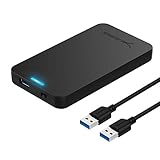
- Tool free design, easy to install,Transfer Rates Up to 480 Mbps when connected to a USB 2.0 port,Transfer Rates Up to 5 Gbps when connected to a USB 3.0 port.
- Suitable for 2.5” SATA/SSD;Supports Standard Notebook 2.5″ SATA and SATA II Hard drives
- Optimized for SSD, Supports UASP SATA III,Backwards-Compatible with USB 2.0 or 1.1
- Hot-swappable, plug and play, no drivers needed
- Operating System:Supported Operating Systems:Mac,Windows;Supported Windows Versions :Windows 7, Windows 8, Windows Vista, Windows XP; Supported Mac Versions: Mac OS X and Higher
| Counted iSCSI TCP connections | Measured (MB/s) | Predicted by the division (MB/s) | Measured ÷ predicted |
|---|---|---|---|
| 1 | 1,135.18 | 625 | 1.82x (prediction too low) |
| 2 | 1,135.18 | 1,250 | 0.91x (prediction slightly high) |
| 16 | 1,970.43 | 10,000 | 0.20x (prediction far too high) |
Two things stand out. First, going from one to two connections did not change the reported sequential throughput, so the second session added nothing in this test. Second, sixteen connections reached 1,970.43 MB/s, about a fifth of the 10,000 MB/s the linear model implied. A linear rule cannot capture both of those results, which is why it fails in both directions.
The author also notes that the same configuration measured differently in another environment, swinging by 2.64x. That is a reason to treat any single set of numbers, including these, as specific to its conditions.
Rank #3

- ENCLOSURE ONLY, SSD NOT INCLUDED: This is the case you put your own M.2 SSD into, not a drive with storage inside. 100% tool-free, so the SSD installs and comes out in seconds with no screwdriver.
- FITS M.2 NVMe AND SATA: Works with both M.2 PCIe NVMe and M.2 SATA SSDs in 2242, 2260 and 2280 lengths. Bare drives only, no room for a drive with a pre-installed heatsink. It does NOT take 2.5in SATA drives or mSATA.
- 10GBPS USB 3.2 TYPE-C: Up to 10Gbps, and up to 1000MB/s in real transfers. Backward compatible with USB 3.1 and USB 3.0 at their own speed limits. Bus powered, no drivers and no external power supply.
- SLIM ALUMINUM BUILD: Ultra-slim aluminum case with an ABS frame, with a thermal pad to move heat off the drive. Light enough to live in a laptop bag, solid enough to survive it.
- IN THE BOX: Enclosure, 8in Type-C to Type-C cable and user manual. Works with Windows 7 or later, macOS 10.5 or later and Linux. Register on the manufacturer's website for extended warranty service.
NVMe/TCP queues are not a simple count either
For NVMe/TCP, the tunable that matters is queue count rather than an iSCSI session setting. In the queue test, requesting 36 queues produced four effective submission/completion queues. The author explains that the effective number depends on what the host and transport negotiate, so the requested value is not what you should expect to get. Four is the observed outcome in that deployment, not a general ceiling for NVMe/TCP on FSx for ONTAP.
What the evidence does and does not establish
- The 5 Gbps (about 625 MBps) figure is an EC2 single-client reference point taken from AWS’s procedures. It is not a documented session-count formula.
- In one defined single-AZ test, the linear division was wrong for one, two, and sixteen iSCSI connections by different margins.
- The measurements do not establish a general replacement formula, a general FSx throughput ceiling, or a ranking of iSCSI over NFS or SMB. The author did not test protocol comparisons.
- Region, ONTAP version, client type, test duration, and the single-AZ topology all shape the outcome. Multi-AZ behavior was not verified.
- Compression state and inline storage-efficiency state were not recorded, so they cannot be ruled out as contributing factors.
- The author mentions placement-group status and network flow treatment as possible explanations for protocol behavior. Neither was tested, so treat them as open questions.
How to size a migration instead
- Define the workload in measurable terms. Record sustained throughput, peak throughput and how long peaks last, IOPS, I/O size, read/write mix, latency targets, and concurrency.
- Check the client path separately. Confirm the EC2 instance’s network bandwidth and whether the instance is limited to a single-client figure. The 5 Gbps reference applies to the client; it does not describe the file system.
- Set the target configuration. Pick the Region, AZ topology, throughput capacity, provisioned IOPS, and volume layout you plan to run in production.
- Configure protocol sessions or queues according to AWS’s procedures, then record what the host actually negotiates. For NVMe/TCP, check the effective queue count, not only the requested one.
- Measure at your I/O profile over a window longer than a burst. Use a load tool and parameters that match your workload, and report sustained numbers alongside peaks.
- Change one variable at a time. If results fall short, separate the client, network, file system, and volume limits before adding sessions or queues.
EBS planning is a separate constraint problem
If your target is Amazon EBS rather than FSx, the same kind of linear shortcut also fails. AWS’s EBS-optimized instance documentation says: “An instance’s EBS performance is bounded by the instance type’s performance limits, or the aggregated performance of its attached volumes, whichever is smaller.” The documentation also states that maximum IOPS and throughput limits depend on each other and on I/O size.
Rank #4

- Flip-Open Tool-Free Design: Open the cover, insert your NVMe SSD, lock it in place, and close—no screws or tools required. Fast and simple for upgrades, cloning, troubleshooting, and portable tech work.
- Cooler 10Gbps Performance: The aluminum enclosure presses the thermal pad directly against your SSD for better heat transfer and more stable 10Gbps speeds than slide-in enclosures. Ideal for long transfers and heavy workloads.
- NVMe Only for Maximum Speed: Supports M.2 NVMe SSDs in sizes 2230, 2242, 2260, and 2280 up to at least 8TB. Not compatible with M.2 SATA SSDs.
- USB C Plug-and-Play: Connect with USB C for up to 10Gbps using USB 3.2 Gen 2. No drivers or external power needed. Works with laptops, desktops, gaming handhelds, and USB C devices.
- Portable and Durable Aluminum Build: Reinforced ABS frame with an aluminum alloy top keeps your SSD protected and cool. Slim, lightweight, and perfect for creators, gamers, and anyone needing fast portable storage.
In practice, check two numbers: the instance’s EBS capability and the combined performance of the volumes attached to it. Do not assume a volume’s advertised maximum is available through every instance. The EBS instance reference lists baseline and maximum throughput in MB/s at 128 KiB I/O and IOPS at 16 KiB I/O. Some instances can sustain maximum performance only for 30 minutes at least once in 24 hours, while others sustain it indefinitely. Check the footnotes for the instance family you choose, because these limits change over time.
When striping makes sense
Striping across several EBS volumes is an option when a single volume cannot meet your throughput, IOPS, size, or operational requirements. It is not an automatic answer to FSx session sizing. AWS’s SAP HANA guidance lists single-volume maximums of 1,000 MB/s for gp3 and 4,000 MB/s for io2 Block Express, and says most HANA deployments do not need striping on io2 Block Express. The guidance also recommends considering higher-performance volume types or settings before striping. Its example for a 4 TiB-memory system targets 1,250 MB/s on gp3 and suggests splitting across two 2,450 GiB volumes at 625 MB/s each. That example is specific to SAP HANA.
Best Value

- Feature - BENFEI Type-C/Type-A 2.5 inch Hard Drive Enclosure easily hook up your 2.5 inch SATA I/II/III hard drive to transfer files from one PC to another PC, laptop, PS4 or as a USB external hard drive.
- Speed - Up to 5 Gbps data transfer rate with supports UASP SATA III transmission protocol, which is 70% faster than traditional USB3.0. Backward compatible with USB 2.0 or 1.1 ports.
- Design - With USB Type-C/Type-A plug design, provide a easy connection option to laptop/phone/pad. Tool free installation, Plug & Play, No driver needed for this SATA enclosure. Just push out the cover, plug in the drive, close the cover and go. Hot-Swappable.
- Compatibility - BENFEI Hard Drive Enclosure supports Windows, LINUX, MacOS 8.0, and above. Specifically designed for 7/9.5mm thick, 2.5 inches, 6TB HDD & SSD. Compatible with Western Digital, Seagate, Toshiba, Samsung, Kingston, Crucial, Hitachi, and more.
- Warranty - Exclusive BENFEI Unconditional 18-month Warranty ensures long-time protection of your purchase; Friendly and easy-to-reach customer service to solve your problems timely.
Don’t confuse 625 MiB/s with 625 MBps
A similar number appears in AWS RDS documentation. For RDS for MySQL gp3 storage, setting IOPS to 40,000 requires storage throughput of at least 625 MiB/s. That is a storage performance rule for RDS, unrelated to the FSx client figure. The units also differ: MiB/s and MBps are not the same, so keep them distinct when you compare sources.
Bottom line for sizing
Do not use 625 MBps as a divisor for iSCSI sessions or NVMe/TCP queues. Measure the target configuration with a workload that matches yours, read the negotiated session and queue counts, and identify which limit (client, network, file system, or volume) is binding before changing anything.
Quick Recap
Product prices and availability are accurate as of the date/time indicated and are subject to change. Any price and availability information displayed on Amazon at the time of purchase will apply.

