
iTechGuides is reader-supported. When you buy through links on our site, we may earn an affiliate commission. As an Amazon Associate I earn from qualifying purchases. Learn more
Yes—core-collapse supernovae are a plausible source of some of the Milky Way’s fluorine. In the proposed neutrino process, neutrinos from a collapsing stellar core interact with neon-20 and help create fluorine-19. Some of it can survive the explosion and return to interstellar space. Stellar abundance patterns support this as a possible contributor, but they do not show that supernovae made all—or even most—of the Galaxy’s fluorine.
How can a supernova make fluorine?
Fluorine’s stable isotope is fluorine-19. In the proposed neutrino process, intense neutrino emission from a collapsing massive star interacts with neon-20 in the star. This interaction can transform some neon into fluorine. The mechanism is usually discussed for the progenitors of Type II, or core-collapse, supernovae. The foundational 2004 model describes neutrino spallation of neon-20; a later observational study describes inelastic neutrino scattering on the same nucleus. Renda et al. (2004); Pilachowski et al. (2019).
Making fluorine inside a star does not guarantee that it reaches space. The supernova’s shock can destroy some of the newly made fluorine; surviving material is expelled and mixed into interstellar gas, where it can become part of later generations of stars. This is a modeled nucleosynthesis pathway, not a direct observation of fluorine atoms forming inside an explosion.
What do stellar abundances tell us?
Astronomers estimate fluorine in stars by analyzing hydrogen-fluoride (HF) vibration-rotation lines in high-resolution infrared spectra, including lines near 2.335 micrometres. The lines are weak, and telluric absorption from Earth’s atmosphere and blending with other spectral features complicate the measurement.
#1 Best Overall

- ★ ADVANCED LEARNING SCIENCE EDUCATION KIT --- Perfect chemistry model kit for modeling simple and small to more advanced and complex chemical structures for schools and college level, students of all ages, researchers and enthusiasts. Fun and interactive early learning molecular set for kids of all years and for use in the classroom.
- ★ HIGH QUALITY --- Made from high quality durable materials designed for easy construction and perfect fit. These Molecular Model Kit pieces are color coded to national standards for easy ID. Organic Chemistry Model Kit includes box for easy storage and transport with your other textbooks, notes, and books. Excellent for the classroom.
- ★ POWERFUL FUNCTIONS --- This Molecular Model Kit has a total of 122 pieces including short link remover tool. Super easy to build models for organic and inorganic chemistry, This model contains C, H, O, N, S and a variety of single and double bonds, Can be put high school, university chemi stry in most of the organic or inorganic molecular structure model for the study of experimental operation.
- ★ QUICK AND EASY ASSEMBLY OF COMPLEX STRUCTURES --- Atoms and bonds that are perfectly suited to being connected and disconnected easily without making your fingers hurt. We've also included a link remover to make the task of easy.
- ★ CONVENIENT STORAGE --- The pieces come in a slim plastic box for convenient storage. See the pictures on this listing for a full understanding of what's inside!
Pilachowski et al. studied Milky Way red giants over roughly −1.3 ≤ [Fe/H] ≤ 0. They reported that below [Fe/H] of approximately −0.4 to −0.5, [F/Fe] stays nearly constant at a subsolar level, around −0.3 to −0.4 dex. Here, [Fe/H] indicates a star’s iron abundance relative to the Sun, while [F/Fe] compares its fluorine-to-iron ratio with the solar ratio. A nearly level trend at low metallicity can be consistent with a source that produces fluorine in a primary-like way—that is, without requiring a high initial abundance of heavy elements.
When the 2019 authors compared the observations with chemical-evolution models, the Type II supernova neutrino process could reproduce such a low-metallicity trend. But a matching trend is not a unique fingerprint: other models can also produce primary-like behavior, and their predictions depend on assumptions about stellar physics and yields.
Rank #2
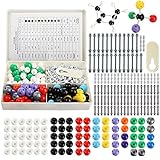
- YOPAY 240 pieces molecular model kit is your chemistry best friend, it includes 86 Atoms and 153 Links and 1 Short link remover tool, Covering 12 elements: hydrogen, carbon, oxygen, nitrogen, sulphur, phosphorus, fluorine, chlorine, bromine, iodine, metal and boron, you can now understand 3D complex molecule structures with ease to provide hands-on learning experience of molecular structures and functional groups.
- The Most Effective and Fun Way to Learn Chemistry - The chemistry molecular structure model kit can unlock and develop your chemistry genius, Models make science come to life! Use atom pieces to practice structures, cyclic compounds, empirical formula, stereo isomerism, and VSEPR theory. Explore chemistry and physics concepts. Visualize atomic structure with atoms, bonds, orbitals, and links.
- High Quality and Portable - It is extremely hard to damage our atom balls or bonds because we used the highest quality PP and LDPE to manufacture. It is made from high quality materials designed for easy assembly. The pieces are color coded to national standards and all kits come with a box for easy storage and transport with your other textbooks, notes, and books.Our model kit is deserve to serve you for years to come.
- For All Levels of Learning - The chemistry model kit utilize the ball and stick toys educational structure to teach students from grade 7 to the University Graduate Level (Over 12 years). Demonstrate fundamental molecular geometry, chemical and biology structure, stereo chemistry with 3D modelling studies.The perfect tool for memorizing organic, inorganic and functional group chemistry.
- 3D Visual Active Learning, Let's Build; Thanks to our universal standard color coded Atomic Balls, you can now understand 3D complex molecule structures with ease by building your favorite molecules with our 240 ball and stick models, The YOPAY Atom Model Kit is your chemistry best friend.
A measured gradient is sample-specific
For the thick-disk and halo stars in the 2019 study, the reported [F/Fe] gradient was 0.02 ± 0.03 dex per kiloparsec across galactocentric radii of about 6–13.7 kpc. That is a result for the studied stars and range, not a universal constant describing every part of the Milky Way.
Why isn’t the supernova explanation settled?
Fluorine can have more than one stellar production site. Proposed sources include core-collapse supernovae, rapidly rotating massive stars, asymptotic giant branch (AGB) stars, Wolf–Rayet stars and novae. AGB stars can make fluorine during thermal pulses, although under some stellar conditions fluorine can also be destroyed. How much each channel contributes depends on inputs such as stellar yields, rotation, reaction rates, neutrino flux and energy, explosion details, and the assumptions used to model the Galaxy’s chemical evolution.
Rank #3
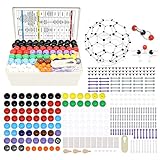
- 【444PCS】This Chemistry Molecular Model Kit contains 136 atom pieces made up of different elements;154 bonds:long flexible bonds (good for double and triple bonds),medium-length hard bonds,short-bonds (used for scale model single bond),overlength bonds,V-bonds (for space-filling models);3 electronic cloud slice;1 complete fullerene model (60 carbon atom+90 bond);1 removing tool for easy to separate atoms from the links.With this set,it is easy to build models for organic and inorganic chemistry
- 【Non-Toxic Material】All materials of our 444PCS Organic Chemistry Model Kit are eco-friendly.Polypropylene atoms (pp plastic) feel smooth,no scraps or cutting edges from the holes;Low-Density Polyethylene links (LDPE plastic) are easy to remove and put on.The atom parts and links are color coded to national standards for ease of identification and come with an Instructional Guide to easily identify all atoms and connectors.Delivered in a sturdy plastic box for easy storage and portability!
- 【Fullerene Models】What makes Our 444PCS Chemistry Model Kit unique is that this Model Kit has a complete fullerene model made up of 60 carbon atoms and 90 bonds.Fullerene is the third isomorphic body found in elemental carbon.The structure of fullerene is similar to the representative work of architect Fuller,so it is called fullerene.This is a great set to be put high school,university chemistry in most of the organic or inorganic molecular structure model for the study of experimental operatio
- 【Making Chemistry Fun】This educational molecule modeling kit is designed for easy chemistry learning for organic,inorganic,o chem and functional groups.The color coded bonds and atoms help visually demonstrate the geometry and structure of compounds & other bond types,let intangible chemical molecules atomic shape transform into tangible,help teachers and parents to cultivate children's interest in chemistry,makes learning chemical 3D molecule or atomic structures fun and interactive
- 【Best Parent-Child Interaction】There is no doubt that maternal-child interaction plays a very important role in child development.It is a good interaction for parents and children.Parents show their kids how to build 3D molecule to explore chemistry and physics concepts,kids teach their family the magic of chemistry and share the education experience.The Molecular model kit is designed for all ages:students from grade 7 to the University Graduate Level,STEM teachers,parents
A chemical-evolution study by Wallner et al., published online on 4 November 2022 and in Monthly Notices of the Royal Astronomical Society volume 518 (January 2023), reached a different emphasis from a supernova-centered interpretation. In its models, rapidly rotating massive stars were the dominant fluorine contributor, with AGB stars also needed from around [Fe/H] ≈ −1. Under the yields and assumptions adopted by the authors, Wolf–Rayet stars and novae were not significant contributors. That ranking is a result of those models, not a universal source inventory. Wallner et al. (2022/2023).
The studies need not be treated as a simple contradiction: they use different model inputs and assumptions, and abundance patterns do not label the birthplace of each fluorine atom. The later analysis compared observations over −2 < [Fe/H] < 0.4, while the low-metallicity data it considered included upper limits over −3.4 < [Fe/H] < −2.3. These are the coverage ranges of the analysis, not measurements of the fraction made by supernovae. The low-metallicity evidence remains limited, and the studies do not establish a consensus percentage for the supernova contribution.
Rank #4
![[425 PCS] Organic Chemistry Model Kit | Molecular Model Kit for Students](https://m.media-amazon.com/images/I/51YKOMTxqhL._SL160_.jpg)
- 𝐇𝐀𝐍𝐃𝐒-𝐎𝐍 𝐂𝐇𝐄𝐌𝐈𝐒𝐓𝐑𝐘 𝐋𝐄𝐀𝐑𝐍𝐈𝐍𝐆: Take chemistry beyond memorizing formulas with an interactive learning experience students can physically handle. Manipulating the pieces of this molecule kit gives learners a more engaging way to practice identifying atoms, connecting bonds, and studying molecular structures.
- 𝐓𝐔𝐑𝐍 𝟐𝐃 𝐃𝐈𝐀𝐆𝐑𝐀𝐌𝐒 𝐈𝐍𝐓𝐎 𝟑𝐃 𝐌𝐎𝐃𝐄𝐋𝐒: Make textbook structures easier to interpret by transforming flat molecular diagrams into physical 3D models. With the help of this chemistry modeling kit students can see the position of atoms and bonds from different angles, helping them better understand molecular shape and arrangement.
- 𝐁𝐔𝐈𝐋𝐃, 𝐄𝐗𝐏𝐋𝐎𝐑𝐄 & 𝐑𝐄𝐁𝐔𝐈𝐋𝐃: Encourage active discovery by letting students construct a structure, adjust its arrangement, and build it again for continued practice. The reusable pieces make it easy to explore different molecular configurations without needing a new model for every lesson.
- 𝐄𝐅𝐅𝐎𝐑𝐓𝐋𝐄𝐒𝐒 𝐀𝐒𝐒𝐄𝐌𝐁𝐋𝐘: Old nobby molecular kit is designed for smooth, straightforward model building, the pieces connect easily so students can spend less time figuring out how to assemble the kit and more time exploring chemistry. Simple construction also makes it convenient for repeated classroom or study use.
- 𝐆𝐈𝐕𝐄 𝐓𝐇𝐄 𝐆𝐈𝐅𝐓 𝐎𝐅 𝐃𝐈𝐒𝐂𝐎𝐕𝐄𝐑𝐘: Bring a creative twist to science gifting with this organic chemistry molecular model kit made for curious students, chemistry fans, and STEM enthusiasts. Whether for a birthday, classroom reward, holiday, or special occasion, it gives recipients something interesting to build, examine, and enjoy.
How strong is the evidence at low metallicity?
Low-metallicity stars are especially useful for testing early sources of fluorine, but they are difficult to measure. HF lines can be weak, spectra can be affected by atmospheric absorption and blending, and available samples are sparse. Some very metal-poor stars therefore have upper limits rather than firm fluorine detections. Those limits constrain models, but they do not settle which source dominated.
What’s actually slowing this PC down?
Pick the symptom - the matching free tool is one click away.
For that reason, stellar abundance patterns are indirect evidence: scientists compare what is observed in stars with what competing stellar-yield and Galactic chemical-evolution models predict. A model that matches a trend makes its proposed source plausible; it does not directly prove that source made the observed fluorine.
Best Value

- Easy to Understand: This molecular model is extremely helpful for both teachers and students. It sparks kids' interest in chemistry by turning invisible molecular and atomic shapes into something tangible. This makes it easier for children to grasp molecular geometry and serves as a fantastic hands-on learning tool!
- Great for Teaching Science at All Levels: With 240 pieces, including 86 atoms and 154 bonds, this kit caters to students from 7th grade up to the graduate level.
- Made from Safe Materials: All models are constructed from food - grade, eco - friendly plastics, including new PP plastic for atom balls, LDPE plastic for link bonds, and ABS plastic for the box.
- 3D Chemical Teaching Molecular Model: It can display chemical structures, molecular bonds, and bond angles in various directions. Use it to demonstrate basic molecular geometry, chemical structures, and stereochemistry through 3D modeling.
- Two Types of Chemical Structure Models: The ball - and - stick model uses balls for atoms and sticks for bonds. In the space - filling model, balls are proportionally sized and positioned close to each other, mimicking how atoms are arranged in real molecules.
What is the safest conclusion?
Supernova neutrinos can help convert neon-20 into fluorine-19, and the surviving fluorine can be returned to the Galaxy. Observed stellar abundances are compatible with a contribution from this process, particularly in discussions of low-metallicity trends. Other stellar sources also matter, and the relative contributions remain dependent on model assumptions and limited observations. It is accurate to say supernovae may help explain Milky Way fluorine; it is not established that they made it all or were its dominant source.
Quick Recap
Product prices and availability are accurate as of the date/time indicated and are subject to change. Any price and availability information displayed on Amazon at the time of purchase will apply.

