
iTechGuides is reader-supported. When you buy through links on our site, we may earn an affiliate commission. As an Amazon Associate I earn from qualifying purchases. Learn more
A light sensor detects light and turns it into an electrical signal. For a simple day/night threshold, an LDR is usually the easiest starting point; for faster or more controlled analog measurement, consider a photodiode; and for repeatable lux-oriented readings with a digital interface, consider an ambient-light sensor IC.
What is a light sensor?
A light sensor, also called a photodetector, detects whether light is present and can measure its intensity. Its sensing element converts incoming optical energy into an electrical response that a circuit or microcontroller can use. The response may be a changing resistance, a current, or a digital reading, depending on the sensor type.
Light sensors are used for automatic display brightness and color adjustment, industrial and outdoor lighting control, automotive instrument displays, and camera functions such as white balance and flicker removal. Wearables, smart-home devices, security cameras, and point-of-sale equipment can also use ambient-light readings. Some sensors report illuminance or color temperature, or help extract flicker frequency. Texas Instruments describes ambient-light sensing; STMicroelectronics lists sensor functions and applications.
How the main light-sensor types work
LDR or photoresistor
A light-dependent resistor (LDR), also called a photoresistor, changes resistance as illumination changes: its resistance falls as light increases. In an Analog Devices example, resistance ranges from millions of ohms in darkness to a few hundred ohms in bright light. Those figures illustrate a particular example, not a guaranteed range for every LDR; the circuit and actual lighting setup may need calibration. Analog Devices explains photoresistors and related detector types.
#1 Best Overall

- Photodiode sensor module: light brightness detection, light brightness sensor, with directionality, only senses the light source directly in front of the sensor, for better light seeking effect
- Module features:1. Can detect the brightness and light intensity of the surrounding environment, compared with photoresistor, directional comparisonGood, can perceive light sources in a fixed direction. 2. The sensitivity is adjustable, adjusted by the blue digital potentiometer in the picture. 3. Working voltage 3.3V-5V4. Output form:DO digital switch output, 0 and 1. and AO analog voltage output5. With fixing bolt holes for easy installation 6. Small board PCB size: 3.2cm x 1.4cm
- Photodiode sensor module interface description: 1. VCC is connected to 3.3V-5V voltage, can be directly connected to 5v microcontroller and 3.3v microcontroller. 2.GND External GND3 .DO small board digital output interface, 0 and 1. 4. AO small board analog output interface
- Product wiring instructions:1. VCC is connected to the positive pole of the power supply 3.3-5V 2. GND is connected to the negative pole of the power supply3. DO TTL switch signal output4. AO analog output
- Packing List: 10 Photodiode Sensor Modules Included
Photodiode
A photodiode is a p-n junction. When light creates electron-hole pairs in the junction, the device produces photocurrent. That current generally needs a low-noise amplifier to become a useful voltage signal. Photodiodes are a good fit when speed, predictable analog behavior, or controlled measurement matters. Analog Devices covers photodiode operation; Vishay outlines photodiode characteristics and uses.
Phototransistor
A phototransistor behaves like a transistor whose signal is generated by light. Its internal gain can make it useful for straightforward light detection or switching, but it is not generally the first choice when photodiode-like speed and linearity are priorities. Analog Devices compares phototransistors with other detectors.
Rank #2

- The brightness of surrounding environment and the light intensity can be detected (compare with the photoresistor, directivity is relatively good, can perceive the fixed direction of the light source)
- Sensitivity adjustable the blue digital potentiometer adjustment
- Operating voltage 3.3V-5V Digital switching outputs (0 and 1)
- With fixed bolt hole for easy installation Small board PCB size: 3.2cm * 1.4cm / 1.25" * 0.55"
- Photodiode module is most sensitive to the ambient light, generally used to detect the brightness of the ambient light intensity, photoresistor sensor module Universal In most cases, the difference between the two is that photodiode module directional, can sense the fixed the direction of the light source
Photovoltaic sensor
A photovoltaic sensor converts light into electrical energy. It is distinct from a detector whose main purpose is to produce a signal for measurement, although both respond to incoming light. Analog Devices groups photovoltaic sensors among common photodetector types.
Digital ambient-light sensor IC
A digital ambient-light sensor (ALS) integrates sensing and signal-processing features and presents readings through a digital interface. For example, Texas Instruments’ OPT3001 is specified with a response intended to match human-eye sensitivity, automatic full-scale setting, and greater than 99% typical infrared rejection in TI’s 2017 product documentation. Its stated operating range is −40 to 85 °C. These are specifications for that device, not universal properties of digital ALS chips. See the OPT3001 product documentation.
Rank #3

- Receive Wave Range : 400-1100 nm
- Response Peak Wavelength:940 nm
- Head Color : Clear; Material:Si, Plastic, Metal
- Head Size : 3 x 4mm / 0.12 x 0.16 inch (D*H)
- Polarity: Anode (Longer Part) | Cathode (Shorter Part)
Which light sensor should you use?
| Type | Best suited to | What to account for |
|---|---|---|
| LDR/photoresistor | Low-cost relative-brightness sensing, simple day/night thresholds, and beginner microcontroller projects. | Resistance varies with illumination; calibrate the divider and thresholds for the real lighting and enclosure. |
| Photodiode | Faster response, predictable analog behavior, or controlled measurement. | Photocurrent generally needs a low-noise amplifier; consider spectral response and the rest of the analog circuit. |
| Phototransistor | Light detection or switching where internal gain and a straightforward circuit are useful. | Choose another approach if linearity or speed is more important. |
| Digital ALS | Digital output, low-power ambient sensing, infrared rejection, or repeatable lux-oriented readings. | Check the specific device’s spectral response, interface, supply requirements, operating range, and optical setup. |
Compare candidate parts against the conditions in your device rather than choosing by sensor name alone. Important factors include visible and infrared response, dynamic range, response time, accuracy and repeatability, output type, supply voltage, power draw, package and window constraints, and calibration effort. Microsoft’s ambient-light sensor guidance also discusses placement, filters, lenses, enclosures, invalid readings, connectivity, and validation.
Using an LDR with Arduino or another microcontroller
An LDR module is a practical first build when the goal is to distinguish relatively bright from relatively dark conditions. A bare LDR can be connected as part of a voltage divider so a microcontroller’s analog input can read a voltage that changes with illumination. Modules may include additional circuitry, so follow the pin labels and circuit documentation for the specific board rather than assuming every module is wired the same way.
Rank #4

- LM393 chip Photoresistor Module for Light Intensity Detection
- Working Voltage: 3.3V-5V; for MCU
- Output Format: digital output (0 and 1) and analog voltage output
- Using wide voltage LM393 comparator with good stability
- Application: Widely used in light intensity detection
- Wire the sensor: Connect the LDR and a fixed resistor as a voltage divider between the supply and ground, then connect their junction to an analog input. If using a module, connect its analog output and power pins according to its documentation.
- Read the analog input: Sample the input under the lighting conditions where the device will operate. The numeric reading depends on the divider, board, and supply; it is not a universal brightness or lux value.
- Calibrate thresholds: Record readings in the bright and dim conditions that matter to the project, then choose a threshold between them. Test again after installing the sensor in its intended enclosure.
- Check the installed behavior: A cover, window, nearby light source, or change in orientation can alter the reading. Adjust placement or thresholds if the device switches at the wrong time.
An LDR setup is best treated as a relative sensor unless the full circuit and lighting conditions have been characterized. Analog Devices notes that the appropriate circuit and physical setup depend on the application and that calibration may be required. Read its LDR application example.
Recommended Free Tools
When to move beyond an LDR
Use a digital ALS when the product needs more consistent lux-oriented readings across different lamps, a digital interface, low power, human-eye-like response, or infrared rejection—especially when the sensor sits behind cover glass. Evaluate the device’s optical guidance and calibrate the assembled product, since the window, enclosure, placement, and surrounding light affect what reaches the sensor. For a faster or more controlled analog measurement, a photodiode and suitable amplifier are more appropriate. A phototransistor is an option when gain and simple switching outweigh a need for high linearity or speed.
Quick Recap
Best Value
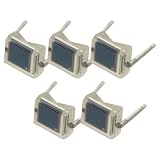
- 5PCS Photodiode BPW34 BPW34S Silicon PIN Photodiode High Sensitivity/Speed DIP
- Silicon PIN Photodiode
- Suitable for visible and near infrared
- High photo sensitivity
- Dimensions (L x W x H in mm): 5.4 x 4.3 x 3.2
Product prices and availability are accurate as of the date/time indicated and are subject to change. Any price and availability information displayed on Amazon at the time of purchase will apply.

