
iTechGuides is reader-supported. When you buy through links on our site, we may earn an affiliate commission. As an Amazon Associate I earn from qualifying purchases. Learn more
LightOn announced LightOnOCR-3 on 8 October 2026. It is an open-weight family of OCR and document-understanding models—not a scanner or other physical device—with three sizes: 0.8B, 1B, and 4B parameters. LightOn reports that the 4B model has the highest equal-weight average across three benchmarks, but it does not lead every benchmark individually.
The models can transcribe page text or produce richer output that connects extracted content to its position on the page. That can include labeled regions, image descriptions, and chart data in table form. These capabilities and proposed uses are described by LightOn; the published benchmark comparisons are also vendor-reported, not independent evaluations.


What is LightOnOCR-3?
LightOnOCR-3 is a family of open-weight models designed for OCR and document understanding, including complex business, technical, and scientific documents. LightOn describes the models as going beyond plain transcription: they can preserve page structure and help identify where extracted information appears. The model card lists an Apache 2.0 license for research and commercial use.
What’s actually slowing this PC down?
Pick the symptom - the matching free tool is one click away.
LightOn describes two broad output approaches:
- Transcription: returns text extracted from a page.
- Grounding: adds labeled bounding boxes for page regions, short descriptions of images, and chart data represented as tables.
Keeping content tied to its page location may suit document search, retrieval-augmented generation, information extraction, and knowledge-base ingestion. Those are intended workflows, not independently established performance outcomes.
#1 Best Overall
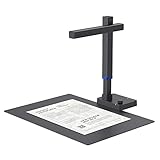
- Design and Speed: Work with Windows XP/7/8/10/11 AND macOS 10.13 or later. Not compatible with Android and iOS. Designed for A3&A4(11.69*16.53 & 8.27*11.75 inch) document, any objects smaller than A3 size can be scanned with Ultra-fast scanning speed, about 1 second per page. Perfect device to scan FLAT papers
- USB Document Camera & Scanner: Work as both a document camera for remote teaching&learning compatible with ZOOM; Goole Meet and a document scanner to scan papers and convert/OCR files. OCR supports 180+ languages for text recognition. Please note that Thai, Hebrew, and Arabic are currently not supported. If you need the complete OCR language support list, please feel free to contact us for more details
- Patented Flattening Curved Book Page Technology: Shine Ultra applies CZUR’s patented technology to flatten the curved surface after pixel transformation to flattening of the book page (Only suitable for thinner books, ET series is recommended for thicker books)
- High Resolution & AI Tech: CMOS 13MP (4160*3120, A4≈340 AND A3≈245 DPI) camera. Smart Paging and Auto Cropping; Combine Sides; Stamp Mode; and Multiple Color Modes
- Height Adjustable & Portable: 2-level height adjustable neck. 90 degree foldable and lightweight 4 lbs with foot pedal for convenient operation
What are the LightOnOCR-3 model sizes?
| Variant | Parameters | Architecture described by LightOn | Positioning |
|---|---|---|---|
| LightOnOCR-3-0.8B | 0.8B | Qwen3.5 vision-language architecture | Lightest variant |
| LightOnOCR-3-1B | 1B | Retains the LightOnOCR-2-1B architecture | Intermediate size |
| LightOnOCR-3-4B | 4B | Qwen3.5 vision-language architecture | Largest and, according to the model card, most accurate; recommended for most OCR tasks |
Parameter count alone does not establish a model’s hardware requirements or speed in a particular deployment. The model card provides examples for Transformers, vLLM, and other serving tools, but the suitable setup depends on how the model is served and the workload.
How does LightOnOCR-3 compare on OCR benchmarks?
LightOn compares models on olmOCR-Bench for text extraction, ParseBench for layout and visual or structured extraction, and fr-bench-pdf2md for French documents. Its reported average gives the three benchmark scores equal weight for models with results on all three.
Rank #2

- ➤Smart and Easy Scanning - This document scanner has a one-key automatic correction feature that intelligently fixes skewed images in seconds. It also supports mass automatic scanning, word, pdf, and text formats, and improves your work efficiency with only manual page turning.
- ➤Clear and Bright Images - This document scanner has a 1300W CMOS sensor that captures high-quality images in any light condition. The built-in LED light provides even and intelligent illumination for better results. It can capture and display images up to A4 size. (Note: This product can runs on Windows,Mac OS,Linux.)
- ➤Stepless Dimming - Elevate your lighting experience with our innovative stepless dimming feature. Effortlessly customize your illumination by simply twisting the switch – no preset levels, just uninterrupted, fluid brightness control. Tailor the light to your mood, task, or time of day with this sleek and versatile book camera.
- ➤Live Projection and Video Recording - This document scanner can also shoot videos and display them in real time, making it ideal for distance learning and online teaching. You can use it for making music scores, teaching, meeting, and more.
- ➤Portable and User-Friendly - This document scanner has a high-quality aluminum alloy body that is foldable and easy to carry. It also has a retractable product bracket that allows you to adjust the angle and height of the scanner. You just need to connect it to your computer with a USB cable and install the software to start scanning.(Note: The package contents include a USB flash drive, which contains a downloadable user manual and software installation package.)
| Model | Equal-weight average | olmOCR-Bench | ParseBench | fr-bench-pdf2md |
|---|---|---|---|---|
| LightOnOCR-3-4B | 78.5 | 86.3 | 75.1 | 74.1 |
| LightOnOCR-3-0.8B | 76.9 | 85.5 | 74.6 | 70.5 |
| Infinity-Parser2-Pro | 75.0 | 87.6 | 74.3 | 63.2 |
| Chandra-OCR-2 | 75.0 | 85.8 | 70.1 | 69.0 |
These figures are from LightOn’s 2026 comparison. On that reported equal-weight average, LightOnOCR-3-4B ranks first among the listed models. It also leads the French-document benchmark in this table, but Infinity Parser2-Pro scores higher on olmOCR-Bench.
Windows Errors? Fix Them Before They Spread
Repair common Windows errors and clear accumulated junk for a smoother, more stable PC - no reinstall needed.Free scan · no reinstallOutdated Drivers Are Slowing You Down
One free scan finds every outdated or missing driver and matches the right update for your exact hardware.Free scan · exact hardware matchParseBench and category-level results
In LightOn’s release article, LightOnOCR-3-4B and 0.8B rank first and second on ParseBench’s five-category overall score; LightOn characterizes the model as leading among open-weight models. That is a specific ranking and should not be read as a win in every category. The same article says Chandra 2 leads some ParseBench categories.
Results vary by document type and test setup
LightOn reports that Infinity Parser Pro remains stronger on old scans and headers or footers. Its release article also reports that LightOnOCR-3-4B was 19% faster on a single page and served 21% more pages per second than Chandra-OCR-2 at the respective olmOCR-Bench settings. Those speed figures describe LightOn’s test setup, not a universal throughput guarantee. For a real deployment, compare results on the document types, resolutions, hardware, and output modes that matter to your workload.
Other category results reported by LightOn include 46.1 for handwritten pages on fr-bench-pdf2md and 91.1 for the ArXiv category of olmOCR-Bench for LightOnOCR-3-4B. These are category-specific scores, not substitutes for the overall benchmark results.
Can LightOnOCR-3 extract tables and charts?
LightOn says its grounding mode can return chart data as tables, along with labeled page regions and short image descriptions. This is more than ordinary text transcription: it is intended to retain structured information and its connection to page locations. The available documentation describes this capability, but does not establish that charts or tables will be extracted accurately across every document or layout.
Recommended Free Tools
How do I run LightOnOCR-3 locally?
The model card includes deployment examples for Transformers, vLLM, and other serving tools. A practical starting point is to choose a variant and an inference framework, then adapt the model-card example to your environment and test it on representative pages.
Best Value

- IRIScan Book portable scanner wireless battery - v7: Compact and handheld mobile scanner that allows you to scan documents on the go with ease. Battery (rechargeable) mobile scanner. SD card provided with adapter. USB powered. USB Cable provided. AC Adapter not provided. Elected Best Handheld Scanner : EDITOR Choice by PCMAG USA pcmag.com/reviews/iriscan-book-5-wifi
- Mini scanner: Small in size, making it highly portable and convenient for scanning documents in various settings. From 300, 600 & 1050Dpi.
- Handheld scanner & Companion Software : No driver needed, Free Unlimited OCR Software Readiris, Free PDF editor Readiris PDF: Edit and modify your scanned documents using the included PDF editing software, providing flexibility and customization options. Free Instant Result software (Windows Only) allows you to scan USB Powered
- wireless document scanner & Scan to Word, PDF, XLS: Convert your scanned documents into editable formats such as Word, PDF, and Excel, allowing for easy editing and manipulation.
- Book scanner & Scan through USB or scan to SD card: Save your scanned documents directly to an SD card for additional storage capacity or scan directly to your computer via USB connection. Compatible with both Windows and Mac operating systems, ensuring versatility and convenience. Battery life (scanning to MicroSD Card) 750 pages daily after recharging (A4, 300 dpi, color)
- Open the LightOnOCR-3 model card and choose a variant. The 4B model is LightOn’s recommended option for most OCR tasks; the 0.8B model is the lightest.
- Select a documented serving route, such as Transformers or vLLM, and follow the corresponding model-card example. The model card is the source for the current code and setup details.
- Choose whether your workflow needs plain transcription or grounded output, and use the appropriate prompt pattern described in the model card.
- Run a small set of representative documents first. Check transcription, region labels, image descriptions, chart data, and page-location links against the originals before relying on the output downstream.
The documentation does not establish one universal hardware configuration for every variant and workload. Validate memory use and throughput on the hardware and document mix you intend to deploy.
Independent reader supportYour contribution helps us test, update, and keep practical guides available for everyone.What do LightOn’s cost claims mean?
LightOn says self-hosted processing costs can fall below one cent per thousand pages, depending on hardware, utilization, and workload. This is a conditional vendor estimate, not a fixed price or independently verified cost. Actual operating costs depend on the deployment and the amount and type of processing required.
Which LightOnOCR-3 variant should you evaluate?
- Choose 4B for a starting point when accuracy is the priority. LightOn calls it the most accurate variant and recommends it for most OCR tasks, but its benchmark lead is an aggregate result and not a win in every category.
- Consider 0.8B when model size matters. It is the family’s lightest option and scores close to 4B on the reported equal-weight average, while trailing it on each of the three listed benchmark scores.
- Evaluate 1B when its architecture or deployment fit is relevant. It retains the LightOnOCR-2-1B architecture; the reported comparison table does not include a score for this variant.
For any choice, prioritize the benchmark and document category closest to your use case—such as French text, handwriting, charts, old scans, or headers and footers—rather than relying on a single aggregate. Then validate the required output mode and performance in your own serving setup.
Quick Recap
Sources
- LightOn’s LightOnOCR-3 research and comparison page
- LightOn’s release article on Hugging Face
- LightOnOCR-3 model card
- LightOn’s release announcement
Product prices and availability are accurate as of the date/time indicated and are subject to change. Any price and availability information displayed on Amazon at the time of purchase will apply.

