
iTechGuides is reader-supported. When you buy through links on our site, we may earn an affiliate commission. As an Amazon Associate I earn from qualifying purchases. Learn more
Neither LFP nor NMC is the automatic best choice for an electric vehicle. LFP (lithium iron phosphate) can help lower battery-pack costs and is more tolerant of charging to 100% when needed. NMC (nickel manganese cobalt) stores more energy for a given battery mass or volume, which can help with longer range and cold-weather use. For a buyer, the decisive evidence is the specific vehicle’s usable range, charging performance, thermal management, warranty, and price—not the chemistry label alone.
What LFP and NMC tell you—and what they don’t
Both LFP and NMC are lithium-ion battery chemistries. They differ in the materials used in their cells, but the chemistry does not by itself determine how far a car travels, how quickly it fast-charges, or how long its battery will last. Pack design, vehicle efficiency, battery management and thermal systems also shape what the driver experiences.
The International Energy Agency’s Global EV Outlook 2025 describes LFP as the main battery chemistry used in China, while NMC was the most widely used in the United States and Europe. Those are regional market observations from the report, not a guarantee about the chemistry in a particular model or what will be available in every market. IEA, Global EV Outlook 2025
How the cost and energy-density trade-off works
In its 2025 report, the IEA said LFP battery packs were almost 30% cheaper per kilowatt-hour than NMC packs. The figure concerns pack prices in the report’s market context; it is not a retail-car discount, a quote for a replacement battery, or a promise that an LFP version of a vehicle will cost a particular amount less.
#1 Best Overall

- High density negative paste, improves performance and increases battery life
- Enhanced life alloy/Silver Calcium stamped alloy increases cycle life and improves performance
- Calcium Lead positive grid, maximizes conductivity and allows for low resistance
- Robust Envelope Separator with puncture-resistant back, allows for increased acid circulation and prevents shorts. Improved acid circulation, helps the battery to remain cool, and extend battery life.
- Vent cap design that resists acid leakage
The same report found that LFP packs had about one-fifth less energy density by mass and about one-third less by volume than NMC packs. These are reported pack-level averages, not specifications for every battery. NMC’s density advantage can matter when a manufacturer wants to fit more stored energy into a given weight or space. LFP’s lower pack cost can support more affordable mass-market designs, and the IEA says its performance has reached a level sufficient for most EV applications. IEA, Global EV Outlook 2025
How to compare range and cold-weather performance
Energy density is not the same as a car’s rated range. Range also depends on usable battery capacity, vehicle size and efficiency, driving style, terrain and climate, according to Australia’s energy department. Compare the exact models’ range figures using the same test cycle and region: ratings from different procedures are not directly interchangeable. Ford Australia, for example, identifies WLTP as the standardized procedure used for its single-charge range comparisons. Australian government EV battery overview; Ford Australia range and battery options
The IEA says LFP is typically less effective than NMC in cold climates, while identifying NMC’s density advantage as relevant to longer-range applications and cold-weather use. That is a general chemistry comparison, not a forecast for every car or winter. A vehicle’s battery heating and preconditioning can affect cold-weather range and charging speed; Ford Australia says preconditioning can improve performance, charging speed and range, particularly in cold weather. Look for model-specific winter-range information and how the car prepares its battery before driving or fast-charging. IEA, Global EV Outlook 2025; Ford Australia range and battery options
What’s actually slowing this PC down?
Pick the symptom - the matching free tool is one click away.
Rank #2

- 12V 12AH BATTERY REPLACEMENT FOR EV RIDER S34-FD TRANSPORT - 2 PACK
For your own routes, check the usable range against your regular longest trip, including highway and seasonal driving. Also examine the vehicle’s charging curve and expected charging stops: a large rated range alone does not tell you how long a journey will take.
Why charging advice depends on the vehicle
The IEA says LFP can be charged to 100% when required without significant degradation, while NMC batteries are typically limited to 80% to preserve long-term performance. Treat this as a general chemistry distinction, not a charging rule for every car. Automakers’ instructions can vary even between configurations.
For example, a Ford owner-manual passage for a specified standard-range LFP configuration says to set the maximum charge level to 100% and charge to 100% at least once per month to maintain range accuracy. In the same manual, the cited extended-range NCM configuration has a 90% everyday limit. Volvo’s general U.S. battery guidance recommends charging to 90% and reserving 100% for longer trips. These are manufacturer instructions for their stated vehicles or guidance, not universal rules for all LFP or NMC packs. Follow the manual for the exact car and configuration. Ford owner manual; Volvo battery guidance
Rank #3
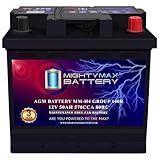
- Fast Starting Power: This 12V 50Ah 570 CCA delivers strong, steady starts is ready for any weather in any season.
- Made to Last: With its 80-minute Reserve Capacity supports longer run times and a longer overall battery lifespan.
- All Power, No Mess AGM Design: Sealed and spill-proof, the MM-H4 is built with high discharge output and deep discharge recovery to keep power steady when it counts.
- Strength That Starts on the Inside: The rugged construction resists shock, vibration, and harsh conditions, delivering reliable performance across a wide range of temperatures and tough environments.
- Tested Tough & Certified Safe: Mighty Max batteries are built in an ISO-certified facility and meet CE standards for quality, safety, and reliability
Home charging access is part of the decision too. Australia’s energy department lists a standard power point and a dedicated Level 2 charger as home charging options. A dedicated charger is a category to consider if you can charge at home, not a requirement for every EV buyer; electrical rules and available equipment differ by country. Australian government EV battery overview
Free tools Windows power users keep installed
One-click scans. No signup required.
What safety and battery-life claims can—and cannot—tell you
The available evidence does not support labeling all LFP cars safe and all NMC cars unsafe, or assigning a universal fire-risk ranking by chemistry. MG Motor Europe describes LFP as having high chemical stability and thermal-safety advantages. Volvo describes battery-management systems that monitor and safeguard the battery and says its own pack is protected within a safety cage. These are manufacturer descriptions of chemistry or specific vehicle systems, not a cross-model comparison of crash or fire outcomes. MG Motor Europe battery technology; Volvo battery guidance
There is no basis here for saying one chemistry lasts a specific number of years longer than the other. Australia’s energy department says many EV batteries last up to 13 years or more before significant degradation; that is a general statement about EV batteries, not an LFP-versus-NMC lifespan comparison. For a new or used car, assess the model’s battery warranty and any documented battery-health information. Volvo notes that its battery state-of-health certificate is an estimate, not a guarantee of future performance. Australian government EV battery overview; Volvo battery guidance
Rank #4

- CONFIRM FIT **Please confirm compatibility using the fitment guide located in the product images** This battery will not fit your key fob unless it exactly matches the examples shown as being compatible.
- Compatible with Chevy ✔ Silverado (fully compatible with 2024–2026, compatible with select trims 2022–2023), ✔ ✔ Tahoe (2021–2026), ✔ Equinox (2025–2026), ✔ Colorado (2023–2026), ✔ Suburban (2021–2026), ✔ Traverse (2025–2026), ✔ Corvette (2020–2026), ✔ Blazer (2024–2026 select trims) ✔ Equinox EV (2024-2026)
- Compatible with GMC ✔ Sierra (fully compatible with 2024–2026, compatible with select trims 2022–2023), ✔ Yukon (2021–2026), ✔ Acadia (2024–2026), ✔ Canyon (2023–2026), ✔ Terrain (2025–2026) ✔ Hummer EV
- Avoid expensive dealer service charges and easily replace your key fob battery yourself - only takes a few minutes - no programming required - simple do-it-yourself guide to changing your key fob battery in the description
- Includes (2) original premium Deluxe CR2450 3V batteries. Does not include actual key fob
A practical checklist for choosing between two EVs
- Range and routes: Compare usable capacity and range ratings under the same test method, then consider your longest regular journey, highway driving and winter use.
- Charging: Check the fast-charging curve and the car’s charging behavior, your access to home and public charging, and the manufacturer’s charge-limit instructions.
- Climate management: Look for battery heating, preconditioning and model-specific cold-weather performance, especially if you expect to fast-charge in cold conditions.
- Price and warranty: Compare the actual vehicle prices, battery warranty terms and local availability. Do not convert a pack-level chemistry cost difference into an assumed sticker-price saving.
- Ownership pattern: Consider daily distance, how often you need a full charge, where the vehicle will be parked and charged, and how long you expect to keep it.
- Battery-health evidence: For a used vehicle, review any available battery-health documentation alongside the warranty and vehicle-level protection and management systems.
Questions such as “How long does an EV battery last?” and “Does Ford have an EV battery replacement cost?” have no single answer across makes and models. Ford Australia says battery life varies with temperature, driving behavior, route profile and maintenance, and that replacement costs vary by model and battery size. Those statements describe Ford Australia’s guidance; they are not a lifespan or price guarantee for every EV. Ford Australia range and battery options
Which chemistry fits your priorities?
- LFP may suit you if the particular car’s usable range fits your routes, its charging behavior works with your routine, and its price and warranty compare favorably. Its pack-level cost advantage and greater tolerance for charging to 100% when needed can be useful, subject to the automaker’s instructions.
- NMC may suit you if you need more energy from a given pack size or weight, prioritize longer range, or often drive in cold conditions. The vehicle’s actual range and thermal management still matter more than the chemistry label alone.
Choose between the complete vehicles, not battery acronyms in isolation. An LFP car that meets your range and charging needs can be a sensible choice; an NMC car may be worth considering when its density advantage addresses a real need in your driving.
The Tool Desk
Outbyte Driver Updater FREEFix the driver behind crashes, sound loss and screen glitchesFind Drivers →Outbyte PC Repair FREEClear out junk files and repair common Windows errorsFree Scan →Quick Recap
Product prices and availability are accurate as of the date/time indicated and are subject to change. Any price and availability information displayed on Amazon at the time of purchase will apply.

