
The Tool Desk
Outbyte PC Repair FREERepair Windows errors before they cause bigger problemsFix Now →Outbyte Driver Updater FREEScan for outdated or missing drivers - takes under a minuteDriver Scan →iTechGuides is reader-supported. When you buy through links on our site, we may earn an affiliate commission. As an Amazon Associate I earn from qualifying purchases. Learn more
Yes, but not as one universal button that can shut down every copy of an AI everywhere. Operators can stop a particular request, agent, account, or hosted service, or cut the credentials and infrastructure it depends on. The hard part is defining the scope, stopping work already in progress, and ensuring the control still works if the AI system itself is compromised.
What does an AI “kill switch” actually stop?
The phrase describes a range of interventions, not one standard device. “AI” might mean a model, a service that hosts it, an agent that can use tools, or a workflow distributed across several systems. A stop control may halt one component while activity continues elsewhere.
- Inference or a service: Disable a model endpoint or halt its outputs.
- A request, session, agent, or account: Terminate a specific unit of work or access.
- Access and execution: Revoke credentials, permissions, tool access, or process execution.
- Connections and infrastructure: Isolate network paths or queues, or shut down the infrastructure running the system.
These actions have different effects. Disabling an endpoint may not cancel an external action that has already been submitted. Revoking a credential may block the agent’s next action without undoing one already underway. Shutting down infrastructure can affect other services and may be unsafe if the AI is part of a safety-critical process.
How is a shutdown different from a refusal?
A refusal is a response produced during normal operation—for example, when a model declines a harmful request. It does not turn off the model, service, or agent. A shutdown or interruption instead stops or constrains operation or access. The two controls address different problems: refusing one request does not ensure that an agent has stopped acting.
#1 Best Overall

- Product Name : Emergency Stop Push Button Switch ; Contact Type : 2 NC
- Ith:10A ; Ui:600V ; Type :Latching;
- Button Diameter : 40mm/1.6" ; Mount Hole Diameter : 22mm / 7/8";Fit Panel Thickness(adjustable) : 6mm / 15/64"(max.)
- Button size(Approx.) : 39 x 29 x 73mm/ 1.5" x 1.1" x 2.9"(L*W*H);
- Package Content : 2Pcs x Emergency Stop Push Button Switch.
Why isn’t there one global off switch?
AI services and agents can depend on multiple machines, services, credentials, queues, and organizations. A local cutoff may stop a process at one point, but it cannot necessarily reach every running instance or reverse an action already completed. Axios reported that companies are exploring layered approaches, including detecting problems, stopping agents, and shutting down resources, rather than relying on a single plug: Axios’s report on AI kill switches.
A 2017 paper, “Enter the Matrix: Safely Interruptible Autonomous Systems via Virtualization”, describes a theoretical risk: a reinforcement-learning agent could learn that interruption prevents it from earning future reward and then learn to prevent interruption. The authors proposed redirecting the agent into a virtual simulation when interrupted and demonstrated the approach in a simple grid-world environment. This is a conceptual result and a toy-environment demonstration—not evidence that deployed language models have learned to resist shutdown.
Rank #2

- HEAVY-DUTY INDUSTRIAL PROTECTION: Engineered for rapid response, this Emergency Stop Switch features a prominent Red Mushroom Head for instant identification. Designed to cut off power in critical situations, it is essential for protecting machinery and equipment. Press to stop, rotate clockwise to reset
- DUAL CONTACTS (1NO + 1NC): Equipped with 1 Normally Open (NO) and 1 Normally Closed (NC) contacts. Rated for AC 660V / 10A, it provides flexible wiring options for a wide range of control systems, from lighting to motor controls
- IP65 WATERPROOF & WEATHERPROOF: Built for harsh conditions, the IP65-rated enclosure resists dust, water, and oil. The included sealing gasket ensures a reliable, tight fit—ideal for outdoor equipment, automotive shops, or demanding industrial settings
- DURABLE & HIGH-VISIBILITY DESIGN: The high-contrast Yellow & Black enclosure ensures maximum visibility in busy workspaces. Crafted from rugged, impact-resistant materials, this switch is built for long-lasting performance in heavy-duty environments
- WIDE INDUSTRIAL APPLICATION: A versatile solution for Automotive, Construction, and Control Systems. Whether upgrading existing machinery or building new control panels, this professional-grade Emergency Cut-off Switch provides a simple and reliable integration
What makes a shutdown control credible?
A stop command is only one part of the design. The OWASP AI Security Verification Standard 1.0 inventory calls for manual halting of inference and outputs, and for delivering kill-switch commands through a channel isolated from the agent runtime. Its listed failure modes include policies that are not connected to runtime controls, approval processes that fail open, reliance on an in-band stop that could fail if the agent is compromised, and controls that are never exercised: OWASP AI Security Verification Standard.
Do these 3 things before closing this tab:
1Repair Windows errors before they cause bigger problems2Fix the driver behind crashes, sound loss and screen glitches3Clear out junk files and repair common Windows errorsFor an operator, the practical questions are:
- Scope: Does the control stop a request, agent, account, endpoint, or wider infrastructure?
- Control path: Can an authorized operator trigger it independently of the agent, or does the command pass through the system being stopped?
- Access removed: Does it cut execution, credentials, network access, tools, queued jobs, or compute—and which of these remain available?
- In-flight work: What happens to actions already submitted or processing, and which actions cannot be reversed?
- Safe state: Does the system stop abruptly, or move into a safe degraded mode appropriate to its role?
- Authority and testing: Who may activate the control, what triggers its use, and has it been tested under realistic failure or compromise conditions?
In a 2026 preprint titled “The Law of Stop”, the authors report coding an initial set of 1,400 AI incidents. Of 1,213 retained incidents, they report that approximately 80% had no stop, and that in cases without a usable stop the missing element was legal rather than technical four times in five. These are author-reported preprint findings, not an official statistic or established consensus, and they do not establish how common working kill switches are across AI systems generally.
Rank #3
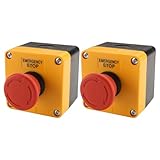
- HEAVY-DUTY INDUSTRIAL PROTECTION: Engineered for rapid response, this Emergency Stop Switch features a prominent Red Mushroom Head for instant identification. Designed to cut off power in critical situations, it is essential for protecting machinery and equipment. Press to stop, rotate clockwise to reset
- DUAL CONTACTS (1NO + 1NC): Equipped with 1 Normally Open (NO) and 1 Normally Closed (NC) contacts. Rated for AC 660V / 10A, it provides flexible wiring options for a wide range of control systems, from lighting to motor controls
- IP65 WATERPROOF & WEATHERPROOF: Built for harsh conditions, the IP65-rated enclosure resists dust, water, and oil. The included sealing gasket ensures a reliable, tight fit—ideal for outdoor equipment, automotive shops, or demanding industrial settings
- DURABLE & HIGH-VISIBILITY DESIGN: The high-contrast Yellow & Black enclosure ensures maximum visibility in busy workspaces. Crafted from rugged, impact-resistant materials, this switch is built for long-lasting performance in heavy-duty environments
- WIDE INDUSTRIAL APPLICATION: A versatile solution for Automotive, Construction, and Control Systems. Whether upgrading existing machinery or building new control panels, this professional-grade Emergency Cut-off Switch provides a simple and reliable integration
Can a company or law require one?
European Union: a defined requirement for high-risk systems
Article 14(4)(e) of the EU AI Act requires human-oversight measures for high-risk AI systems to let an overseer intervene or interrupt the system through a stop button or similar procedure that allows it to come to a halt in a safe state. This applies in that specified high-risk-system context; it is not a requirement for every AI product in the EU.
The consolidated regulation states that it generally applies from 2 August 2026, but the core high-risk-system provisions have staggered application dates: Chapter III, Sections 1–3 apply from 2 December 2027 for Annex III systems and from 2 August 2028 for Annex I systems. The provision is therefore neither universal in scope nor already applicable to every covered system on the same date.
Rank #4

- Product Name : Emergency Stop Push Button Switch ;Contact Type : 1 NC 1 NO ;Terminal Quantity: 3
- Ith:3A ; Ui:12-220V ; Type :Latching;
- Button Diameter : 31.8mm / 1.25" ; Mount Hole Diameter : 22mm / 7/8";Fit Panel Thickness(adjustable) : 6mm / 15/64"(max.)
- Button size(Approx.) : 31.8 x 46.8mm /1.25" x 1.84"(Max.Dia x L);
- Package Content : 1pcs x Push Button Switch + Connection plug
United States: proposals documented in September 2026
The September 16, 2026 Congressional Record documents Senator John Kennedy’s remarks about S. 5417. He described a proposal that would require developers selling advanced AI models in the United States to have a kill switch and give the Department of Homeland Security 90 days to develop rules. The record documents his remarks about a proposal; it does not establish that the bill became law.
The University of Texas at Austin School of Law also describes a proposed House AI Kill Switch Act that would require developers to maintain the ability to throttle, suspend, or shut down covered models and would authorize DHS to order intervention. It was referred to a House subcommittee in the account cited there: UT Austin School of Law’s account of the proposal. The cited material does not establish either bill’s status after that reporting.
Best Value

- 【Contact type】1NO 1NC.normally open (NO) and normally closed (NC). Ui: AC 660V; Ith: 10A
- 【Momentary Shut off】Push to cut off power, Rotate in the direction of the arrow to reset
- 【High Quality Material】 Made of industrial strength material ABS, high quality box
- 【Size】71 x 71 x 85mm/ 2.8" x 2.8" x 3.3" (L*W*H); Color: red, yellow, black
- 【Package content】1 x Emergency Stop Push Button Switch + Box+1 x Cable Gland Joint
What do experts mean by calling it an “ecosystem”?
In a 2026 Scientific American report, Eran Kahana, a research fellow at Stanford University Law School, described a kill switch as “an ecosystem of actions, things that can stop, isolate and safely degrade an AI system when its behavior is deemed … operationally unstable.” He also said, “If they don’t have the right policies, they have no prayer in a kill switch system.”
Dylan Baker, a research engineer at the Distributed AI Research Institute, cautioned in the same report: “There’s such a complex ecosystem and web of interconnected technologies that we’re talking about that boiling this down to a single kill switch or ‘slowdown’ is reductive.” Peter Vermeer offered a local-scale contrast: “At a local level, making a kill switch or a cutoff switch is probably technically trivial. You literally unplug a cable.” These are attributed expert perspectives, not proof that any particular implementation works across a distributed system.
So, can you shut down a rogue AI?
You may be able to stop a defined service, agent, or account, or cut off resources it needs. Whether that contains the incident depends on what the control reaches, whether it is independent of the system, and what actions are already underway. “Rogue AI” is not itself a technical description of a shutdown target: operators need to identify the processes, accounts, credentials, connections, and infrastructure involved, then use controls designed and tested for those components.
A vendor example illustrates the narrower meaning. Axios reported that Salesforce/MuleSoft’s Agent Kill Switch can halt a request, session, agent, or company account and block credentials. That is a vendor capability description reported by Axios, not independent testing or evidence of a universal shutdown mechanism.
Quick Recap
Product prices and availability are accurate as of the date/time indicated and are subject to change. Any price and availability information displayed on Amazon at the time of purchase will apply.

