
Do these 3 things before closing this tab:
1Clear out junk files and repair common Windows errors2Fix the driver behind crashes, sound loss and screen glitches3Repair Windows errors before they cause bigger problemsiTechGuides is reader-supported. When you buy through links on our site, we may earn an affiliate commission. As an Amazon Associate I earn from qualifying purchases. Learn more
The right industrial sensor analog front end (AFE) depends first on the sensor’s electrical output and the interface your instrument must provide. MAX40109 is aimed at resistive-bridge sensors; TI’s AFE881H1 targets loop-powered 4–20 mA HART transmitters; and TI’s TIDA-00168 shows a thermocouple measurement design built around ADS1220.
What does an industrial sensor AFE IC do?
An analog front end sits between a sensor and the controller or field interface. Depending on the device, it may excite a sensor, amplify a small signal, filter interference, digitize the measurement, generate an analog output, store calibration data, run diagnostics, or handle a field protocol.
These functions are not present in every AFE, and an AFE is not necessarily a complete instrument. The useful first question is therefore not simply “Which AFE has the most features?” but “Does it match my sensor topology and the signal path I need?” A bridge sensor, a thermocouple, and a loop-powered transmitter impose different requirements.
The Tool Desk
Outbyte PC Repair FREEClear out junk files and repair common Windows errorsFree Scan →Outbyte Driver Updater FREEScan for outdated or missing drivers - takes under a minuteDriver Scan →Which AFE fits a pressure sensor or load cell?
MAX40109: resistive-bridge signal conditioning
Analog Devices describes the MAX40109 as a precision signal-conditioning AFE for resistive-bridge pressure sensors. Its listed applications also include strain gauges, force, temperature, and Wheatstone-bridge sensors. That makes it a candidate when the sensor presents a bridge signal, rather than a general-purpose choice for every industrial sensor.
#1 Best Overall

- Heating voltage: 5 plusmn 0.2V (AC middot DC)
- Working current: 5-10mA
- Response time: le5S;Settling Time: le60S
- Detection Temperature range: 0-80 ℃
- Component Power: le0.5W
The vendor specifies a programmable-gain amplifier with 20 gain options, an ADC, and a DAC with output buffer. The device also includes calibration memory supporting third-order polynomial compensation, digital 1-Wire and I²C interfaces, internal bridge-current drive, and EMI rejection. Its specified supply operating range is 3 V to 36 V, typical supply current is 2 mA, and specified temperature range is −40 °C to +125 °C. These are component specifications, not guarantees of system-level accuracy or immunity in a finished instrument.
For a pressure sensor or load cell, check that the bridge excitation, signal range, gain choices, calibration approach, and output interface suit the actual sensor and instrument. The listed features can reduce external circuitry, but they do not remove the need to validate the complete signal chain and board-level noise and EMC behavior.
How do I interface a thermocouple to a PLC?
Use a thermocouple measurement chain with cold-junction compensation
A thermocouple produces a small voltage related to the temperature difference between its measuring junction and its reference junction. A practical measurement design therefore needs cold-junction compensation (CJC), as well as appropriate gain and conversion. Filtering, sensor diagnostics, and thermocouple linearization also matter; the PLC connection comes after those measurement tasks are handled.
Rank #2

- 🎯PHOTOELECTRIC SENSOR : As a photoelectric switch, this device operates by emitting an invisible infrared beam; when an object blocks the beam, the switch triggers a signal change. It has a detection distance of up to 30cm, making it suitable for short-range sensing tasks. The simple design allows for quick wiring without complex calibration steps.
- ⚙️ COMPATIBLE WITH MOST MICROCONTROLLERS : Designed as a light sensor module, it features built-in voltage regulation, supporting 5V DC input, which is compatible with most microcontrollers. The module includes indicator LEDs that show power and detection status, helping users troubleshoot connections easily during setup.
- 📦16-PIECE SET FOR MULTI-PROJECT NEEDS : This package includes 8 Pairs of photoelectric beam sensor, constructed with a plastic casing and metal pins for stable connections. The sensor consists of a transmitter and receiver pair that detects obstacles when the infrared beam is interrupted. It’s a basic light sensor moudule essential component for various electronic and automation setups.
- 🔌 REMOTE CONTROL APPLICATIONS : This remote switch ir sensor can be paired with wireless modules for remote control applications, such as automatic door openers or security alarms. Infrared sensor compact size enables installation in tight spaces, like inside small appliances or DIY robot projects. The non-contact sensing method reduces wear compared to mechanical switches.
- 🛠️ HIGH-SPEED PRECISION DETECTION : Beyond basic sensing, it functions as a photocell ir beam device, responding to infrared light changes, and can be used alongside a laser photoelectric sensor. This through-beam photoelectric switch delivers ultra-fast 2ms response time, far outperforming traditional PIR sensors for reliable. It’s also a versatile alternative to a distance sensor for simple presence detection tasks in hobby or industrial projects.
TI’s TIDA-00168 is a reference design for precision temperature measurement using a K-type thermocouple. TI’s page states a thermocouple range of −200 °C to 1372 °C and 0.02 °C noise-free resolution. Its design supports CJC using either an RTD or the ADS1220 internal temperature sensor. The page says the design’s sole objective is to provide comprehensive details for a simple, robust, accurate thermocouple AFE circuit.
The associated TI design document instead lists a K-type range of −200 °C to 1375 °C. This is a source/version discrepancy, so use the range from the specific TI document you are designing against rather than treating the two upper limits as interchangeable. That document also describes RTD or internal-sensor CJC, ADC and DAC offset/gain calibration, 1 °C lookup-table linearization, and an operating board temperature of −40 °C to +85 °C.
The design discussion covers anti-alias filtering, biasing resistors for sensor diagnostics, linearization, PCB challenges, and IEC 61000-4 design intent. These are implementation concerns, not extras that an ADC resolution figure alone resolves. To connect a thermocouple measurement to a PLC, confirm the PLC’s input requirements and determine how the conditioned and digitized result will reach it; the reference design itself is a measurement AFE example, not a claim that every PLC can accept its output directly.
Rank #3

- MQ-8 module for hydrogen h2: SnO2 sensing element heated inside a metal mesh cap
- Analog output AO rises with gas concentration; digital output DO switches at a level you set
- 5V DC supply, 4-pin 2.54 mm header (VCC / GND / DO / AO), power and signal LEDs
- Onboard LM393 comparator and threshold potentiometer, so DO can drive a buzzer or LED with no extra code
- Two modules per pack; needs warm-up and your own calibration - a prototyping module, not a certified detector
Which AFE supports a 4–20 mA HART transmitter?
AFE881H1: low-power loop-powered transmitter AFE
TI’s AFE881H1 is a 16-bit low-power AFE for sensor transmitters. TI specifies it for 4–20 mA, two-wire loop-powered applications and lists an integrated DAC, HART-certified FSK modem, 10-ppm/°C voltage reference, and diagnostic ADC.
Free tools Windows power users keep installed
One-click scans. No signup required.
TI specifies operation from supplies as low as 1.71 V, maximum quiescent current of 220 µA, and a specified temperature range of −40 °C to +125 °C; the device is functional from −55 °C to +125 °C. These figures describe the IC, not total transmitter power or performance. A complete transmitter still requires external voltage-to-current conversion and power regulation.
For a transmitter design, check how the AFE fits the loop’s power budget and how the external current-conversion and regulation stages will be implemented. Also verify that the complete signal path and HART implementation meet the product’s requirements; an integrated modem does not by itself make every finished transmitter compliant.
Rank #4
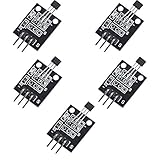
- Hall Switch Integrated Circuit Using hall Effect Principle
- Uses The Semiconductor Integrated Technology Manufacturing Magnetic Susceptibility of the Circuit
- Its Input For the Magnetic Induction Intensity, the Output is a Digital Voltage Signal
How should you compare industrial sensor AFEs?
Start with the sensor output and required field connection, then compare the device and system requirements that follow. The examples below are representative choices, not interchangeable parts.
| Choice | Sensor or application fit | Integrated functions relevant to selection | Important system boundary |
|---|---|---|---|
| Analog Devices MAX40109 | Resistive bridge; pressure, strain, force, temperature, and Wheatstone-bridge sensors | Programmable-gain amplifier, ADC, buffered DAC, bridge-current drive, calibration memory, 1-Wire and I²C | Validate the entire bridge signal chain, calibration, noise, and EMC in the target instrument. |
| TI AFE881H1 | 4–20 mA, two-wire loop-powered sensor transmitters using HART | DAC, HART-certified FSK modem, voltage reference, diagnostic ADC | External voltage-to-current conversion and power regulation are still required. |
| TI TIDA-00168 / ADS1220 approach | K-type thermocouple measurement | ADC-based measurement design with RTD or internal-sensor CJC; design discussion includes filtering, diagnostics, and linearization | It is a reference design, not a single all-purpose industrial AFE IC or a direct-PLC compatibility guarantee. |
Across candidates, compare sensor topology, excitation needs, gain range, ADC and DAC resolution, input noise and drift, calibration, diagnostics, isolation and EMC strategy, field interface, current consumption, temperature range, package, lifecycle, and evaluation-module availability. For several of those comparisons, the cited product and design descriptions do not state a comparable value, so check the relevant current vendor documentation rather than inferring equivalence.
High integration can reduce the number of external components, but it can also constrain architecture or protocol choices. Treat vendor electrical specifications as a starting point: system performance still depends on the sensor, PCB layout, filtering, calibration, isolation, and electromagnetic environment.
Quick Recap
Product prices and availability are accurate as of the date/time indicated and are subject to change. Any price and availability information displayed on Amazon at the time of purchase will apply.

