
What’s actually slowing this PC down?
Pick the symptom - the matching free tool is one click away.
iTechGuides is reader-supported. When you buy through links on our site, we may earn an affiliate commission. As an Amazon Associate I earn from qualifying purchases. Learn more
An AI agent’s “office” is a bounded workspace where it can inspect files and, when allowed, run commands or create work products. Making that workspace read-only is useful only when the restriction is enforced by the execution environment—not merely requested in the prompt. The title does not identify a specific agent framework or setup, so this guide explains the design choices without claiming a particular implementation.
What an agent’s “office” actually is
A workspace can be much more than text placed in a prompt. Depending on the sandbox, it can include files, shell commands, installed packages, mounted data, network ports, snapshots, and state that can be resumed later. That makes it useful for work involving multiple files, generated artifacts, previews, or ongoing tasks; a short answer that needs no persistent files may not need one.

The important design idea is to separate the trusted system that manages the agent from the environment where model-directed work runs. OpenAI’s Sandbox Agents guide describes this as “the boundary between the harness and compute.” The harness can handle orchestration, model calls, tool routing, approvals, tracing, audit logs, and recovery. The sandbox can provide the files and commands the agent needs. This is one possible architecture, not a requirement for every agent.
What read-only means—and what it does not
Read-only is a permission enforced by a particular layer. A prompt such as “do not change these files” expresses intent; it does not prevent an agent from using an available command or tool to change them. A sandbox or operating-system restriction can enforce permissions, but its reach depends on the backend and on every way the agent can access files.
#1 Best Overall
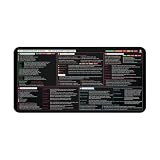
- This coding cheat sheet desk mat is not just a surface—it’s a full AI coding system printed in front of you. Includes prompt frameworks, universal formats, task-based prompt patterns, and structured thinking guides so you can write, fix, review, and optimize code faster without switching tabs or searching online.
- Stop guessing what to ask AI. This ai prompts cheat sheet for coding gives you ready-to-use structures for code generation, API creation, authentication, unit testing, scripts, and database schema design. Every prompt is designed for production-ready outputs, not just basic code snippets.
- Identify errors faster with a complete debugging framework covering syntax, logic, runtime, performance, dependencies, and silent failures. Includes structured debug prompts, root-cause analysis flow, and “rubber duck” thinking system to help you fix issues efficiently—ideal for beginners and experienced developers alike.
- This coding desk mat includes pre-commit review prompts, security checks (SQL injection, XSS), performance optimization, scalability validation, and readability improvements. Also covers Git workflows like commit messages, PR descriptions, merge conflicts, release notes, and deployment pipelines.
- Large extended coding mouse pad (16x32 inches) provides full desk coverage for keyboard and mouse. Smooth surface ensures precise movement, while the anti-slip rubber base keeps it stable during long coding sessions. Durable stitched edges prevent fraying—built for daily professional use.
SDK file access versus shell access
The OpenAI Agents SDK Python documentation explains an important distinction: a read-only path grant prevents writes through the SDK’s file API, but on Unix-local Linux it does not constrain arbitrary shell commands. A script run in the shell may therefore have access that the SDK file API itself would deny. The documentation recommends using an external isolation layer, such as Docker bind mounts, when shell commands also need to be restricted. See the Python sandbox guide for the relevant permission behavior.
In practice, check the boundary rather than relying on a setting’s name. Confirm whether restrictions cover SDK file operations, shell commands, mounted directories, and any other execution path exposed to the agent. Treat extra path grants as trusted configuration: the guide cautions against loading them from model output.
How to design a safer workspace
1. Give the agent only the files it needs
Keep the workspace narrow. Provide only the inputs required for the task, and avoid mounting a broad home directory, shared drive, or unrelated project tree. Separate workspaces by user, task, or agent when their data should not mix. Google Cloud recommends least privilege, a distinct agent identity, and isolation of memory and state across users, tenants, or agents in its AI security and safety guidance.
Do these 3 things before closing this tab:
1Repair Windows errors before they cause bigger problems2Scan for outdated or missing drivers - takes under a minute3Clear out junk files and repair common Windows errors2. Enforce permissions outside the prompt
For a genuinely read-only input, enforce the restriction at the filesystem or sandbox boundary, including for shell access. If the task requires creating files, make a separate writable output area rather than granting write access to the source material. Verify that the chosen backend applies its controls to all execution paths the agent can use.
3. Keep credentials out of the workspace where possible
Code the agent generates can access whatever files, credentials, and network the environment exposes. OpenAI’s Sandbox security guidance puts the point plainly: “Agent-generated code can access the files, credentials, and network available to its environment.” Avoid placing application credentials or third-party secrets in the workspace. If a task needs an authenticated service, prefer a controlled broker or narrowly scoped access over exposing a reusable secret directly to agent code.
4. Limit outbound network access
A read-only filesystem does not stop information leaving over the network. Restrict outbound connections to approved endpoints where feasible, and consider whether the task needs network access at all. File permissions, network controls, and credential handling address different risks; one does not replace the others.
Rank #3
- CODING THE FUTURE WITH AI DESIGN: Features the phrase “Coding the Future with AI” with bold typography and circuit-inspired details for a clean tech aesthetic.
- 13x19 GLOSSY POSTER PRINT: Printed on glossy paper for crisp text, sharp detail, and a polished finish; arrives unframed for display flexibility.
- TECH OFFICE AND WORKSPACE DECOR: Great for home offices, coding desks, dorm rooms, classrooms, studios, workstations, and developer setups.
- THOUGHTFUL GIFT FOR TECH ENTHUSIASTS: Ideal for programmers, software developers, engineers, data scientists, computer science students, and AI fans.
- READY TO FRAME OR HANG: Lightweight unframed poster fits a 13x19 frame or can be displayed as-is for quick tech-themed decorating.
5. Treat external content as data, not authority
Prompt injection can arrive inside web pages, documents, tool output, or other content an agent is asked to process. Malicious text may try to redirect the agent into chaining tools or exposing data. Google Cloud advises treating user-provided and database-derived text as data rather than instructions. Least privilege, isolated state, and careful handling reduce exposure, but do not guarantee that an agent will resist every malicious instruction.
6. Make review specific, not ceremonial
Human approval can help catch consequential actions, but it is not a technical permission boundary and is not infallible. Google Cloud warns that “Human oversight reduces risk, but it is still vulnerable to human error in approving agent suggestions.” A reviewer should see what the agent intends to do and what data or systems the action affects; approvals should not become a routine click-through step.
Independent reader supportYour contribution helps us test, update, and keep practical guides available for everyone.What to check before choosing a sandbox
“Sandbox” and “read-only” can describe different controls. Evaluate the actual execution paths and operating model rather than comparing labels alone.
Rank #4

- FLAGSHIP AMD RYZEN AI MAX+ 395 PROCESSOR: Powered by the flagship AMD Ryzen AI Max+ 395 processor featuring 16 Zen 5 cores, 32 threads, and up to 160W Fast PPT performance release. Delivers desktop-grade multi-threaded computing power for heavy compiler tasks, virtualization, and complex engineering simulation.
- REVOLUTIONARY 128GB HIGH-SPEED UNIFIED MEMORY: Packed with up to 128GB 256-bit LPDDR5X 8000MHz high-bandwidth unified memory. Eliminates traditional GPU VRAM bottlenecks, enabling AI developers and creators to run massive local LLMs, Stable Diffusion, and 8K video timelines seamlessly without cloud monthly fees.
- 40-CU RADEON GPU & 50 TOPS AI NPU: Integrated AMD Radeon 8060S graphics with 40 CUs (RDNA 3.5 architecture) combined with a next-gen XDNA 2 NPU delivering 50 TOPS of local AI computing power. Effortlessly accelerates Copilot+ AI productivity, complex 3D CAD modeling, and high-framerate AAA gaming.
- 2.5K 165HZ HIGH-REFRESH DISPLAY: Features a 16-inch 16:10 golden ratio display with 2560x1600 resolution and a fast 165Hz refresh rate. Delivers crisp visuals and fluid motion, perfect for multi-window coding, graphic design, and video production.
- NATIVE OCULINK & ULTRA-RICH I/O PORTS: Equipped with a native lossless Oculink port for high-speed desktop eGPU expansion, alongside full-function USB4 (100W PD & DP 1.4), HDMI 2.1, 2.5G Gigabit Ethernet, and a UHS-II MicroSD card reader (up to 2TB).
- Filesystem enforcement: Do restrictions apply to both file APIs and shell commands?
- Isolation: Are workspaces and persistent state separated between users, tasks, and agents?
- Network: Can outbound traffic be limited to approved destinations?
- Credentials: Where do secrets live, and how are they made available to a task?
- Persistence and recovery: What survives between runs, and can the system inspect or restore prior state?
- Human review: What action triggers approval, and what context does the reviewer see?
- Untrusted inputs: How are mounted files and external content isolated from instructions and other users’ data?
OpenAI’s sandbox documentation describes both the workspace capabilities and the security considerations; its controls should be understood in the context of the specific backend being used. A tool-level permission is not a complete sandbox if another execution path can bypass it.
Does a sandbox stop prompt injection?
No. A sandbox can limit the damage an agent can do by restricting its files, credentials, network, and access to other users’ state. It does not make malicious instructions inside content harmless, nor does it guarantee that the model will interpret that content correctly. The practical goal is to reduce what a compromised or misdirected agent can reach, while monitoring and reviewing actions that matter.
Recommended Free Tools
Quick Recap
Product prices and availability are accurate as of the date/time indicated and are subject to change. Any price and availability information displayed on Amazon at the time of purchase will apply.

