
Do these 3 things before closing this tab:
1Scan for outdated or missing drivers - takes under a minute2Repair Windows errors before they cause bigger problems3Fix the driver behind crashes, sound loss and screen glitchesiTechGuides is reader-supported. When you buy through links on our site, we may earn an affiliate commission. As an Amazon Associate I earn from qualifying purchases. Learn more
Colored glasses alone cannot turn a normal 2D television into a 3D display. They work only when the video itself has already been encoded as anaglyph, usually by separating the left- and right-eye images into red/cyan or red/blue channels. A conventional Blu-ray 3D disc uses stereoscopic video for a 3D-capable playback chain, so it will not become anaglyph merely because you put colored glasses on.
On an ordinary TV, you have three legitimate options: play an anaglyph-authored disc or file, convert compatible stereoscopic content to anaglyph on a computer, or use a 3D TV and player as the disc format requires.
First identify what kind of 3D video you have
The phrase “3D Blu-ray” can describe two different presentation methods. They are not interchangeable.
Free tools Windows power users keep installed
One-click scans. No signup required.
| Video type | How depth is stored | What a regular TV does | What you need |
|---|---|---|---|
| Standard Blu-ray 3D | Separate left- and right-eye views in a stereoscopic Blu-ray 3D format, commonly using the MVC profile | Usually plays as 2D if the disc and player support a fallback; some 3D-only discs may not play | A compatible 3D display, 3D-capable player, suitable HDMI connection and compatible 3D glasses |
| Anaglyph video | Both eye views are combined into color channels, such as red/cyan or red/blue | Displays as an ordinary color video | A normal TV and player or media app, plus glasses whose filters match the encoding |
Look at the disc case, menu, file description or software export settings. The word anaglyph must appear, or the video must explicitly specify a color pair. A normal Blu-ray 3D label is not evidence that anaglyph glasses will work.
#1 Best Overall

- 👓UNIVERSAL COMPATIBILITY: These 3D glasses work with most 3D-ready TVs, movies, DVDs, and gaming systems that use red/blue anaglyph 3D technology
- 🎮PACKAGE CONTENTS: Set includes 4 pairs of classic red and blue lens 3D glasses for shared viewing experiences with family and friends
- 📺LIGHTWEIGHT DESIGN: Simple frame construction ensures comfortable viewing during extended movie sessions or gaming periods
- 🎬VERSATILE USE: Compatible with various 3D content including printed materials, videos, games, and television programs using anaglyph technology
- 📽️EASY TO USE: Simply put them on and enjoy instant 3D effects with compatible content - no batteries or power source required
Why anaglyph glasses do not convert an ordinary Blu-ray 3D disc
Anaglyph glasses are passive color filters. One lens allows one color channel to reach one eye and the other lens allows a different channel to reach the other eye. The television is simply showing the already-separated color image; the glasses do not decode a 3D signal, create a second view or change the disc format.
A conventional Blu-ray 3D title sends stereoscopic views through a compatible player and display. The player and display coordinate how those views are delivered, often through a 3D HDMI mode. If the TV is only a 2D model, there is no setting in the glasses that can transform that signal into red/cyan video. At most, the player may offer ordinary 2D playback, and some discs may refuse to play without a 3D-capable output.
This is why putting red/cyan glasses over a normal 2D version of a film produces a tinted picture rather than depth: the two eye views were never encoded into the file.
Rank #2

- COMPATIBILITY: Universal design fits for most 3D movies, TV shows, and video games using red-blue anaglyph 3D technology
- PACKAGE CONTENTS: Set includes 4 pairs of classic red and blue 3D viewing glasses for group entertainment
- CONSTRUCTION: Lightweight frame with durable plastic construction and red-blue filtered lenses for optimal 3D viewing
- VERSATILE USE: Compatible with red-blue 3D content across various media including DVDs, gaming consoles, and television programming
- DESIGN FEATURES: Simple, comfortable frame design suitable for extended viewing sessions with minimal eye strain
Route 1: play an anaglyph-authored disc or video
This is the simplest method when you have a regular television. An anaglyph release contains the color separation in the video itself, so a standard compatible Blu-ray player can send it to an ordinary TV like any other video.
Check the release before you buy or insert it
- Confirm that the packaging or listing explicitly says anaglyph, not merely “3D.”
- Read the required glasses color carefully. Red/cyan and red/blue are common descriptions, but they are not automatically interchangeable.
- Check whether the release is a Blu-ray disc, a DVD, or a downloadable video file; the playback device must support that medium.
- Do not assume that a standard Blu-ray 3D edition includes an anaglyph version. Treat them as separate presentations unless the release says otherwise.
Set it up
- Connect the player to the television using the same HDMI or other video connection you use for normal discs.
- Insert the anaglyph disc or open the anaglyph file in your ordinary media player.
- Choose the title’s anaglyph video or menu option if the release offers more than one version.
- Put on the specified glasses only after the video is playing. Keep the red, cyan or blue lens on the side stated by the release.
- Adjust the TV’s brightness, contrast and color only after confirming that the correct color filters are being used. Picture controls cannot correct a mismatched encoding.
If the image still looks like two overlapping pictures, the content may be a different stereo layout, the lenses may be reversed, or the video may not actually be anaglyph. Recheck the release instructions before changing player settings.
Route 2: convert stereoscopic content to anaglyph on a computer
If no anaglyph edition exists, a computer workflow can convert compatible stereoscopic content into an anaglyph video file. The computer must understand the source’s stereo arrangement and then render both eye views into the selected color channels. You can play the resulting file on the TV through a normal media player, streaming device or computer connection.
Rank #3

- PRODUCT DETAILS - Brand: LYMGS; Owner: JQ Whale; Material: Paper Card; 3D Style: Red / Cyan; Size: 142x130x40mm / 5.59x5.12x1.57in; Package Inclues: 10 Pairs; Weight: About 52g.
- HIGH QUALITY - The paper 3D glasses is made of high quality material, comfortable to wear, attractive and durable.
- EASY TO CARRY - The 3D glasses is lightweight and foldable, you can carry it to anywhere to enjoy your 3D movies. NOTE: This product can not be used as sunglasses.
- SPECIAL DESIGN - With red and cyan filters, the glasses can be used for either red left or red right depending on which way you fold the temples. Two different fold-scores allow you to fit the glasses to smaller or larger viewer's heads.
- WIDELY USED - The 3D glasses universal fit for 3D image (Red and Cyan) viewing on Internet, DVDs, VHS tapes and broadcast TV (anaglyph). NOTE: These RED & CYAN anaglyph white cardboard glasses are unusually a one-time use.
Corel VideoStudio v22 documentation describes an anaglyph export option that requires generic colored glasses and no special 3D display. Its help text says: “Anaglyph — Requires only the red and blue generic anaglyph 3D glasses to view 3D video without the need for special display monitors.” That documentation establishes the export method for that version; it does not establish that every current version reads every Blu-ray 3D disc directly, that protected discs can be imported, or that the software remains available or supported today.
Conversion workflow
- Verify the source format. Determine whether your source is side-by-side, top-and-bottom, frame-sequential or another stereoscopic layout. The converter must support that layout; selecting the wrong one can produce doubled or incorrectly aligned images.
- Confirm that you are allowed to use the source. A conversion application may accept a video file while refusing a protected commercial disc. The available evidence does not provide disc-copying instructions or promise that a particular program can bypass protection.
- Import a compatible source file. Use the software’s documented import path and confirm that both left- and right-eye views are recognized.
- Choose anaglyph as the output or 3D mode. Select the color scheme specified by the glasses you own. The option may be labeled anaglyph, red/blue, red/cyan or similar.
- Preview a short section. Check that foreground objects have depth, text remains readable and there is no severe color fringing. Reverse the lens order only if the software’s preview or instructions indicate that the channels are swapped; do not compensate for a wrong source layout with the glasses.
- Export a standard video file. Use a format your TV, media player or streaming device can decode. Anaglyph is part of the picture data, so the playback chain does not need a 3D output mode.
- Play the exported file on the TV. Copy it to supported storage, open it through a media player, or connect the computer directly. Put on the matching glasses and select the correct lens orientation.
What this route can and cannot guarantee
- It can make stereoscopic material viewable on a normal display when the source is supported and the conversion succeeds.
- It adds computer storage, processing time and an extra file-management step.
- Color-filter 3D is inherently a compromise: each eye receives only selected color information, so the image will not look like the original full-color presentation.
- There is no universal quality score or success rate for every title, converter and source layout. Test a short sample before converting a long video.
- A software help page for one version is not proof of current availability, current operating-system support or direct compatibility with protected Blu-ray 3D media.
Route 3: use the normal Blu-ray 3D equipment chain
If you want the original stereoscopic Blu-ray presentation rather than anaglyph color filtering, use equipment designed for that format. A Philips player manual identifies the required chain as a 3D-compliant TV, an HDMI connection, compatible 3D glasses and a 3D Blu-ray disc. Sony’s guidance likewise calls for a 3D TV and a High-Speed HDMI connection and directs owners to the documentation for the exact model.
Typical setup
- Connect the 3D-capable player to a 3D-capable TV with a suitable HDMI cable. A cable being physically HDMI-compatible does not by itself make a 2D TV 3D-capable.
- Enable the TV’s 3D mode if the model requires a manual selection, or allow the player and TV to negotiate it automatically.
- Use the glasses designed for the display’s 3D system. Anaglyph paper glasses are not a substitute for the TV’s compatible active or passive glasses.
- Insert the Blu-ray 3D disc and follow the player’s on-screen prompts.
- If you want a 2D picture instead, use the player or disc option documented for that model. One Philips manual gives the specific instruction: “To play 3D video in 2D, turn off Blu-ray 3D output.” That wording belongs to the cited player manual; menu names and behavior vary by model.
Using different brands together
A player and TV do not have to carry the same brand name. Cross-brand operation is possible when the television accepts the required Full HD 3D signal over HDMI and both devices support the same relevant format. Philips states this for the models covered by its documentation, but the statement is not a blanket guarantee for every combination. Check both model manuals for 3D input support, HDMI requirements and glasses compatibility before purchasing.
Rank #4
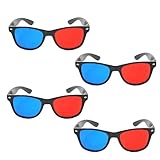
- 👓CLASSIC 3D VIEWING: Red and blue anaglyph glasses designed for watching 3D movies, playing 3D games, and viewing 3D images on compatible screens and media
- 👓COMPLETE SET: Package includes 3D glasses in black, perfect for family movie nights, gaming sessions, or sharing with friends for an immersive viewing experience
- 👓LIGHTWEIGHT DESIGN: Simple and light construction ensures comfortable wear during extended viewing sessions without causing pressure or discomfort on the nose and ears
- 👓UNIVERSAL COMPATIBILITY: Works with red-blue 3D content including classic 3D movies, video games, comic books, magazines, and online 3D videos
- 👓CONVENIENT ACCESSORY: Compact and portable design makes these glasses easy to store and carry, ideal for home entertainment or on-the-go 3D viewing
Choosing and checking the glasses
The glasses must match the color separation used by the video. “Red/blue” is a common label in software instructions, while many releases use red/cyan. Cyan is not simply a marketing name for every blue lens: the exact filter colors affect how well each eye is isolated.
- Read the content instructions first. The video or disc should specify the pair and, where necessary, which lens belongs over which eye.
- Do not mix systems casually. Red/cyan glasses used with red/blue content can leave incorrect color leakage and weak or absent depth.
- Test lens orientation. If the picture looks inside-out or depth seems reversed, swap the glasses left-to-right once. If that fixes it, keep the orientation requested by the release.
- Expect color changes. Anaglyph filters intentionally remove or attenuate portions of the color spectrum. A correct setup can still look tinted compared with a normal 2D version.
What happens when you try a standard Blu-ray 3D disc on a 2D TV?
Behavior depends on the disc and player. A documented Philips player says playback on a non-3D TV may revert to 2D depending on the disc, while some 3D-only discs may not play in 2D at all. Therefore, “it plays” and “it plays in 3D” are separate questions.
| Symptom | Likely explanation | Action |
|---|---|---|
| The disc plays but looks flat | The player is using a 2D fallback, or the title contains only a 2D-compatible version | Check the disc manual and player settings; colored glasses will not add depth to this 2D output |
| The player reports that 3D equipment is required | The title may be 3D-only, or the player detected a non-3D display | Use a compatible 3D TV chain or obtain a verified anaglyph source |
| The picture is tinted but has no depth | The video is ordinary 2D, or the glasses do not match the encoding | Confirm that the content is anaglyph and check the specified lens colors |
| Two images appear side by side or above and below | The source is stereoscopic but has not been converted to anaglyph | Use the display’s supported 3D mode or convert the source with software that understands its layout |
| Depth appears reversed | The left/right lens orientation is wrong | Swap the glasses orientation and follow the content’s instructions |
| Conversion fails at import | The software may not support the source layout, codec or protected disc | Test with a compatible, legally usable video file and verify the application’s documented formats |
Trade-offs: anaglyph on a regular TV versus a real 3D setup
| Factor | Anaglyph route | 3D Blu-ray route |
|---|---|---|
| Display | Any TV that can show the video file or disc | 3D-capable TV required for stereoscopic output |
| Player | Ordinary compatible player or media app | 3D-capable Blu-ray player |
| Glasses | Inexpensive passive color-filter glasses matching the encode | Glasses compatible with the TV’s 3D system |
| Source | Anaglyph-authored release or converted file | Standard Blu-ray 3D disc |
| Color | Color is filtered and may look strongly tinted | Preserves the display system’s intended color presentation |
| Complexity | Low for an authored anaglyph release; higher when conversion is needed | Requires coordinated display, player, HDMI and glasses compatibility |
| Compatibility certainty | Depends on the exact anaglyph colors and file support | Depends on the exact TV, player, disc and HDMI capabilities |
A practical decision checklist
- Read the disc or file label. If it says anaglyph and specifies colors, use an ordinary player and matching glasses.
- If it says Blu-ray 3D only, do not buy glasses expecting a conversion. Decide whether you can use a 3D TV chain or whether you need a separate, legally usable source file for conversion.
- For conversion, verify the source layout and software support first. Do not assume that a program that exports anaglyph can import every commercial Blu-ray 3D title.
- Match the glasses to the encoded colors. Treat red/cyan and red/blue as distinct until the content documentation says otherwise.
- Check exact model manuals. Confirm 2D fallback behavior, HDMI requirements, supported disc types and the menu path for disabling 3D output.
- Test before committing to a full conversion or purchase. A short sample reveals wrong lens orientation, unsupported layouts and unacceptable color loss quickly.
Bottom line
A regular television can show 3D through anaglyph glasses only when the video has already been authored or converted into anaglyph. A standard Blu-ray 3D disc is a different stereoscopic format; without conversion, it needs a compatible 3D TV, player, HDMI connection and glasses. Identify the source first, follow its specified color scheme, and verify the exact disc and equipment manuals before assuming that 2D fallback or cross-brand 3D playback will work.
Quick Recap
Product prices and availability are accurate as of the date/time indicated and are subject to change. Any price and availability information displayed on Amazon at the time of purchase will apply.

