
iTechGuides is reader-supported. When you buy through links on our site, we may earn an affiliate commission. As an Amazon Associate I earn from qualifying purchases. Learn more
Most old stereo speakers can work with a modern TV, but passive speakers need a receiver or amplifier between them and the TV. Match the TV’s audio output to an input on that receiver, then connect the speaker wires to the receiver—not to the TV’s RCA, optical, or headphone port.
First, identify the speakers and the equipment you have
Look at the speaker connections and check their labels or manual. Conventional passive speakers use speaker wire and require an amplifier. Powered speakers have built-in amplification and usually accept a line-level audio connection instead.
Next, inspect the TV and any receiver or amplifier. Look for labels such as HDMI ARC, Optical Digital Audio Out, Audio Out, RCA, or headphone. Check the manuals as well: port names and audio-output settings vary by model. Choose a connection that matches an output on the TV and an input on the receiver or amplifier.
Free tools Windows power users keep installed
One-click scans. No signup required.
Choose a connection that matches both devices
| Connection path | What must be available | What to know |
|---|---|---|
| HDMI ARC | ARC-labeled HDMI ports on both TV and receiver | Can support TV-remote volume or power control when both devices and settings allow it. |
| Optical digital audio | Optical output on the TV and optical input on the receiver; or an optical-to-stereo converter and an analog receiver input | If the receiver or converter cannot decode the TV’s selected format, set the TV’s digital output to PCM or stereo. |
| Analog RCA or 3.5 mm | A matching TV audio output and receiver analog input | Check whether the TV output is fixed or variable, since that affects how volume is controlled. |
| Source device to audio system | A suitable audio output on a device such as a cable box or DVD player, plus a compatible audio-system input | This may play that device’s sound, but does not necessarily carry audio from built-in TV apps or other TV sources. |
HDMI ARC
Connect the TV’s HDMI port labeled ARC to the receiver’s HDMI ARC connection. ARC must be supported at both ends; a regular HDMI input does not return TV audio to the receiver. Follow the manuals to enable ARC and any related control settings. When compatible settings are enabled, ARC may also allow the TV remote to control receiver volume or power.
#1 Best Overall
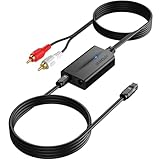
- 【192 kHz Optical to RCA Converter】AUTOUTLET 192kHz DAC converter is designed for professional audio signal processing. 192 kHz optical to RCA male cable can directly connect to stereo amplifier and convert optical toslink digital audio signals to RCA analog audio signal
- 【Excellent Sound Quality】Our dac audio converter adopts a built-in professional audio amplifier chip and a dual-channel operational amplifier, which can amplify the RCA output level and make the sound pure and clear
- 【Professional Input Signal Processing】Analog to digital audio converter provides professional 24Bit/192KHz sampling rate, avoiding distortion of the original signal. Optical input supports signal processing up to 32, 44.1, 48, 96, 192 sample rates, and 24-bit bit streams
- 【Plug and Play】SPDIF to RCA converter works great with HDTVs, set-top boxes, DVD/Blu-Ray players and game consoles. (NOTE: It is incompatible with 5.1 channel signal such as Dolby AC3, please adjust the audio output to PCM before use.)
- 【Note】Before using the product, adjust the audio output format of the TV to PCM (Device Home→System Settings→Picture and Sound→Sound Settings→Digital Audio Output→PCM), and Volume can only be adjusted on the output device, not via the TV remote control. In addition, the product does not support connection to headphones
Optical digital audio
Connect the TV’s optical audio output to the receiver’s optical input. If your receiver has only analog RCA inputs, place an optical-to-stereo converter between the TV and receiver: optical cable from the TV to the converter, then RCA cables from the converter to the receiver’s analog input. The converter changes digital audio to analog line-level audio; it does not amplify passive speakers.
If there is no sound or the receiver cannot handle the selected audio format, set the TV’s digital audio output to PCM or stereo if that option is available. Confirm that the receiver or converter supports the format the TV sends.
Rank #2

- Before use, please set the audio output to PCM or Stereo mode. Follow the instructions below to set the audio format to PCM: Samsung TV: Settings → Sound → Expert Settings → Audio Format → PCM LG TV: Menu → All Settings → Sound Out → Optical → Digital Sound Output → PCM Sony TV: Home → System Settings → Picture & Sound → Sound Settings → Digital Audio Output → PCM
- Kind Reminder: Only compatible with ARC/eARC-enabled TV HDMI ports. Not compatible with standard HDMI ports or other devices. Does not support direct connection to game consoles or set-top boxes----TV audio output must be set to ARC/eARC with the format set to PCM / LPCM; RCA output volume can be adjusted via the TV remote control (CEC)----Does not decode multi-channel compressed audio (Dolby Digital 5.1 / DTS / 7.1)----Supports TV ARC/eARC → RCA output only; reverse use is prohibited----USB power must be connected; otherwise, the device will not function
- Our Advantages: Designed for TV HDMI ARC/eARC ports to convert digital audio return signals into 2RCA analog audio, solving the loss of traditional audio outputs on modern TVs----All-in-one ARC/eARC breakout cable integrates HDMI ARC/eARC plug, USB power cable, and RCA audio cables into a single design for cleaner setup and higher stability, with no extra converters needed----100% tested to ensure reliable ARC/eARC audio return with supported TVs, preventing “port but no sound” issues----Gold-plated HDMI/RCA connectors, aluminum alloy housing, overmolded PCBA, and OD4.0mm braided jacket improve interference resistance and durability
- High Performance: Supports PCM / LPCM 2-channel audio for accurate and stable digital-to-analog stereo conversion----Analog output up to 192kHz / 24-bit, suitable for HD TV content and streaming----Built-in audio processing PCBA reduces distortion and noise, delivering clear, balanced sound for amplifiers, speakers, and home theater systems----Independent USB (1.6FT) power supply for power only (no audio), compatible with TV USB ports or external 5V sources for stable operation----Plug and play with no drivers or software required; simple TV setup makes it ideal for home and non-professional use
- Universal Compatibility: Compatible TV devices: suitable for most TVs that support HDMI ARC/eARC, including Samsung / LG / Sony / TCL / Hisense / Philips / Sharp, etc.----Compatible audio devices: via RCA L/R analog audio output, can connect to amplifiers, active speakers, soundbars with analog input, and home stereo systems----Applicable scenarios: living room TV audio upgrades, connection to legacy amplifiers/speaker systems, basic home theater stereo systems, and conference room audio systems----Strong system independence: not restricted by TV operating systems; compatible with Android TV, WebOS, Tizen, etc. (provided ARC/eARC is supported)
Analog RCA or headphone output
If the TV has RCA audio out, use an RCA cable to connect it to a compatible analog input on the receiver. If it has a 3.5 mm headphone output instead, use a 3.5 mm-to-RCA cable only when the receiver has RCA inputs. Select the corresponding receiver input and check the TV manual for audio-output settings. A headphone output may have its own volume behavior; determine whether the TV’s output is fixed or variable before relying on either the TV remote or receiver controls.
No suitable output on the TV
If the TV has no output compatible with the audio system, a source device may offer another route. For example, you may be able to connect a cable box or DVD player directly to the receiver or amplifier. That only addresses audio from the connected source; it may not provide sound from the TV’s built-in apps or other inputs.
Rank #3

- 【Upgraded DAC Converter】Converts Coaxial or Toslink digital PCM/ LPCM audio signals to analog L/ R RCA and 3.5mm Jack audio (✅Not capable of being reversed). Can be Used for PS3, PS4, Xbox, Blu-ray Player, HD DVD, Home Cinema Systems, AV Amps, Etc
- 【Sampling Rate Achieved: 192KHz】Hdiwousp digital-to-analog signal converters actually Support sampling rate at 32, 44.1, 48, 96, and 192 kHz; 24-bit S/PDIF incoming bit stream on left and right channels, provides crystal clear electromagnetic noise-free transmission
- 【Plug and Play】Simple installation and easy operation, needn't install extra driver. In addition, the DAC adapter comes with an optical cable and a power adapter for transmitting digital and providing power respectively, everything is arranged for you! (✅ Please set PCM/LPCM audio format when using)
- 【Audio In and Out】Input Audio Connector: 1xToslink, 1xCoaxial (coaxial cable is not included); Output Audio Connector: 2 x RCA (R/L, RCA cable isn't included), 1x3.5mm Jack; Powered by 5V/1A Power Adapter. (✅ NOTE: can not support AC3, Dolby, DTS, and any other SPDIF audio that is not in PCM format.)
- 【NOTE】Please set the correct audio format PCM / LPCM before use, otherwise it will not work. If you don't know how to set it, please refer to the picture on the page or contact our customer service team, we will help you to solve the problem!
Connect passive speakers safely
- Check compatibility: Read the receiver or amplifier manual for its supported speaker impedance and power guidance, then compare that with the speaker labels or manual. Compatibility depends on the specific equipment; there is no universal numeric rule for an unidentified vintage speaker and receiver combination.
- Connect the TV to the receiver: Use the compatible route above and connect to the receiver input you plan to select.
- Connect the speaker wire to the receiver: Attach the speakers to the receiver’s speaker terminals, observing the left/right and polarity markings in the equipment manuals.
- Select inputs and settings: Turn on the receiver, choose the input used for the TV, and set the TV’s audio output as required by its manual. For optical, choose PCM or stereo if the receiving equipment needs it.
- Test at a low volume: Play TV audio and raise the volume gradually. If you hear nothing, use the checks below before changing connections.
Never connect bare speaker wire directly to a TV’s RCA, optical, or headphone output. Those are not speaker-level outputs. Sony explains that direct speaker connection requires speaker-level output jacks, which many TVs do not provide: Sony’s guidance on connecting external speakers to a TV.
Fix common connection problems
- No sound over any connection: Confirm the receiver is on, its selected input matches the cable, and the TV is set to output audio through the external connection. Check whether TV-speaker or external-output settings need adjustment for your model. Teufel’s TV connection instructions describe setup and settings for specific systems.
- ARC is silent: Check that the cable is connected to the ARC-labeled ports at both ends and that ARC is enabled. Both devices must support ARC. Philips explains TV-to-audio-system connection options.
- Optical audio is silent or incompatible: Set the TV’s digital audio format to PCM or stereo if available, then confirm the receiver or converter supports that format. Klipsch notes that PCM may be needed for some TV-connected audio equipment.
- The TV has optical out but the receiver has only RCA: Use an optical-to-stereo converter, then connect its RCA output to the receiver’s analog input. The converter does not replace the amplifier required by passive speakers. Panasonic describes audio connection options, including optical-to-analog conversion.
- Only one source plays through the stereo: If you connected a source device directly to the audio system, that path may not carry sound from TV apps or other inputs. Use a TV audio output when you need sound from multiple TV sources.
Which route should you use?
Start with port compatibility, then consider convenience and extra equipment. Use ARC when both devices have ARC-labeled ports and you want its potential TV-remote control features. Use optical when the TV and receiver both have optical connections; add a converter only when the receiver accepts analog audio but not optical. Use RCA or 3.5 mm when the actual TV and receiver ports match. For passive speakers, every route still needs an amplifier or receiver to drive them.
Rank #4

- 【HDMI ARC Audio Converter】The Audio Converter can send the sound from ARC-enabled TVs back to the adapter's L/R channel and 3.5mm headphone port via the HDMI ARC connector, solving the problem that TVs without an audio output connector can't be connected to a sound system. Note: This HDMI ARC audio converter is only compatible with TVs and not with other HDMI ARC devices
- 【Note】Before use, please ensure that the HDMI port connected to your TV supports the ARC function—this converter can only transmit audio normally on ports with ARC return capability. 1) We recommend first consulting your TV manual or checking the device label to locate the port labeled “HDMI ARC”; 2) Different brands may bundle this feature with CEC functionality in the settings menu , so you must enable the relevant options in your TV settings to activate audio return. 3) When connecting, be sure to use a high-speed HDMI cable that meets the specifications (HDMI 1.4 or higher is recommended) to ensure stable signal transmission
- 【L/R and 3.5mm Audio Output Simultaneously】HDMI ARC Converter can convert audio from TV to L/R and 3.5mm analog stereo audio via HDMI ARC connector, supports simultaneous audio output from L/R and 3.5mm ports. Note: Some TVs can get ARC sound directly when connected to the HDMI ARC port, some TVs need to go into settings to select ARC mode. Be sure to set your TV's audio output format to PCM2.0, otherwise it will not work
- 【192 KHz Sampling Rate】ARC Audio Converter supports 32KHz, 44.1KHz, 48KHz, 96KHz and 192KHz. note: this is not an HDMI audio decoder, it does not support 5.1 CH or 7.1 CH digital audio RAW format input, such as DTS/DSD, please make sure to set your TV to PCM audio output. Note:The converter does not have a built-in CEC protocol and the volume cannot be adjusted directly by the TV remote control
- 【Plug and Play】HDMI ARC Adapter does not require driver, plug and play, very convenient. With digital noise reduction technology, the sound quality is clear and pleasant. Made of high quality aluminum metal material, it has good durability and stability to ensure heat dissipation. Support multi-channel synchronized audio output, sound synchronization without delay
Before connecting vintage speakers, rely on the manuals and labels for the exact receiver and speaker models. The connection options above do not establish whether an unknown pair is electrically compatible.
Do these 3 things before closing this tab:
1Clear out junk files and repair common Windows errors2Fix the driver behind crashes, sound loss and screen glitches3Repair Windows errors before they cause bigger problemsQuick Recap
Best Value

- SPDIF to RCA Converter: DAC Converter Converts Optical Toslink Digital Audio Signals to Analog RCA L/R Audio. TV Optical to RCA Audio Converter.Make Your New TV Work With Old Speakers
- Built-in Audio Amplifier Chip:Professional Audio Amplifier Chip can Amplify the RCA Output Level and Makes the Sound Pure and Clear
- 192kHz Sampling Rate:Sampling Rate at 32, 44.1, 48, 96 and 192 kHz, 24-bit SPDIF Incoming Bit Stream on Left and Right Channels, Providing Clear Audio
- Compact and Convenient:With a Built-in 1.1m/3.6ft RCA Cable, it is more Convenient to Connect and Install without Occupying any Space
- Plug and Play:Perfectly Work with HD TV, Set top box, DVD/Blu-Ray players and Game Consoles. Powered by 5V 1A USB Cable. Support Digital PCM or LPCM Audio Format(NOTE: It Is Not Compatible with 5.1 Channel Signal Such as Dolby AC3, DTS)
Product prices and availability are accurate as of the date/time indicated and are subject to change. Any price and availability information displayed on Amazon at the time of purchase will apply.

